Log in


The Pentagon is fond of playing wargames where they try to come up with scenarios estimating what the enemy might do so they’ll be ready in case it happens. You and me, we’re not in charge of thousands of bombers and missiles and dozens of aircraft carriers and warships and Middle East bases that have had the shit bombed out of them, so let’s play another kind of game.
Let’s imagine we’re the leaders of Iran. This morning, Iran’s leaders woke up in Tehran (or wherever they’re hiding) and they checked their iphones and they read a story on the Washington D.C. insider tip-sheet Axios that said Trump held a big meeting in the Situation Room on Tuesday with Vice President Vance and Secretary of State Rubio and Secretary Tap-a-Keg Hegseth, and they discussed Trump’s plans for “massive” new strikes on Iran.
Here’s the quote Axios got straight from Trump on Thursday morning: “Next week, it gets really bad for them because next week comes the power plants. Next week comes the bridges. We’re gonna knock out all their power plants. We’re gonna knock out all their bridges unless they get to the table and negotiate.”
Now, just wait a minute!
The leaders of Iran have had several of their guys flying all over the place – to Geneva, to Oman, to Qatar, any place they were told to go to “negotiate” with Trump’s thieving son-in-law and his real estate buddy Witkoff. The leaders of Iran agreed to a memo of understanding and a ceasefire, which Trump quickly broke, and now they’re supposed to go somewhere else and “negotiate” with Trump’s two fools again? He keeps sending the same guys, a skinny one in a Brioni suit and Ferragamos carrying a ledger marked “Trump Organization” and a hefty one whose pockets are already stuffed with spare change he found in the seat cushions of the jet he flew in on. All they want to talk about is how much oil Iran is going to put on the market if they lift sanctions on Iranian oil, so they can make bets on oil prices before the market opens the next day.
What good are “negotiations” if the “agreements” they lead to dissolve like teaspoons of sugar in tiny cups of afternoon tea?
Here is what the Iranian leadership read on their phones this morning: Trump told Axios – he calls up their reporter Barak Ravid anytime he wants to rattle markets or scare the Iranian leadership – “I am considering a massive attack. Bigger than ever before. I am close to making a decision. We are all set for it.”
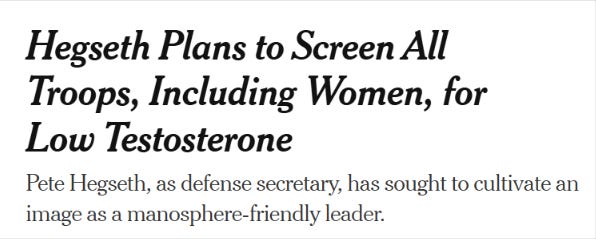
You betcha, is the reaction over there in Tehran. Secretary Pop-a-Cork was on Capitol Hill yesterday flexing his tattoos and showing off track marks from his latest round of High-T injections, and he was begging for 78 billion dollars, because his approved leakers at the Pentagon had spent the weekend telling anyone who would listen that the Pentagon is “running out of money.” What they’re running out of is bombs and missiles, but over in Tehran, they’re willing to forgive a new blizzard of lies, because as expert negotiators, they’re used to feeling their way through lie-whiteouts whipped up by Trump’s bumbling “negotiation team.”
Here’s where it gets good. For the 23rd time -- or is it the 42nd time, it’s so hard to keep an accurate count -- Trump told Axios that the Iranians “want to negotiate,” but they’re not ready to make a deal because “they haven’t received enough pain yet.”
Now, we civilians, we don’t have missiles that we regularly fire off every time a satellite picks up a rockslide on a mountain “thought” to be hiding some nuclear centrifuges or missile launch sites or Iran’s secret supply of tea Samovars, so we’re left trying to figure out what the reaction would be in Tehran when they read what Trump just said about how they haven’t received “enough pain.” See, that’s the difference between Tehran and the Situation Room at the White House. Trump and his crew of Loyal Florsheim Wearers think that if they drop enough bombs on Iran, they’ll run to Geneva or wherever with their hats in their hands and beg him to stop. When all Tehran has to do is stop oil tankers from transiting the Strait of Hormuz and get the Houthis to shoot at a few tankers in the Bab el-Mandeb strait at the mouth of the Red Sea, and the oil price graph will head straight up and cross the almighty Bad News Bears hundred dollar mark, and stock prices will head in the other direction, sending Trump to his phone to call Axios with a new roundelay of lies intended to “calm the markets” while he issues a few new threats to Tehran.
Are you picking up a pattern here? Isn’t that something: neither am I. There is no pattern. There is chaos in Washington D.C. and glee in Tehran as they watch Master Strategist Trump try to handle the war he started with absolutely no idea of how to finish it. Iran’s leaders are looking at photos in the Washington Post of Trump’s stupid drained Reflecting Pool and the diaper he put on the Kennedy Center to hide the fact his name isn’t on it, and the absolute mess that is the White House and all the silly gold leaf he’s plastered on everything but the seat cushions in his new Marine One helicopter, and the leaders of Iran are just sitting there waiting for Trump to fuck up again, so they can take Kushner and Witkoff to the cleaners and get back to collecting tolls on the Strait of Hormuz and selling their oil to China.
Ain’t this a hoot? If you’re one of the Iranian leaders in Tehran, you’re getting on the blower to the Houthis and telling them to blast a few more tankers out of the water in the Red Sea, and you’re sitting back and waiting.
Iran’s leaders are good at waiting, because they know what waiting gets them: yet another fuckup from the Flailing Blunderbuss of Errors and Terrors in the White House.