With a little over a week before the midterms, we are being inundated with warnings. No, not reasonable warnings that the regime will lie and cheat and tamper with the ballot by any means necessary to retain power. What we’re seeing is a deluge of articles telling us that, “What if, oh my god!, WHAT IF THE POLLING IS ALL WRONG?”
It’s become quite the cottage industry, selling panic in the form of “just asking questions.” We’ll circle back to the why later, as well as a more detailed look at why these people are full of shit. For now, it’s important to understand that there is a tried-and-true indicator that tells us Republicans are about to get absolutely fucking curbstomped. You can set your goddamn watch by it. It’s as obvious as it is simple: How much the GOP’s base, that mindless horde of “fuck your feelings” rage junkies, suddenly rediscovers and craves the idea of bipartisanship:
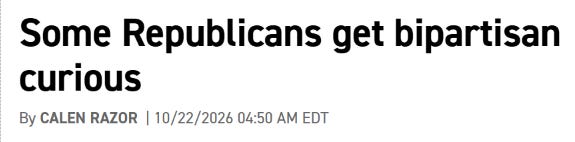
A new POLITICO poll shows that 66% of Republican voters this midterm want a Democratic House to find common ground with President Donald Trump to pass legislation next year, assuming the party flips that chamber in November.
Allow me to carefully construct a well-thought-out response to MAGAland’s newfound desire to work together: BWAHAHAHAHAHAHAHAH FUUUUUUCCCCKKKKK YOOOOOOUUUUU!
Please take a moment from your chuckling to consider becoming a paid subscriber to this newsletter. I love to write, and I love to deliver information while doing my bit to build the future we all deserve. That takes time and effort, and you can help by becoming a monthly subscriber for just $5 or take the plunge with an annual sub for just $50 only $25 during October’s Spoooooky 50% Off Sale! Thank you for sticking with me!
If subscriptions aren’t your thing, you can leave a one-time PayPal or Venmo tip instead! Let’s get back to the article, shall we?
Now, that’s not to say I want Democrats to burn it all down. I do not want to breach the debt ceiling. I do not want a six-month-long government shutdown. Even though it would be tough for my family personally, we would survive it. It would, however, financially destroy hundreds of thousands of others, if not more. So, no, please don’t do that. That would be Very Bad.
But everything else the regime wants to do? Project 2025 and everyone merrily implementing it can eat shit and die.
If Trump and his party of pedophiles and Nazis suddenly want to pass real legislation to lower the price of groceries? OK. To lower the price of healthcare? Sure. To bring back the billions of dollars to school lunches and Medicaid and special needs services they stole? Great!
But they’re not going to do any of that. They just are not. Republicans, in the minority, will demand Democrats give them everything they want and offer nothing in return. They’ll demand tax cuts for the rich and offer nothing. They’ll demand an increase in military spending and offer nothing. They’ll demand more money for fossil fuels and Silicon Valley and cuts to Social Security and Medicare and offer nothing. That’s what they do. That’s what they ALWAYS do. So they can fuck off into the sun as Democrats block every illegal executive order, grind Washington to a standstill, and investigate the GOP for their legion of crimes. Unity? Unite your ass with my foot, you fascist scumbags.
Back to the matter at hand, though, Republican voters know their party is doomed. They know there isn’t going to be an “October Surprise” to hand them a last-minute win. One or two candidates may pull a rabbit out of their hat, but Republicans are looking at a blue wave large enough to blot out the sun, and everything, literally every single thing Trump does, makes it worse.
I know people used to pretend Trump had uncanny, almost mystical, political instincts. In reality, Trump was really good at feeding hate to his base, and a complicit media sanewashed the rest. That was it. That was the “magic” of Trump. Without the protection of a fawning press, he would have self-destructed in 2016, and that would have been the end of him.
A decade later, his dementia is so far advanced, his own base is bored of his ranting and screaming and confused outbursts. They don’t give a flying fuck about his ballroom or about how he’s the Greatest Victim Who Ever Lived. They really REALLY do not care to hear about how much he wants to fuck all the men around him. His crowds are gone, and now they’re worried that all the hate and rage and cruelty they wallowed in for ten years is going to come back and haunt them. Thus, they want bipartisanship. Pretty please?
Remember, the thing mediocre racist white people fear more than ANYTHING else in the world is consequences. While in power, they can be lawless. They can trample the Constitution. Install an emperor who can rule without limits. But when that power shifts to Democrats? Well, the rules have to change! Right fucking now! The minority has to have a voice! It didn’t yesterday, but today it does because…reasons!
And do we really have to waste time on all of these congressional investigations?! Can’t we just, ahem, “look forward for the good of the nation?!”
That one, more than the rest, will be especially galling. These are the people still braying for the blood of Dr. Anthony Fauci. Who are still demanding the arrest of Hillary Clinton and Barack Obama and Hunter Biden. But arresting anyone in Trump’s circle? That’s tyranny! That’s not the America they grew up in! Sob sob whine whine.
My heart bleeds for the poor lambs. In the meantime, I’m sharpening my knife. Trump’s DOJ, of course, won’t arrest a single member of the regime no matter WHAT Democrats expose. Oh? They were running a literal child trafficking ring out of the West Wing, and there’s video evidence? Sorry, that’s protected by executive immunity, and it’s fake news anyway. Oh? Jared Kushner has been taking billions of dollars from the UAE and acting as a foreign agent while manipulating America’s foreign policy? Yeah, sorry, he’s protected by the power of being the Emperor’s Son-in-Law.
But all of this will be out in the open, and Trump won’t pardon EVERY single one of his cronies. When Democrats take the White House in 2029, purge the DOJ, and install professionals dedicated to upholding the law instead of perverting it? Whole lot of Republicans are going to prison for a very long time.
Think Republican voters are begging for unity now? Just you fucking wait until October of 2028. They’ll be on their hands and knees, screaming and wailing that America “needs to heal” and that “looking back will only tear us apart.”
Should have thought of that before you elected a treasonous pedophile rapist whose entire campaign was a single promise: “I will be your retribution.” Retribution is a two-way street, motherfuckers, and we’ll be in the driver’s seat very very soon.
Now, let’s have a quick conversation about why people are writing so many “OMG! Maybe we’re actually losing!” articles. There are two reasons to do this. The first is clickbait. Fear sells. Scared and nervous people will read anything that confirms what they’re afraid is going to happen. I’ve written clickbait before back when I was first getting into political writing. I was working for someone who made me do it, and I didn’t know any better. It was repulsive. I lasted a few months and refused to keep debasing myself. People who write clickbait to scare people for a living are the lowest form of life in this arena. If you’re one of them, I hope you die a slow and painful death, alone and abandoned by all who once loved you.
The other reason is worse: Ratfuckers laying the rhetorical groundwork for the regime to challenge the results of dozens of elections across multiple states. After all, look at all of these articles saying the polls might be wrong! That’s proof there was a giant conspiracy to rig the elections and cheat Republicans out of a rightful victory. It doubles to give MAGA voters a fig leaf to hide behind when their Dear Leader simply throws the Constitution in the trash, seizes ballots and voting machines, and declares entire elections null and void. Do presidents have that authority? No, but so what? Didn’t you see how wrong the polling probably was? Clearly the election was rigged! We have to do something!
I hate ratfuckers even more than I hate Nazis, and I openly advocate for violence against Nazis. Interpret that how you will.
But here’s the thing about these articles: They’re all bullshit. Never mind the polling. Never mind the massive turnout in early voting. Never mind the insurmountable enthusiasm gap. Just look at the conditions going into the midterms:
The president (one Donald J. Trump) is deeply unpopular among every demographic, including the ones that he won with in 2024.
We are in the middle of a deeply unpopular and very stupid war in the Middle East. A war everyone understands we’ve lost. A war started by Donald J. Trump.
The price of oil/gas/diesel is sky-high (because of said stupid war).
Inflation is high and going higher.
Groceries are painfully expensive, and so is everything else.
Job growth is nonexistent.
Wages are growing slower than inflation.
We are on the brink of a massive AI bubble collapse, which will push us into the worst depression in history. A lot of people are aware of this and are really mad about it.
There are not a lot of hard rules in politics. But one of them is that when the economy is a train wreck, the party in power gets the blame, unfairly or not. When the party in power is directly responsible for the economic pain, though? They don’t just lose elections; they are punished. Severely.
I made this observation the other day, but it’s worth repeating. Here is a comprehensive list of all the midterms in which the party in power won during an economic downturn while waging an unpopular war:
Absolutely
Fucking
Never
Even
Once
And that’s aside from the normal headwinds of being the party in power during the midterms and ignoring how pissed off people are about the regime’s ridiculous, over-the-top, cartoonish levels of corruption. Put all of those ingredients together, boil in a stew of white-hot resentment coming for literally every part of the political spectrum, and even suggesting that Republicans might have some hidden level of deep support we just aren’t seeing, and maybe, JUST MAYBE, they’ll hold on to power is an insult to my intelligence. Like, motherfucker, no, I will not be buying a bridge in Brooklyn from you. How fucking stupid do you think I am?!
These polling doomer articles are either assholes trying to scare you for clicks, or ratfuckers trying to sell the lie that the midterms are rigged. Ignore them. Elon Musk, alone, is pouring more than half a billion dollars into races he knows Republicans are losing because he’s panicking. As a Senator in Texas, where Musk’s businesses are, James Talarico will be an existential threat to Musk. Does this look like a man who thinks the polling is wrong?
Meanwhile, MAGAland suddenly wants to hold hands when just five seconds ago, they were promising to murder us in the streets. The rats in the White House are scurrying about, hiring lawyers and pre-emptively blaming each other for the coming bloodbath.
If this is what Republican winning looks like, can you imagine what kind of chaos losing would unleash? The fascists are fucked. You know. I know it. They absolutely know it. Anyone telling you otherwise has an agenda. Tell them to fuck off and go vote.
These are dark times, but I will continue to tell the stories you need to hear in a clear (and usually profane) voice. If I entertain/anger/inform you, preferably all three, please consider becoming a supporting subscriber today for only $5 a month or just $50/year $25/year during the 50% Off Spectacular Spooky Season Sale!
Not a fan of long-term subscriptions? That’s OK! I’ll be your one-night stand with a one-time donation through PayPal or Venmo! I’m easy like that! Just don’t tell Mrs. Ogre! 😜
 Log in