Log in


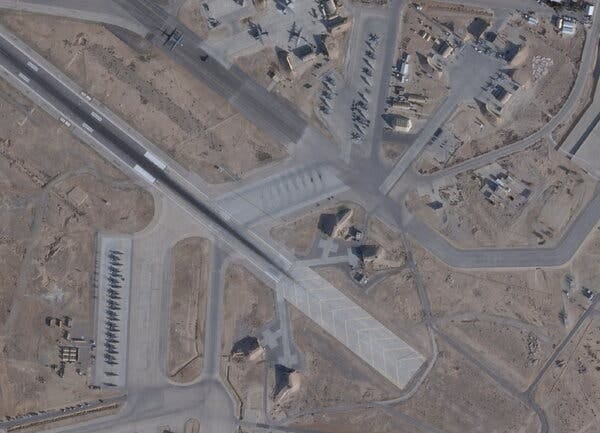
Today it was announced that the remains of a third soldier have been found at the U.S. military base in Jordan that was struck by an Iranian missile on Friday. That brings the total of U.S. dead to sixteen.
The Pentagon immediately announced that U.S. forces would strike targets in Iran “in retaliation” for the three deaths in Jordan. That is where we are today. We’re not bombing Iran’s nuclear facilities. We’re not attempting to knock out Iran’s ability to shut down the Strait of Hormuz. We’re “retaliating” because Iran killed three members of our armed forces.
You hit me, so I’m going to hit you back is not a war. Nations go to war to achieve objectives that cannot be reached by other means. Trump said in a video, or he mumbled on his way walking across the lawn to Marine One, or he posted on Truth Social – I can’t remember which, and it really doesn’t matter – that we were going to war so that Iran will never achieve possession of a nuclear weapon. That’s an objective, and a legitimate one, but then what happened?
Well, when we bombed Iran, they started firing missiles and drones at our bases along the Persian Gulf and elsewhere in the Middle East such as Jordan, Iraq, and Saudi Arabia. Plus, Iran fired missiles and drones at our allies in the Gulf, hitting some of their oil production sites, their airports, and even some civilian targets such as hotels and apartment buildings.
Iran also decided to shut down shipping through the Strait of Hormuz, which they control because geography, not international law, has given them that control. Reopening the Strait of Hormuz became the object of our war.
Then the market spoke. Trump doesn’t listen to even one human being, but he hears the market. The market moves money, and he likes money. The market sent oil and gas prices up very quickly, and then the market sent the price of everything else up, because it’s all connected.
So, when the market had caused more pain that he could stand, Trump sent his son-in-law and one of his New York real estate buddies over to the Gulf to “make a deal” with Iran that would bring prices down. They produced an agreement called a “memo of understanding” that accomplished exactly zero of the goals Trump had said we were fighting a war for. The agreement did accomplish two of Iran’s goals, however. It acknowledged Iran’s control of the Strait of Hormuz, and it gave them a ceasefire, during which they could repair all the military stuff we had damaged with bombs and missiles, and it let them restart their production lines and rearm.
It has become startlingly apparent that no one running things in the White House or the Pentagon has had even a cursory look at Carl von Clausewitz’ elemental tome, “On War.” Right at the beginning of page one, Clausewitz warns that the idea you can defeat an enemy without the use of maximum force is a “fallacy.” On page two, Clausewitz says simply that “The aim of war is to disarm the enemy.” “If the enemy is to be coerced you must put him in a situation that is even more unpleasant than the sacrifice you call on him to make… Otherwise the enemy would not give in but would wait for things to improve.”
While Witkoff and Kushner dicked around in Geneva and Oman and wherever else their alleged “negotiations” took place, Iran just waited, and things improved for them in multiple ways. The world economy began to slide. The U.S. economy was badly stung. Trump’s poll numbers crashed. His political party panicked. Trump was driven to invoke the Defense Production Act to force defense manufacturers to build more weapons – very, very expensive weapons -- because we were running out of them.
On page three of “On War,” Clausewitz discusses “the maximum exertion of strength.” He says this is necessary if you want to damage the enemy’s means of making war and “the strength of his will.”
In fighting an air war against Iran, we have not employed anywhere near the maximum strength of our military, and we have not broken the will of Iran, which was sent sky-high on the first day of the war when U.S. and Israeli bombs killed Iran’s supreme leader and his immediate family and most of the country’s top military and political leadership.
The first three pages of one of the two most important books ever written about war, and the White House and Pentagon have fucked up everything Clausewitz taught about war and warned against if you’re going to wage one.
It is undeniably tragic every time one of our soldiers is killed in a war. But the death of soldiers is not a reason to fight a war. You don’t retaliate against the enemy because he killed our soldiers. You fight a war to bend the enemy to your will by killing his soldiers and defending the lives of our soldiers. If you kill more enemy soldiers than a country can afford to lose, and if you knock out enough of his weapons that the enemy becomes effectively disarmed, then you break the enemy’s will. If your enemy is Iran, and your break his will, he will do things like stop trying to build a nuclear weapon and go back to allowing unfettered shipping through the body of water that because of his geography he controls.
The Persian Gulf is not a playground, and war is not a spat. War is serious business. We do not have serious people in charge of the war we are waging against Iran. We have people presenting cage fights on the White House lawn, people who cannot fill a reflecting pool with water without turning it lime green. That is why we are nowhere close to achieving even one goal Trump claimed we had when we began bombing Iran.
We have lost only 16 soldiers in this war. We have lost only one fighter jet shot down by the enemy, and one AWACS aircraft destroyed on the ground. We have lost no Navy surface ships or submarines.
Iran, on the other hand, has achieved multiple goals in a war they did not choose but was forced upon them.
Trump is losing this war bigly.