Did you know that white identity was erased for generations by…you know…Those People? Feminists. The Lefty Intellectual Elite. Black Radicals. The LGBTQ Community. You know…Those People. Whiteness, specifically, white men, have been oppressed all this time, afraid to speak up for themselves, and now? Now it’s their turn!
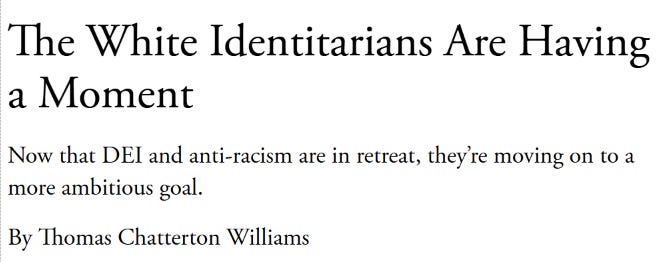
I swear to fucking god, this is the actual premise of an article in The Atlantic:
I am not joking when I say that the author believes whiteness was rendered invisible by the left:
For most of the post-civil-rights era, a tacit consensus discouraged white Americans from thinking of themselves as avatars of a racial demographic. Race mostly belonged to other people. Many white Americans commemorated certain aspects of their ethnic background—in the case of my Baby Boomer mother, the language of her German grandparents. But honoring whiteness itself was deemed impolite, to say the least. Given the advantages that whiteness often conferred, calling attention to it was like being a sore winner.
This is not a subtle rewriting of history. This is just bullshit propaganda to justify the grievances of America’s white nationalist movement. But this paragraph reveals far more than the author intended. He tells us EXACTLY why whiteness, as a concept, was discouraged.
Substack has been slowly choking off traffic to smaller newsletters like this for more than a year. If you appreciate the stories I tell and the voice I tell them in, please become a contributing subscriber and push back on corporate censorship. We need all of the independent media we can get before the only news we’re allowed to consume is what is allowed by a fascist regime controlled by billionaires. For just $5 a month or just $50 a year (a 17% discount!), you can help fight back against Substack’s censorship. Thank you for reading and keeping this newsletter going.
🌟BECOME A CONTRIBUTING SUBSCRIBER!🌟
Click here for a PayPal donation!
I prefer Venmo, please!
It’s important to understand that whiteness NEEDED to be invisible. It was vital that it be the air we breathed. The water we swam in. That whiteness was everywhere but unspoken. Not because it was “deemed impolite” to acknowledge it, but because to acknowledge it would, in fact, call attention to it, and that could not be allowed.
Here’s the part that really gives it away: "Given the advantages that whiteness often conferred, calling attention to it was like being a sore winner.” Bullshit. It wasn’t about being a sore winner. It was about making sure no one saw white people as the winners in the first place. We’re going to circle back to this in a minute.
For now, come back in time with me to the 2010s. In this distant past of just a decade and change ago, a strange thing happened. We, as a society, started to talk about white privilege and white supremacy and whiteness itself. We had talked about it before, of course, but this time was different. This time it took root, and the conversation became part of the national consciousness.
Remember, according to Williams, we didn’t do this previously because it was gauche to talk about whiteness. White people were denied their whiteness by…someone. Social norms? Angry Black people? Radical leftists? Williams is never quite clear, but it’s heavily insinuated that minorities somehow forced white people to deny their whiteness:
All racial identities were named and valorized, except one. This wasn’t the sole cause of the white backlash that ensued; racist politicians and media figures bear ample responsibility for that. Still, the rhetorical and ideological excesses of the left generated a sense of unfairness that has become central to the white-identitarian project.
But when we started to talk about whiteness and white privilege, and again, remember Williams explicitly says being white confers advantages, what did white people do? Were they delighted to be seen? Did they start chanting “Free at last!”? Did they rejoice at no longer having to hide the shamefulness of being white?
No. That’s not even remotely what fucking happened. Instead, they lost their goddamn minds and spent years screaming in aggrieved outrage.
Now, I remember this clearly because I didn’t understand it at first. I got that the right was falling to its knees and wailing big, sobby tears of outrage. But an awwwwful lot of white leftists and liberals got up on their hind legs and screeched in pain like a fucking vampire seeing sunlight for the first time.
Oh yeah, that happened. I couldn’t post the words “white privilege” without being lectured about how “my white skin didn’t give ME any advantages! My life has been rough! How fucking DARE you suggest I’ve had it easy as a white person?!” And this from people whose Facebook feeds were nothing but bragging about what good allies to minorities they were.
This went on for years. I don’t see it much anymore. Probably because we’re too busy dealing with Nazis marching in the streets to complain about how white privilege doesn’t exist.
But the fact remains that white people were not quietly pining away for recognition of their whiteness. Even the ones who didn’t think of themselves as racist or benefitting from structural racism needed it to remain unseen and unspoken. That is how systemic injustice operates. It becomes so ingrained and “natural,” we stop seeing it as injustice and think of it as “just the way things are.”
It’s a nice fairy tale we can tell ourselves. Everything I have, I earned through the power of my own awesomeness. And all of the women and Blacks and Latinos and Asians and and and that didn’t make it as far? Well, they should have tried harder. Like I, Todd Bradford Whiteson, did!
But of course, privilege is not necessarily life on the easy setting. You don’t have to have it easy to be the winner. You just have to have EASIER. And white people did. Privilege made us the winners by putting life on the difficult setting for everyone else. And the nightmare setting for specific groups like Black women and trans people. Intersectionality is a hell of a word that captures a world full of pain.
But once we started to talk about whiteness, it stopped being invisible. That’s what made these secretly “oppressed” people so angry. Williams opines that white people felt excluded, but once we saw them, they wanted nothing else but to disappear again, and they instinctively knew why. Even if they didn’t grasp or admit to benefiting from generations of privilege, they knew that being exposed was not in their best interest. They didn’t WANT to be seen.
But they were, and there was no putting the toothpaste back into the tube. We kept talking about whiteness and white supremacy and white privilege. We talked about Karens and white women’s tears and how white people policed Black bodies in public spaces. Suddenly, all of the bad behavior white people had engaged in all along stopped being “normal.” It stopped being the air we breathe and the water we swim in. Suddenly, we stopped tolerating it.
And just like that, white people went from being invisible to being victims.
One doesn’t need to be a white man to see that this is true. Over two decades in and around universities, nonprofits, and the publishing industry, I have repeatedly served on selection committees in which jurists—in many cases white jurists—stated that a candidate’s racial, ethnic, or sexual claim to marginalization ought to be the deciding factor for a coveted position or prize.
“Today, the advantages white Americans have are mostly informal and evanescent cultural legacies,” as Carl writes in The Unprotected Class. “The discrimination they experience is also sometimes informal but is increasingly legal and formal.”
It’s hard to choke down the self-martyrdom of white men. After literal centuries of structural, legal, social, and economic white supremacy, we started to take steps to reach the very tiniest beginnings of balance. We didn’t make great strides; we barely took fucking baby steps.
Yet, you would think someone passed a law dictating that all white people were to be put into chains. That’s how great the temper tantrum from white people has been.
To his credit, Williams does not think the far right’s race war is helpful or productive. He thinks going full white power is not the way to restore balance in America. He would prefer a “color-blind” system. You know, the one where whiteness was invisible and absolutely everywhere, shoved down our throats 24/7. He doesn’t SAY that, of course, but who the fuck does he think he’s kidding?
We know what Williams is really after because even as he laments the extremism of the right’s march towards white nationalism, he just feels so fucking terrible about how “both sides” don’t get it:
Justin Lee, a writer published by Passage Press and an associate editor at the conservative journal of religion First Things, told me that the white identitarians are mimicking the “woke” identity politics they ostensibly seek to counter, resurrecting the hyper-racialized politics of 2020, when the left was at the peak of its dominance.
The white identitarians’ ultimate goal seems to be the moral and institutional power that comes with victimhood status, which is now anyone’s prize in post-woke America.
The difference, of course, is that to be Black or Latino or Muslim or any minority IS to be a victim in a system designed by white people to exclude everyone else. And the only remedy is to pull everyone else up until they’re on equal footing. The fact that Williams sees this as anti-white oppression tells you everything.
But here’s the money shot:
In a country that is becoming less white, any short-term victories notched by white identitarianism will be pyrrhic, just like the “wokeness” that preceded it—and that it continues to sustain by foregrounding race.
Thhhhheeeeereeee it is. One wonders if Williams is even aware of how hard he is telling on himself in this article? The real concern is not that white people are oppressed or that “both sides” are too extreme. Williams wants a return to the original status quo of invisible omnipresent whiteness because without it, white privilege will disappear in the not-too-distant future.
This is the thing racist white people fear more than death itself. White privilege is how they have maintained the illusion of racial superiority for centuries. Without it, everyone will see the unspeakable truth: That there is nothing special about white people. They are not smarter than anyone else. They’re not more competitive or innovative. They’re not the best mankind has to offer. They’re just like everyone else.
Without white privilege, the millions of mediocre white people who have secured an unearned place on top of the racial hierarchy will be revealed as the nobodies they’ve always been. That future is unacceptable, and they would rather end human civilization than let it come to pass.
Williams is just another in a loooong line of trash looking to provide cover for the right’s racism. This entire article is an extended exercise in bothsiderism. Sure, the white racists are going too far but really, whose fault is that? If minorities hadn’t made racist white people so mad by demanding equal rights special privileges, none of this would be happening.
Because if everyone is guilty, then no one is guilty. And if no one is guilty, then we never EVER have to hold racist white people accountable for what they’re doing. Best to just go back to the way things were and stop all this silly identity politics stuff. Sure, that would benefit white people the most, but let’s not quibble about the details, people!
Always pay attention to the people who tell you not to talk about race and gender and class. Those are the people most invested in keeping systems of injustice in place, and they are always the ones who benefit the most from them. Push the lies aside and push back even harder. If they weren’t scared of us, they wouldn’t be trying so hard to take away our voice.
I hope you feel better informed about the world and ready to kick fascists in the teeth to protect it. This newsletter exists because of you, so please consider becoming a supporting subscriber today for only $5 a month or just $50 a year (a 17% discount!). Thank you for everything!
🖕FUCK RACISM!🖕
Prefer a one-and-done tip? Click here!
Venmo tips go here!
There are 146 days until the most important midterm election in American history. The regime is afraid, and they should be. We are legion, and they are weak. Stay strong. You are never alone.
 Log in