Log in


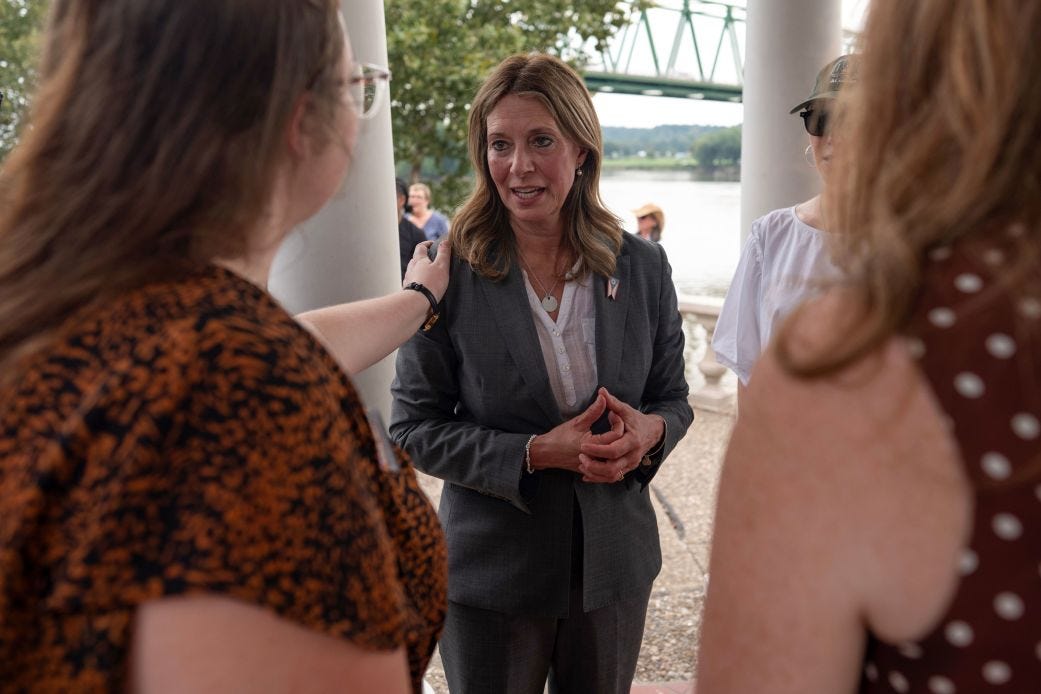
I spent most of this afternoon going through everything I could find about the rape of Ohio Democratic gubernatorial candidate Amy Acton when she was 12 years old. Nearly all of it was about the disgusting ad being run by Republican Vivek Ramaswamy.
I pulled myself up short. Amy Acton is much more than a victim of childhood sexual abuse. She overcame it and worked her way through college, went to medical school, got an advanced degree in public health, and became Ohio’s Director of Public Health in 2019. She received the “Profile in Courage” award from the John F. Kennedy Presidential Library for her work in Ohio during the COVID pandemic and has held several jobs running non-profits since then. She announced her candidacy for governor in 2025 and ran unopposed in the state’s Democratic Party primary.
The coverage of the ad Ramaswamy is running against her is voluminous. Her birth mother, from whom she has been estranged since she and her brother were removed from her mother’s custody when she was 12 years old, appears in person in the ad calling her a liar, saying that she “needs help,” that if people vote for her daughter, it will only make their lives worse.
Naturally, Donald Trump and his vice president, JD Vance, a former senator from Ohio, have weighed in, endorsing the despicable ad. Trump said “Vivek should keep it up,” referring to the ad. Ramaswamy should “let everyone listen to the mother of a defective, dishonest, and incapable Candidate, explain how the daughter is a DISASTER who, uncontrollably, lies, cheats, and steals!” Trump posted on his failing social media platform, Truth Social, today.
Democrats have denounced the ad and demanded that Ramaswamy take it down. In response, Ramaswamy has committed $4 million in campaign funds to keep it on the air. Some Republicans, including Ohio Governor Mike DeWine, have denounced the ad. DeWine called it “deeply troubling,” and encouraged that it be taken down. Still, he has kept alive his endorsement of Ramaswamy.
And so, the back-and-forth has gone for the last several days, with the press and the political commentariat concentrating on the politics of the moment and whether the ad will work for Ramaswamy or backfire against him.
All of which would be normal in today’s political climate, when seemingly nothing is off the table in the knock-down-drag-out battle for control of Congress that will be decided at the polls 12 days from now.
Except for one thing. What Trump and Vance and Ramaswamy are talking about is a woman who was repeatedly sexually abused and raped by her stepfather when she was nine to twelve years old, a fact that has been lost in the political heat surrounding the ad.
I looked up everything I could find about the facts of what happened in 1978. Acton’s mother divorced her husband and named Cledith Arthur, who had already been charged with abusing his daughter in a previous marriage. The charges were later dropped. When his abuse of Amy was reported to the police in July of 1978 by her biological father, Arthur was arrested and charged with sexual abuse of a minor. The local NBC affiliate in Youngstown, Ohio, where Acton was living in July of 1978, published the file of court documents from Mahoning Valley Clerk of Court. The entire file amounts to 37 pages of documents showing that Arthur was arrested and charged with “sexual conduct with, [name blacked out], not the spouse of the offender, when the other person is less than 13 years of age, whether or not the offender knows the age of such person.” Yes, the language is that dry.
Arthur was given a $2,000 personal appearance bond and released. After failing to make court appearances, he was eventually charged by a grand jury with sexual abuse of a minor under 13 years of age. Multiple arrest warrants were issued, one in October of 1978 and a second in December of 1981, accusing Arthur of rape of a minor. Arthur and Amy’s birth mother, now known as Donna Arthur, fled the state to Pennsylvania.
No attempt was made to pursue Arthur to Pennsylvania. At that time, there was no national crime database, and states did not share information about arrest warrants. Arthur died in Mechanicsburg, Pennsylvania, near the state capital of Harrisburg, in 2004.
The greatest tragedy of this case is that the sexual abuse of Amy Acton is being used against her in the campaign for the Ohio governorship. The other tragedy, that I would argue is just as great, is that while the abuse of minor children is common, it is not talked about by victims and certainly not by the criminals who abuse them. It is of course up to Amy Acton whether to talk about what happened to her as a child, and if she decides to discuss it, how much she should say. Acton has refused to debate Ramaswamy, at least in part because of the ad he is running, and because he has attacked her in the past using false charges that were leveled against her when she was the state’s Director of the Department of Health.
The statistics regarding child abuse are astounding. A third of women report being abused as children. I have written this before, but I feel the need to say it again: I have known multiple women in my life who experienced abuse by a family member or close relative or friend of their families. When I lived in California in the early 2000’s, the state passed a law that required registered childhood sexual abusers to report their addresses to the state, and made that information available to the public. California put up a website where you could access maps that showed the addresses of sexual abusers. We lived in the Hollywood Hills, and when our first daughter was born, I logged on to the website and accessed the map of our neighborhood. It was filled with little red dots signifying the addresses of child sexual abusers. Dozens lived within walking distance of our address.
It wasn’t like we let our seven- or-eight-year-old daughter walk around the neighborhood by herself. We didn’t. But the number of child sex abusers was scary. These guys had been convicted, probably on reduced charges, and imprisoned and been released early enough in their lives that they took up living as free men again, had jobs, qualified to rent apartments or buy houses. Amy Acton’s abuser lived similarly out in the open in Pennsylvania, not even having faced a court or conviction. Nobody in Mechanicsburg knew an accused child abuser lived down the street from them.
It isn’t until something like the horrid Ramaswamy ad against Amy Acton makes the news that the subject of childhood sexual abuse becomes a “thing” by the press in the political firmament. But it’s everywhere. If it is a fact that a third of women admit to being abused as children, it is a certainty that the number is much, much higher, because of the painfulness of the subject and the desire of most people to keep their lives private.
It’s no wonder. Even having heard women I have known personally describe the horrors that happened to them as children, it is impossible for me to imagine myself into their experience, impossible for anyone, I would think. How can you see in your mind’s eye the violence that happened to a small child in the dark of a bedroom or in the closet of a school or the seat of a car or in the leaves under a tree in the woods? Do you see what I mean? The pain. The shame of not telling anyone. Being so young. So vulnerable.
Writing those phrases feels dry to the point of being clinical. The reality had smells and blood and bodily fluids and stains and more agony than could ever be described, even by those who experienced it.
And this is what Vivek Ramaswamy and his enablers in the Republican Party, including the President and the Vice President of the United States, think is an appropriate “issue” to be flung at a victim of sexual violence to win a political office.
I despair not only about what this country has become, but what it has always been. It is even worse to think of what it says about how we, as human beings, can live among those who would use such deeply personal pain against another human being just to achieve power they want to exert over others.
Words fail me. We cannot fail Amy Acton.