Crusading against evil since ...
3519 stories
·
1 follower

Trump's Iran War Is Now About His Fragile Ego vs. His Desperation

1 Comment

These are dark times but I will continue to tell the stories you need to hear in a clear (and usually profane) voice. If I entertain/anger/inform you, preferably all three, please consider becoming a supporting subscriber today for only $5 a month or just $50 a year (a 17% discount!).

🌊Join The Blue Wave!🌊

Can’t do a sub? We got you!

The next couple of weeks will tell us a lot about where we are as a country. The price of oil is, as of this writing, wobbling around $92 a barrel. That’s up from the roughly $65 it was just a month ago, but down from the $115 it spiked to last week.

Should the war continue and shipping through the Strait of Hormuz remain closed or severely reduced, we cannot just shift oil production to other parts of the world to make up the difference. Oil prices will rise, and global inflation will rise with them.

Some of Trump’s people are in a hot panic and telling him a prolonged war is suicidal for the midterms. We have to declare victory and leave, Lord Emperor Mr. President, or you’ll be impeached again. You don’t want to be impeached again for the third time, do you, sir?! And Democrats in control of the House and Senate will 100% sue to force the remaining Epstein files to be released. You don’t want all of the remaining Epstein files released, do you, sir?!

On the other hand, not staying to “finish the job” means leaving in place a far more dangerous Iranian regime. Ali Khamenei, as Supreme Leader, was hostile to the West and a monster. I could spend all day listing his crimes.

His son, Mojtaba, the new Supreme Leader, is going to be worse.

Mojtaba is more extreme, is far more interested in developing nuclear weapons, and has a real-world axe to grind (as opposed to political and ideological) with the United States (and Israel) since we just killed both of his parents, his wife, and one of his sons in an unprovoked sneak attack in the middle of peace negotiations.1

But we are not prepared for the kind of war it would take to topple the Iranian regime. It would take years and cost thousands of American lives. This was supposed to be quick and easy, not a quagmire. Go in, blow stuff in a manly way, be done, and throw a parade.

Some of Trump’s people are telling him that a prolonged war now is the only way to protect America. Also, ending the war before toppling the government would be seen as surrender, which would make Trump look like a weak sissy. You don’t want to look like a weak sissy like Biden, do you, sir?!

So what does Trump do?

Clearly, he’s swinging back and forth depending on who talked to him last and when the stock market is open. When the market is open, Trump will talk about how this will be a short war. We’re definitely going to be done soon. The market loves that, and stocks go up.

When the market is closed, Trump suddenly remembers how tough he is and talks about how we’ll be there “until the job is done.” How long will that be? Could be weeks. Could be months. No one knows. It’s not up to him. It’s up to Iran to be nice. The market would hate that, but it’s closed, and by the morning, maybe Trump will have changed his mind again.

For a good long while, the legacy press pretended that Trump was running Nixon’s “Madman Theory.” Act crazy, keep everyone off-balance and unnerved, and then play 10-dimensional chess. It allowed them to not ask the scary question. No, not “Is Trump actually a madman?” The question the legacy press has twisted itself into ever-tigher knots to avoid asking is, “Is Trump really as stupid and incompetent as he appears?”

They’ve avoided that question the entire time because the answer is manifestly “Yes.” Trump has no fucking idea what he is doing. Trump 1.0 at least surrounded himself with competent people who could rein in some of his dumber ideas, like dropping a nuke on a hurricane.

Trump 2.0 does not have any adults in the room, and it is no longer possible to hide just how fucking dumb he is. Only an imbecile would look at Venezuela and think, “We can totally do that in Iran! We’ll just kill the leader, and they’ll 100% bend the knee!”

I am no expert in the Middle East, and even I knew Iran wouldn’t fold that easily.

But here we are, in a war with no defined end other than “Iran has to be nice.” Something a child would say. We’re killing hundreds of people a day and creating the conditions for a humanitarian crisis that will lead to tens of thousands of radicalized Iranians, and the end goal is being decided by a toddler.

Said toddler has to choose the two options in front of him now: Maybe save his own skin by ending the war and declaring a TOTAL VICTORY! or continue dropping bombs and…do something else.

TOTAL VICTORY!!!

This option is based on Trump’s desperation. The midterms are just seven months away, and Trump is in deep trouble. If either the House or the Senate flips to Democratic control, a lot of Trump’s corruption will be exposed. If both flip, the hearings will be endless, and how long can the courts slow-walk the release of the Epstein files? Will SCOTUS step in to help? Not guaranteed. Protecting pedophiles is not really a Federalist Society priority and after Trump called Kennedy and Barrett embarrassments to their families, they may not be overly inclined to indulge a man who rapes children.

Even Trump, dumbfuck that he is, understands that high inflation and high gas prices will turn an already uphill struggle in the midterms into a complete rout. All of his plans to tamper with the vote won’t mean anything if the blue wave is large enough. Worse, outright stealing the election becomes impossible if everyone knows Republicans are losing everywhere by 15 points or more.

A little push here, a little push there, and you can “lose” just enough votes to convince people the swing states went for Trump. But in a blue wave of this size? No one will believe Republicans didn’t lose control of their one-seat majority in the House. Overt election interference is just as dangerous as no interference at all for the regime. Tight rope to walk for a fascist regime. My heart bleeds for them.

A prolonged war, even two or three months, would be catastrophic for the economy (on top of all of the people who will die). With an economy that is already floundering, a hard push over the cliff that will send it into freefall, something a competent government with good intentions would have incredible difficulty tackling. Joe Biden managed to do it, and his thanks was to be punched in the face by a country of ingrates and imbeciles who were mad at the price of eggs.

The Trump regime is neither competent nor well-intentioned. The next economic collapse will be met with a clown show alternating between panic and indifference. Panic because it hurts Trump electorally. Indifference because we really do have a “Let them eat cake” regime of millionaire and billionaire elitists detached from reality. I don’t really use “elitist” in my everyday vocabulary, but these people have taken great pains to insulate themselves from the rest of us, living lives of obscene wealth and decadence. Watching The Poors suffer is sport for them. “Elitist” is a pretty good word for that kind of cultivated isolation and cruelty.

Maybe if they had started the war after the midterms and had managed to keep control of Congress, Trump would be more likely to go all-in on a quagmire. But he has finely tuned survival instincts. He’s really going to want to pull out of Iran. If his ego will let him.

Quagmire

This option is Trump giving in to his overwhelming ego and listening to the warmongering neocons who have obviously appealed to Trump’s not-so-inner fascist.

War is fun! War is manly! Killing brown people in faraway countries makes the Evangelicals happy! Iran really made Trump mad during his first time in office. Also, they signed a peace treaty with Obama. Blowing Iran to smithereens scratches two itches at once.

Here, we have Trump deciding that war is the solution to a lot of his problems. Violence abroad makes violence at home more acceptable. Does it? Not really, but Trump may decide to just run with that idea.

The regime has been suppressing reports of possible (likely) terrorist attacks at home. That is a “up is down, black is white” situation. The regime has done nothing BUT fearmonger every second of every day. The only possible reason to suppress this kind of report is because the regime wants the public to be caught unawares by an attack. The more unprepared, the more shocked and afraid people will be. The more shocked and unprepared and afraid, the easier it will be for the regime to declare a “national emergency,” giving itself unlimited power to do anything it wants.

Arrest Muslims. Suspend civil liberties. Make opposition illegal. Put elections on hold. Just for a little while, of course. Just until things calm down and the emergency passes.

It’s Authoritarian 101. The emergency never passes. There’s always a new emergency. Liberities are never restored.

Timothy Snyder wrote about this a few days ago. It’s so obvious what the regime is trying to do; it’s literally in his book, On Tyranny:

We must anticipate, with sadness and resolution. We will be horrified, but we cannot be surprised, if there is a terrorist attack on the United States. If choose to be surprised, we co-create a moment that Trump will exploit to undo what remains of our democracy. If the unthinkable happens, it will happen because some of Trump’s people thought about it, some of them created the conditions for it, and some of them looked away. The responsibility for catastrophe will be theirs. And the responsibility for democracy will be ours.

Trump knows the war will destroy his chances of holding power in the midterms. He may decide his best chance is to use the war to seize control as a dictator. Besides, without the war, the Epstein files will come roaring back. Even with the war, his crimes as a pedophile can only be held off for so long. But without a war and, hopefully, a deadly terrorist attack to justify martial law, Trump’s past will consume him long before he has a chance to steal a single vote in November.


This is where we are right now: Locked in a struggle between Trump’s desperation to win the midterms, telling him to end the war, and his ego screaming at him to stay and fight. Honestly, I don’t know which will win.

I suspect that if there is no terrorist attack in the next month and the regime cannot stage one while oil prices continue to rise, Trump will start to lean very heavily towards declaring TOTAL VICTORY!!! and getting the fuck out of Dodge.

Also, if we run low on interceptors and Iran continues to slam drones into the surrounding Gulf states, they’re going to demand Trump stop the war. They paid billions to destroy their enemy. Being under constant attack was not part of the deal, and they will not have the stomach for it. No more bribes if the war continues, and Trump won’t like that. Although if we’ve already committed ground troops to the fight, backing out will be difficult, and the neocons are pushing Trump really hard for their new forever war.

I won’t say it’s a coin flip, but we are at the whim of a dementia-riddled toddler who has, at most, a third-grade understanding of the Middle East.

Goddamn every single person who said not to vote for Clinton and Harris, the “warmongers.”

I write to help you cope with the fear and anger threatening to overwhelm you every day. If this newsletter gets you through these dark times, please consider becoming a contributing supporter for only $5 a month or just $50 a year (a 17% discount!). Thank you for everything!

🔥Burn Fascism To The Ground!🔥

Prefer a one-and-done tip? Click here!

There are only 237 days until the midterms, and the regime is panicking. They’re afraid of us. Keep making them afraid every single day. Remember, you are never alone. We beat the fascists once. We will fucking do it again.

1

I pointed out on today’s podcast recording that if I wrote this as a Bond supervillain origin story, it would be rejected as heavy-handed, but here we are.

Read the whole story
DGA51
13 hours ago
reply
This was supposed to be quick and easy, not a quagmire.
Central Pennsyltucky
Share this story
Delete

Avoiding Any Blame in Iran

1 Comment

There’s plenty of boastful propaganda from and for this Trump administration when things look like a military rout against Venezuela’s Nicolás Madura, drug cartels or now in Iran.

It’s less clear that anyone on Team Trump is willing to stand tall when the news is not so clear. Accountability for a war in Iran is no more at hand than it is for the excesses of ICE tactics or tariff effects on prices or the impact of Epstein files mishandling on victims of sexual abuse.

On Monday, Donald Trump told a CBS reporter, “I think the war is very complete, pretty much. They have no navy, no communications, they’ve got no air force.” He added that the U.S. is “very far” ahead of his initial 4-5 week estimate on its “little excursion.”  War/Defense Secretary Pete Hegseth has said basically the opposite, that there would be plenty more war.

We can’t even figure out whether we have won.

Yet with each passing day in this undeclared war in Iran it seems clearer that Iran, unlike Venezuela, is not going to stand by passively. The job of winning any victory in a war lacking goals with an enemy that refuses to roll over is going to be problematic to anyone but Trump.

The decision to choose Mojtaba Khamenei as a new leader is a sign of defiance. So, too, are the actions of a dispersed Islamic Revolutionary Guard Corps even in diminished capacity to continue to lob missiles and to encourage retaliation despite air superiority for US and Israeli forces. Rather than any Washington acknowledgement that the going may be tougher than promised, what we get from our leadership are more dismissive words about lethal domination.

Emerging information that increasingly suggests that it was a “precise” U.S. tomahawk missile that killed 175 schoolchildren draws attempts to shift eyes toward Iranian weapons rather than take responsibility for errant intelligence or aim. Still, Trump and Hegseth blame Iran for killing its own children.

Even the central target in the war — stopping Iran “imminent” nuclear weapons capabilities — is crumbling under review by experts never included in any of the abandoned “negotiations” abruptly ended to send in the jet fighters and missiles. The White House remains silent on the degree to which there was no immediate threat.

There seems no U.S. ownership for any sudden rise in retaliatory attacks on civilian targets in Israel and Gulf nations, on global shipping, on various military bases and embassies, or arising from would-be sympathizers by lone actors seemingly motivated by the violence in Iran.

A bar killing of two in Texas by a suspected Iranian sympathizer and an attack on New York’s Gracie Mansion, the mayor’s home under investigation as an Islamic State incident pass without acknowledgement that the war in Iran is causing ripples globally.

No Need to Own Mistakes

In this egoistic, personality-launched war by Trump and Israeli Prime Minister Benjamin Netanyahu there is no heed for possible miscalculation and no acceptance for blame.

We are becoming accustomed to the daily repetition that Trump is bravely ending 47 years of bad behavior by Iran to justify preemptive killings and bombings by the U.S. Those decades of ayatollah rule provide the reason for war now, complete with threats of sending in ground troops to achieve nebulous goals that may include retrieval of nuclear stockpiles or control of oil fields.

There is little White House discussion about whether it was Netanyahu whose lobbying campaign for war at a time when Iran had suffered setbacks was the real reason for Trump to push the attack.

In these early days, there is no sign of renewed nuclear weapons development, no sign of uprising from within Iran, no outbreak of demand to take back the country from its dictators or sudden emergence of a more moderate majority.

Instead, there is continued belligerence of a large Iranian military in control acting like a disturbed beehive. If anything, we learned this week through leaks that the U.S. intelligence services were advising that the full-scale attack would not result in Trump’s desired results.

Just Declare Victory

Amid rising gas costs, rapidly inflating prices, and global worries, it seems impossible not to notice Trump’s dismissive attitude towards whatever doesn’t go exactly his way. There is no presidential capacity for complexity — or responsibility. It apparently took all White House hands on deck to get Trump to even acknowledge dead US servicemen at Dover.

This White House seems to mistake military successes for diplomatic persuasion to change Iran’s national outlook and priorities.

We have yet to hear Trump acknowledge that there is something very wrong about reports that Russia’s Vladimir Putin is sharing targeting information with Iran even as Trump continues to withhold weapons aid from Ukraine in its self-defense against Putin. We only hear that Ukraine needs to concede. Trump talked with Putin on Monday.

In a week of shifting explanations and goals, Trump has walked back from demanding an end to a theocratic state, from an anti-democratic government willing to shoot its own people for protests, from a state aligned with Russia and showing interest in China. Trump already has all but declared victory, telling the Brits that their late offer of help is no longer needed.

Trump already has indicated he is ready to move on to Cuba next.

If this is victory, what do we call a mess that requires global cleanup?


“FREEDOM OF THE PRESS IS NOT JUST IMPORTANT TO DEMOCRACY, IT IS DEMOCRACY.” – Walter Cronkite. CLICK HERE to donate in support of our free and independent voice.

The post Avoiding Any Blame in Iran appeared first on DCReport.org.

Read the whole story
DGA51
13 hours ago
reply
If this is victory, what do we call a mess that requires global cleanup?
Central Pennsyltucky
Share this story
Delete

The Lesson From the McDonald's CEO Who Couldn't Eat His Own Burger

1 Comment

It was the bite heard round the world: McDonald’s CEO Chris Kempczinski posted a video to Instagram of him trying his company’s new offering, the Big Arch, an ultra-processed sandwich he aptly described as “the product.” He was not lovin’ it. The bite was barely a bite — more of a tentative nibble. “That is so good,” he said — but it did not look so good.

Subscribe now

Chris Kempczinski on Instagram: "The Big Arch might be my new g…

The video went viral. Other fast food companies jumped in, showing their CEOs enthusiastically chowing down on their own “products.” But the McDonald’s moment is an informative one, and a good reminder: The very wealthy corporate leaders who sell you things like McDonald’s hamburgers are not eating that stuff themselves The very wealthy tech entrepreneurs who hawk social media apps and AI tools are not giving their own kids unlimited time online. There is an entire class of hyper-elite who are selling you stuff they know is terrible. The McDonald’s CEO just made it obvious.

Read more

Read the whole story
DGA51
13 hours ago
reply
There is an entire class of hyper-elite who are selling you stuff they know is terrible. The McDonald’s CEO just made it obvious.
Central Pennsyltucky
Share this story
Delete

Inside the pure babble of the Trump twilight zone

1 Share

Someone wrote on Facebook – I don’t know who, I’ve lost the post – describing Donald Trump as he walked away from the press conference at his Doral golf resort yesterday. The witness said Trump walked haltingly, his head down, his arms leaden at his sides, with his mouth hanging open. Trump had just described to the press people “who died because of the roadside bombs died and are now walking around without legs, without arms, with a face that is so badly damaged.” He claimed the war is “a little excursion because we felt we had to do that to get rid of some evil. And I think you’ll see it’s going to be a short-term excursion,” before he said that “we could call it a tremendous success right now — as we leave here, I could call it — or we could go further, and we’re going to go further.”

It was pure babble. Most of what he says is pure babble. He can keep only a couple of thoughts in his head at one time before he pivots to one of his favorite subjects, like the “rigged” election of 2020, how he “beat Biden very badly,” that Biden is the worst president “in the history of the world.”

Let me remind you tonight that we are in real trouble.

The mainstream media doesn’t behave like we are in trouble. They just sat there at Trump’s Doral press conference, and at every other press conference or Oval Office “gaggle” for that matter, and they ask him questions, and he cranks out a dozen or so lies, and they report what he says, and the entire machine of our national existence just lumbers forward. The mainstream outlets report that Trump ordered the attack on Iran because Iran was an “imminent threat to U.S. interests in the region.” Then he said Iran was an imminent threat to the United States itself. Then we are told that within a year, Iran would have had 11 nuclear weapons if Trump had not attacked with missiles and bombs and drones.

There is no proof of any of this, because proof does not matter anymore.

Trump tells us that the entire Iranian leadership has been knocked out, even the ones he liked, which is too bad, because now he doesn’t have anyone he can make one of his “deals” with, as he did in Venezuela. In fact, Venezuela starts to come up every day in the administration’s stories about the Iran attack. It begins to appear that Trump thought attacking Iran would be like attacking Venezuela.

All this is reported as if it’s just another day in America. Trump says anything he wants to say. The war is ending soon. We still have a way to go. He answers a question with a “yes.” He answers with a “no.” None of what he says means anything because nothing he says is grounded in reality. Everything that comes out of his mouth is spilling from his brain like the goo inside a Boston Cream donut that has been left out in the sun.

Information and facts and recording facts and talking and comparing facts has been with us since clay tablets were inscribed with information about trading sheep for goats and firewood for wheat in the Tigris and Euphrates Valley. We treated information seriously for thousands of years. We even turned information we discovered from the beginning of recorded time into history and declared that history is important information.

But now we have reached a point where information has no value. It doesn’t matter if something is true or false, because Trump will say whatever occurs to him at one moment, and then he will contradict what he said without acknowledging that he said the first thing, and all of it will be reported as if contradiction is normal and lies are acceptable. History doesn’t matter because history has been negated, or changed, or erased, or simply pulped. Trump has appointed one of his cabinet secretaries to the job of disassembling facts proven by science, because science doesn’t matter anymore. The Covid vaccine can kill you. It has killed “thousands” of people. The Covid vaccine has killed more people than it saved. The flu vaccine can make you sicker than the flu. Measles can be cured by taking vitamin D, or is it C? Does it matter? Thousands of children in South Carolina and Texas have not been given the measles vaccine. Hundreds are getting sick. Does that matter? Not if you believe that the cure is worse than the disease, which is what Trump’s secretary of Health and Human Services believes.

Trump has established a system in which he has no responsibility for anything. Consider this: His war on Iran is going so well, he’s playing golf on the weekend. He doesn’t have to pay attention because someone is paying attention for him. Then he picks up the phone and calls Vladimir Putin, whose intelligence services helped Iran’s military to target one of our radar stations in Saudi Arabia, and suddenly Trump is acting as if his war on Iran should come to an early end.

Did he excoriate Putin for giving Iran the intelligence that took out one of our radar facilities with equipment that takes several years to construct? Does it matter that Russia’s intelligence led to the death of one U.S. service member? Today we’re told that 140 members of our military have been wounded by Iranian missiles and drones, eight of them seriously, and Trump just talked to the man who is providing Iran with the satellite data to pinpoint where our service members are on the ground.

Does it matter that Trump betrayed our soldiers just by speaking to the man who had a hand in their deaths, and we know that he did this?

Trump is an avowed racist. He is a rapist. He has sexually abused dozens of women. He has been credibly accused of forcing a 13-year-old girl to perform fellatio on him, and when she bit his penis, he hit her on the side of her head and yelled curses at her.

Trump was best friends with Jeffrey Epstein, who we know was a pedophile who was convicted of sex trafficking a minor girl and was accused of many more sex trafficking crimes. We know that Epstein was involved in money laundering and concealing money for wealthy people in off-shore accounts. It is very likely that Jeffrey Epstein was involved in helping Russian oligarchs launder money though Trump properties. It is just as likely that Epstein helped Trump recover from his bankruptcies when no one would loan money to him.

Does it matter that we know all this about Jeffrey Epstein and Donald Trump?

We know that Donald Trump ordered the kidnapping and jailing in the United States of President Maduro of Venezuela. We know that Trump approved Maduro’s vice president taking over leadership of that country, even though her election and Maduro’s was corrupt, and another individual won. We know that the new leader of Venezuela “gave” 30 to 50 million barrels of oil, worth two billion dollars, to the United States. We know that Trump announced this “deal” and told us that he would “control” the money. We know that he subsequently sent some or all of that money to a bank in Qatar.

We know that money is not in the U.S. treasury. We do not know if “control” of the money means it is in an account belonging to Donald Trump, but that is very likely.

Does it matter that Trump ordered the U.S. military to carry out an operation to kidnap a foreign leader that resulted in his gaining access to and control of $2 billion?

All this is reported as if these are normal things that happen in the United States. Does it matter that no president has ever taken money from another country and parked it in an offshore account that he alone controls?

About Trump’s ballroom, we are told that he has “raised” $400 million to pay for a ballroom to be built where the East Wing of the White House once stood. The thing is so large, it’s like one of Trump’s skyscrapers laid on its side. Where is this money allegedly “raised” from private donors? Is it in the U.S. treasury? No, it is not, because if it was, the money would be under the control of the U.S. Congress, and that body was not even given a phone call before huge machines started to demolish the East Wing of the White House, part of a building that belongs to the United States and was paid for with taxpayer dollars allocated by a law passed by Congress.

If we are honest with ourselves, we know where that money is. It is in an account, probably in Qatar, controlled by Donald Trump, all $400 million of it.

Does it matter that one man, Donald Trump, without consulting anyone in Washington D.C. – not the National Trust, not the Congress, nobody – has decided to destroy part of the White House and build a monument to himself with his name on it?

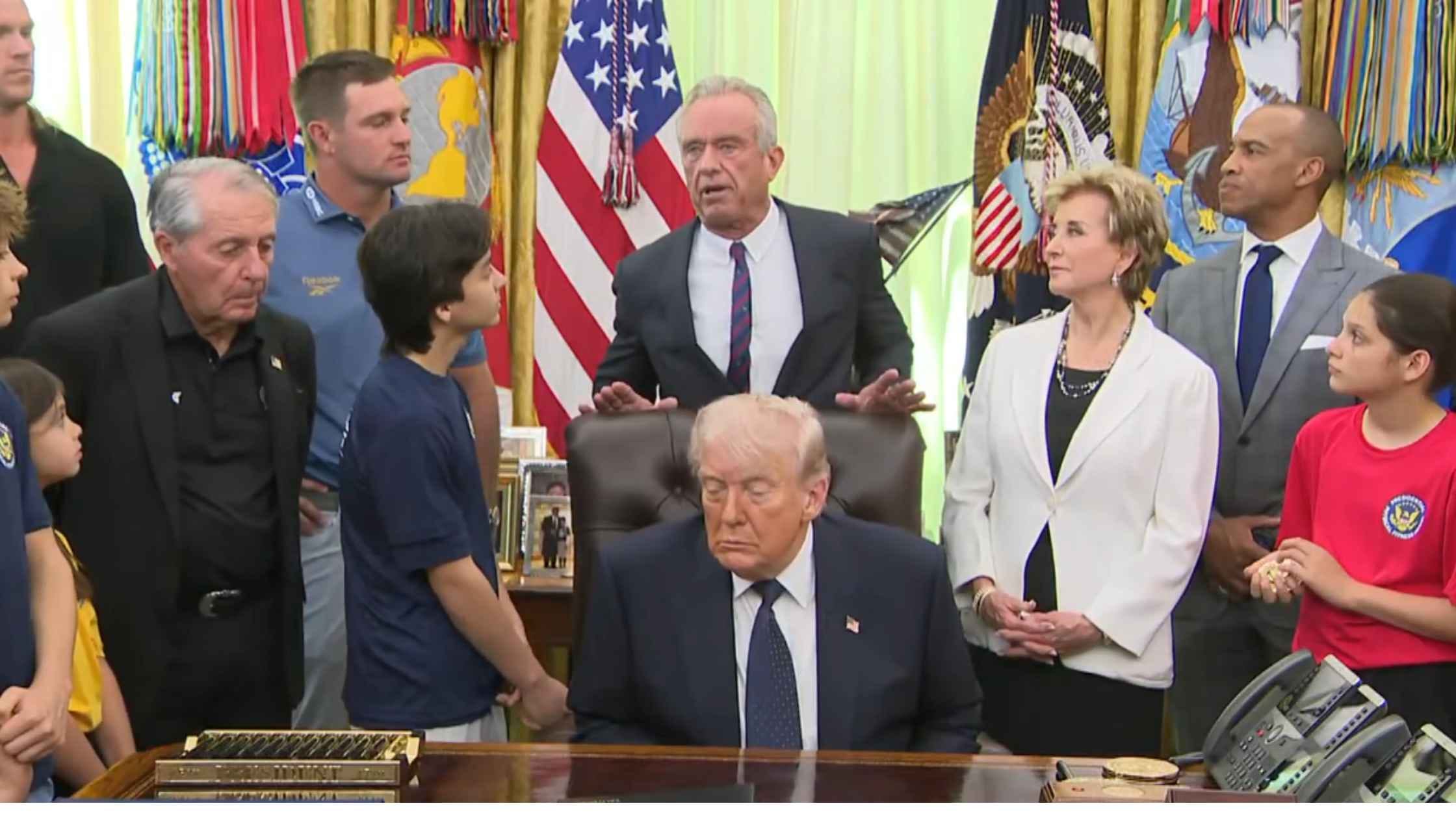
Let’s take a moment and go back to that extraordinary day that Elon Musk was permitted to take his young son into the Oval Office and conduct what amounted to a carnival sideshow for the assembled White House press. Musk wore a black MAGA hat and danced around for nearly an hour while his son played on the carpet and picked his nose leaning on the edge of the Resolute Desk, as Donald Trump just…sat…there…with…a…blank…look…and…said… nothing.

What the fuck was that? We know Musk is the world’s richest man. We know that at that time he was running the disastrous DOGE operation that defenestrated the federal government all in the name of saving money that was never saved. We know that the government is having to rehire half the people who were fired by DOGE. We know that the whole thing was a gigantic sham, months of chaos that the government is still recovering from.

Who the hell ordered that? Did Trump allow Musk to take over the Oval Office because Musk had given him so much money, hundreds of millions of dollars, when he was running for the presidency in 2024? Why was all this treated as if it was normal, just another day in the government of the United States, another day at the White House? Why, multi-billionaires show up at the Oval Office and are allowed to run amok all the time, Lucian! Didn’t you know that?

Who has so much power over Donald Trump that he would allow such a thing to occur in his own office and by the look on his face, humiliate him no end? Who has so much power over Donald Trump that he would order the U.S. military into a war for a week and then call the leader of an enemy nation and appear to change his mind about the war he ordered?

Why are all these things being treated as if they are normal?

Does anything matter anymore?

The information we have about what is going on with our own country is valueless because there are no consequences for anything that has happened since Donald Trump took office. Trump opened his mouth at his press conference yesterday and he may as well have been screaming into a huge sucking void, for all that it mattered to the American mainstream media. Hell, we don’t even have a reasonable facsimile of a “media” at the Pentagon anymore, because Pete Hegseth fired the reporters who covered his department when they would not sign loyalty oaths. Hegseth oversaw the U.S. military going to war against Iran with no one looking over his shoulder but a bunch of right-wing podcasters that include an avowed white supremacist Nazi and several alleged “reporters” who do pretty much nothing but spread rumors about the killing of Charlie Kirk. And by the way, Trump just appointed Kirk’s widow to the Board of Governors of the Air Force Academy to carry out Kirk’s “legacy,” whatever the hell that was.

Here is the sum total of what we know about the man who is spending one billion dollars a day of our taxes on a war that we have no idea whatsoever why we’re fighting, for whom, and when it will be over, and what will happen next.

We know that Donald Trump does not get up in the morning and put on his socks and shoes and suit and shirt and tie unless he is going to get paid. We know that he has no friends. We know that he trusts no one. We know that doctors are shooting him full of some sort of drug cocktail through an IV port in one or both of his hands. We know that he spends hundreds of millions of our tax dollars so he can fly away to his own courses and play golf any time he wants to.

We know that someone is running him, but we do not know who that is, and we will still will not know even if Trump himself tells us, because we cannot believe a word he says.

We are living fully and completely in the twilight zone of Donald Trump, and we do not know when it will end, and if it does end, we do not know what happens next.

My Substack column is not part of the mainstream media. No one pays me a salary. I have no donations from millionaires or billionaires. I am completely independent, and I depend on your support to keep this column going. Please consider helping my efforts by becoming a paid subscriber. We are in this struggle for reality together.

Leave a comment

Share

Give a gift subscription

Read the whole story
DGA51
1 day ago
reply
Central Pennsyltucky
Share this story
Delete

Three Problems of Big Standardized Testing

1 Comment

Of all the various Great Ideas launched at education in the past couple of decades, none have done more damage than the Big Standardized Test, a practice that has been in place now for a generation. So on top of the other harms done by test-driven accountability, the cherry on top is that a whole crop of newbie teachers has emerged thinking that test-centric schooling is natural and normal and how the U.S. education system has always worked. Meanwhile, we are just about to enter the season in which school staffs start creating cutesy videos and holding noisy pep rallies in an attempt to convince these tests are Important and students should Do Their Best. Yuck. 

The BS Tests have been a source of toxic waste in schools for years and years, and they have created this toxic effect in three distinct ways.

High stakes for a narrow measure

A single test is used as a broad measure of educational achievement. It claims to measures reading and math and nothing else, and yet it is repeatedly used as a measure of educational quality, students achievement, and teacher/school effectiveness. States have used BS Test results to label schools as "failing" which can have consequences ranging from a loss of funding to charterization to plain old reputational damage. 

Attaching high stakes to the test has led to a twisting and warping of curriculum, with course content and even courses themselves judged by just one metric-- is it on the Test? Science, history, the arts, even recess cut from schools so that extra work can be put into getting studennts to raise those scores, because the BS Test turns schools upside down. The school doesn't exist to serve students by giving them an education; students exist to serve the school by generating test scores. The upside down school effect is particularly notable in manuy charter schools, where the scores are an important marketing tool and so students who don't help make good numbers have to be "counseled out."

Meanwhile, test scores make an easy reference point for journalists, especially when combined with such prestidigidatation as "days/months/years of learning" which is just a fun mask to slap on the increase or decrease in test scores. Or soaking test scores in VAM sauce to make them seem as if they Really Mean Something. Or the transformation of scores into a kind of stock market, rising and falling as if they are waves of data flowing through a single medium, rather than representing the scores of different students.

But, hey. If the scores represent real measures of reading and math skills, isn't all of this justfied? Isn't it?

Lousy tests

Have the Big Standardized Tests been checked for validity and reliability? Do they measure what they purport to measure? Will they produce consistent results (iow, if the same student takes the test multiple times, will he get pretty much the same score every time)? 

The most likely answer is "Nobody knows for sure, but probably not." 

Multiple choice questions are about the weakest measure of knowledge and skill we have. But written answers create an assessment challenge that is almost insurmountable at that scale (and certainly insurmountable by any bots currently available). Also, a test needs to be created for a particular purpose, while the BS Tests are sold as being useful for multiple purposes. "We will sell you," say testing companies, "a piece of string that can be used to measure the circumference of a cloud and the amount of water in a swimming pool."

If we start with the number of skills that the BS Test claims to measure and multiply it by the number of items that it would probably take to measure those skills, we arrive at a test much larger than the actual tests. 

All of this gives us ample reason to suspect that the BS Tests are less-than-awesome assessment tools, suspicions that might be quelled by extensive test testing to show validity and reliability. Except that there doesn't seem to be any such test testing out there. Meanwhile, folks keep arguing that if teachers just teach the standards, the test results will take care of themselves, despite the fact that test results vary wildly from year to year for the same teacher.

But, hey. It generates some data, and even that sketchy data should be useful for something. Shouldn't it?

Tortured data

When a classroom teacher uses an assessment to evaluate learning and instruction, she can dig down to a granular level. Go question by question, checking student responses against the test items to see exactly where students are going wrong (or right). 

But the BS Tests are black boxes. Policy makers have accepted the notion that a test manufacturer's proprietary material is more important than useful data for schools, so teachers are forbidden to so much as look at the questions on the test, and the results that come back to schools (in too many cases, still after too many months) are rough summaries. For years, my results for student on the BS Test were broken down into "reading fiction" and "reading nonfiction," and that was it. 

Imagine you are a parent whose child brought home a C on a major reading test, and the teacher wouldn't let you see the test and wouldn't tell you what areas your child needed help with and what areas were your child's strength. In response to the question, "What can we do to help him," the teacher replied, "Just, you know, work on his reading." That is where teachers are with BS Test results. 

This tiny sliver of data is one of the reasons that schools take to carpet-bombing students with a host of broad, unfocused "interventions." It's also why we've seen the booming cottage industry of pre-test testing, with schools giving multiple tests throughout the year in an attempt to identify students who can be dragged to a higher score and to identify the areas in which interventions for these students might help. The actual BS Test doesn't give us the information we need, so maybe a few rounds of NWEA MAP testing will tell us what the BS Test won't (spoiler alert: it won't, in part because it's hard to predict how students will do on a test that isn't very reliable or valid).

So very little useful data gets back to teachers and schools. It is almost as if policy makers are only interested in generating pass-fail labels for schools and not in providing data that would actually help improve performance.

Solutions?

Policy makers could fix any one of these three factors. They could reduce the stakes attached to the BS Test, or combine test results with other measures of education. They could simply require the tests to be better, and they could certainly require test manufacturers to provide more useful data in a more timely fashion. In fact, in some states, policy makers have taken some baby steps. But it's not nearly enough.

Underneath all of this, there are philosophical questions to be answered, like how does one distinguish between good schools and bad, can you measure the difference, and if you can, is there any benefit to trying to slap "good" and "bad" labels on schools or teachers. But I don't recommend holding your breath while waiting for policy makers to have serious philosophical conversations about education in this country.

But in the meantime, high-stakes large-scale standardized testing continues to be one of the single most destructive factors in U.S. education. If you handed me a magic wand, it is the very first thing I would disappear. Barring that, it would be great if we could just do better.

Read the whole story
DGA51
1 day ago
reply
People who do well on Standardized tests continue to do well on Standardized tests. PSAT, SAT, GRE, LSAT, etc.
Central Pennsyltucky
Share this story
Delete

When Fiscal and Monetary Policy Row Together–and Not

1 Comment

There are times when the direction for fiscal and monetary policy is obvious. During the Great Recession in 2007-09, it was clear to most that the Federal Reserve should be reducing interest rates and the federal government should be running larger budget deficits, to counter the effects of the recession. Perhaps this seems obvious? But during the Great Depression in 1932, the federal government reacted to lost tax revenue from higher unemployment with a large tax increase. A year earlier in 1931, the Federal Reserve has raised interest rates out of desire to maintain the gold standard (that is, to keep the same value between US dollars and gold). Fiscal and monetary policy in the early 1930s were rowing together, but in the wrong direction.

Christina D. Romer discusses these and other episodes in “Rowing Together:
Lessons on Policy Coordination from American History
” (Hutchins Center Working Paper #105, February 2026). She writes:

It is not enough for monetary and fiscal policy to be well coordinated. They also need to be moving toward the appropriate goal. To put it another way: Rowing together is great when the boat is headed in the right direction; it can be a disaster when the boat is headed in the wrong direction. Coordinated policy was a godsend in 2009; it was a tragedy in 1931. A corollary to this fundamental point is that sometimes rowing in opposite directions can be preferable. At least then, the boat stays where it is rather than move in the wrong direction. If monetary or fiscal policy is going astray, it is vitally important that the other tool of macropolicy be uncoordinated.

The current policy issue is that the federal government is running an expansionary fiscal policy with large budget deficits, and President Trump would like the Federal Reserve to run a more expansionary monetary policy as well with dramatic interest rate cuts. But as Romer points out in her review of historical examples, the US economy has some precedents here worth considering.

First, in the late 1960s and early 1970s, fiscal and monetary policy were coordinated on a substantial stimulus. There was a big tax cut in 1964, then spending increases related to the Vietnam War and social programs (“guns and butter,” it is sometimes called), followed by more tax cuts and spending increased when President Nixon assumed office. Meanwhile, the Federal Reserve was cutting interest rates. The new head of the Federal Reserve under Nixon, Arthur Burns, viewed himself as a political ally for Nixon and cut interest rates further in 1971 to stimulate the economy in the lead-up to the 1972 election.

A prevailing economic theory of that time held that stimulating the economy in this way could lead to faster growth and only modest inflation. That theory went badly off the tracks by the mid-1970s as inflation and recession combined in what was called “stagflation.”

A second example, from the late 1970s and into the early 1970s, was that the federal government kept running large budget deficits, in part in response to the deep recession of 1974-75 and the double-dip recessions from 1980-1982. However, the Federal Reserve under Paul Volcker did not coordinate with an expansionary monetary policy, and instead raised interest rates by six percentage points (!), and kept the rates that high for two years until inflation came down.

A third example, from the mid-1990s was that tax increases and minimal spending increases early in the Clinton administration, combined with the “dot-com” economic boom of the 1990s, led not only to lower budget deficits but to actual budget surpluses for a couple of years. During this time, the Federal Reserve did not raise interest rates, thus keeping a monetary stimuls in place. The overall result of this 1990s policy–contractionary fiscal policy and expansionary monetary policy–was that the US economy managed to dramatically reduce its budget deficits while continuing to grow.

These kinds of examples are what economists have in mind as they consider the current mix of fiscal and monetary policy. Here’s a figure showing the inflation rate on which the Federal Reserve focuses: core PCE inflation. “Core” means that price changes in food and energy are not included, because these fluctuate a lot, and the Fed is trying to focus on longer-term inflationary momentum. PCE refers to “personal consumption expenditures” index, which included more of consumer spending, and using a more flexible formula to allow for substitution between goods, than does the better-known Consumer Price Index measure of inflation.

Inflation spiked during pandemic, under pressure from coordinated strong expansions of fiscal and monetary policy, along with supply chain disruptions. Although core PCE inflation has come down since then, it’s still not yet down to pre-pandemic levels. In this situation, the Federal Reserve is going to be hesitant to cut interest rates dramatically. Among central bankers, the remembrance of what happened when Arthur Burns cut rates in the early 1970s and inflation took off remains crystal-clear.

As best I can tell, the strong preference for the Federal Reserve would be to re-run the 1990s, in which the government made a substantial effort to reduce budget deficits, and the Fed could then make sure that economic growth remained solid by counterbalancing the tighter fiscal policy with looser monetary policy. However, the Fed was also been gritting its teeth back around 2022 for a possible repeat of the early 1980s, when the central bank might need to fight inflation all by itself with a large jump in interest rates. Inflation has come down enough that a large jump no longer seems needed, but remains high enough that a large interest rate cut doesn’t make sense either. The lesson from the early 1970s about not letting a president prod a central bank into interest rate cuts for his own political purposes remains clear-cut, as well.

The post When Fiscal and Monetary Policy Row Together–and Not first appeared on Conversable Economist.

Read the whole story
DGA51
1 day ago
reply
The current administration is not likely to reduce deficits.
Central Pennsyltucky
Share this story
Delete
Next Page of Stories