Log in


 Despite Tougher Standards, Marine Corps Data Show More Than 9 in 10 Women in Combat Arms Are Passing the Test
When Defense Secretary Pete Hegseth summoned hundreds of generals and admirals from around the world to Quantico, Virginia, last September, he delivered a blunt message: Things were changing fast in the newly renamed Department of War.
“No more division, distraction, or gender delusions,” he said. “We are done with that shit.”
What mattered going forward, Hegseth said, were standards.
“I don’t want my son serving alongside troops who are out of shape or in combat [units] with females who can’t meet the same combat arms physical standards as men,” he said.
The same day, Hegseth signed a directive requiring sex-neutral fitness standards for all troops in combat roles. The service began implementing the new standards earlier this year.
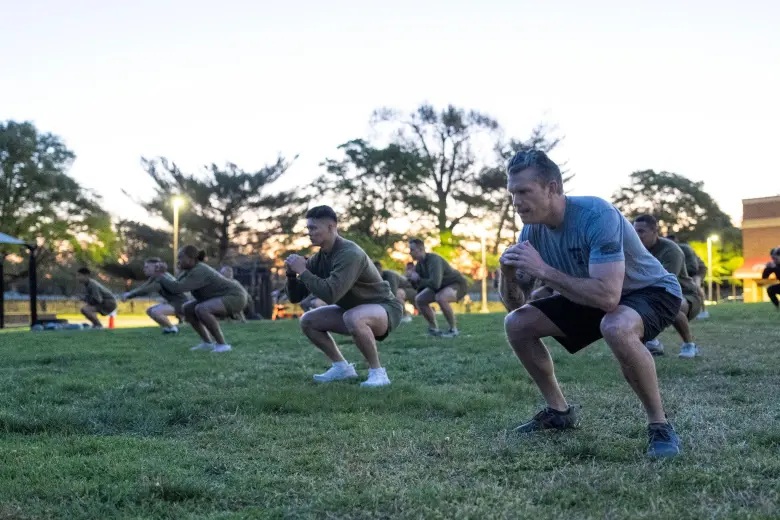
Marines take two fitness tests annually: a physical fitness test in the spring and a combat fitness test in the fall. In January, the Marine Corps began sex-neutral grading for combat Marines on the annual physical fitness test, which consists of a 3-mile run, a choice between pushups or pullups, and an abdominal plank. Since January, Marines in combat specialties have been required to score at least 210 out of 300 points.
The Marine Corps spring physical fitness test data obtained by The War Horse shows that more than 90% of female Marines who have taken the test have met or exceeded the standard.
Kris Fuhr, co-founder of the Women in the Service Coalition, which advocates for equal opportunities for military women, said she was not surprised.
“The women prepare and they train and they’re ready,” she said.
Women serving in combat specialties have always been required to meet the same job-specific standards as men, based on the physical demands of their chosen field, such as infantry or artillery. But the broader physical fitness tests taken by all service members once or twice a year serve a different purpose: measuring overall fitness. Those tests have historically been scored using age- and sex-based standards.
While Hegseth has argued that scoring women against a male standard will preserve the level of fitness required for combat, the new policy still allows standards to vary by age, with benchmarks declining for older service members.
According to the Marine Corps, 422 women currently serve in combat specialties, 400 of whom have taken the test under the new scoring standard. Experts caution that those results cannot predict how women in combat roles across the military will fare, given the small sample size.
“Women are a small part of the Marine Corps. Women are a smaller part of combat arms within the Marine Corps,” said Kyleanne Hunter, a Marine veteran who leads Iraq and Afghanistan Veterans of America. “Making generalizable conclusions from this is very, very difficult.”
But, she added, “It still tells the story that the vast, vast majority of the women who are in this career field are doing just fine.”
The War Horse has requested similar data from the Army but has not yet received it.
Hundreds of Women Have Served in Combat Roles
When the Pentagon moved to open all combat jobs to women, the Marine Corps resisted, seeking an exemption based on a study that service leaders said showed gender-integrated units performed worse than all-male units. Critics argued the study was flawed, and the secretary of the Navy denied the request.
Over the past decade, hundreds of women have gone on to serve in Marine Corps combat roles. Thousands more have served in Army infantry units, and a few have even completed the grueling process to serve in special operations roles.
Hegseth, however, has repeatedly questioned whether women in combat positions are being held to sufficiently rigorous standards. Within months of his confirmation, he ordered a review of combat arms standards before he directed the services to adopt sex-neutral fitness standards for troops in combat roles. The Pentagon has also launched a new review of women in combat, tapping the researcher who led the earlier Marine Corps study to lead the evaluation.
“I think his mandate is based on the belief that women can’t meet men’s fitness standards within combat arms,” Fuhr said.
The early Marine Corps data suggests otherwise.
According to Marine Corps data, 91.38% of women and 96.53% of men in combat arms who have taken the test since January have met or exceeded that threshold.
Hunter said that while the results are encouraging for women serving in combat roles, she cautioned that the new scoring system could still have negative implications for women.
“It can create unnecessary promotion problems,” she said.
A female Marine who might have earned a perfect 300 under the previous female scoring scale now receives roughly 240 points for the same performance under the male scale—comfortably passing the new requirement, but with a substantially lower score, which could impact performance evaluations.
Fuhr said she expects women to adapt.
“If you tell a woman what the standard is, she will do the work to not only meet it, but often exceed it,” she said.
This article from The War Horse was edited by Paul Szoldra, fact-checked by Jess Rohan, and copy-edited by Mitchell Hansen-Dewar.
This article was originally published by The War Horse on September 15, 2026.
“FREEDOM OF THE PRESS IS NOT JUST IMPORTANT TO DEMOCRACY, IT IS DEMOCRACY.” – Walter Cronkite. CLICK HERE to donate in support of our free and independent voice.
The post Hegseth Made the Fitness Test Harder for Women in Combat Roles. Most Female Marines Are Passing appeared first on DCReport.org.