Log in


Trump just keeps escalating. There were more attacks by the U.S. on Iranian tankers today, one off Kharg Island and the others in the Gulf of Oman, according to news reports. The Pentagon said the attacks came after Iran had attempted to hit two U.S. Naval vessels near the Strait of Hormuz.
Late today, Iran said it had launched “a heavy missile strike” at a U.S. base in Jordan and had fired on two more U.S. destroyers, according to the New York Times. Iran also warned oil tankers near Kuwait and Bahrain to disembark their crews, saying they would be targeted in retaliation for U.S. strikes on Iranian oil tankers.
This is, of course, pure and simple insanity. It costs the United States tens of millions of dollars a day to maintain our naval presence outside the Strait of Hormuz and elsewhere in the area of the Middle East. Every time we shoot a missile at an Iranian tanker, that missile has to be replaced. The replacement missile must come from munitions stocks in the U.S., because we don’t maintain stockpiles of offensive or defensive missiles in the area of the Strait of Hormuz.
The same is not true of Iran. They can shoot missiles at our ground forces in Jordan – they are the only U.S. forces left in the Middle East – and they can do it all day, every day, because their missile stocks are right there in Iran. They also manufacture their missiles in Iran, in underground facilities that were not destroyed when the U.S. and Israel started our war with Iran in February.
The war between the U.S. and Iran is now official again, since Trump used the word “war” over the weekend. It has devolved into a very old sort of war, one in which the U.S. fires missiles from ships in the region, and Iran shoots back at our ships from missile installations dug into mountains along Iran’s coast on the Strait of Hormuz.
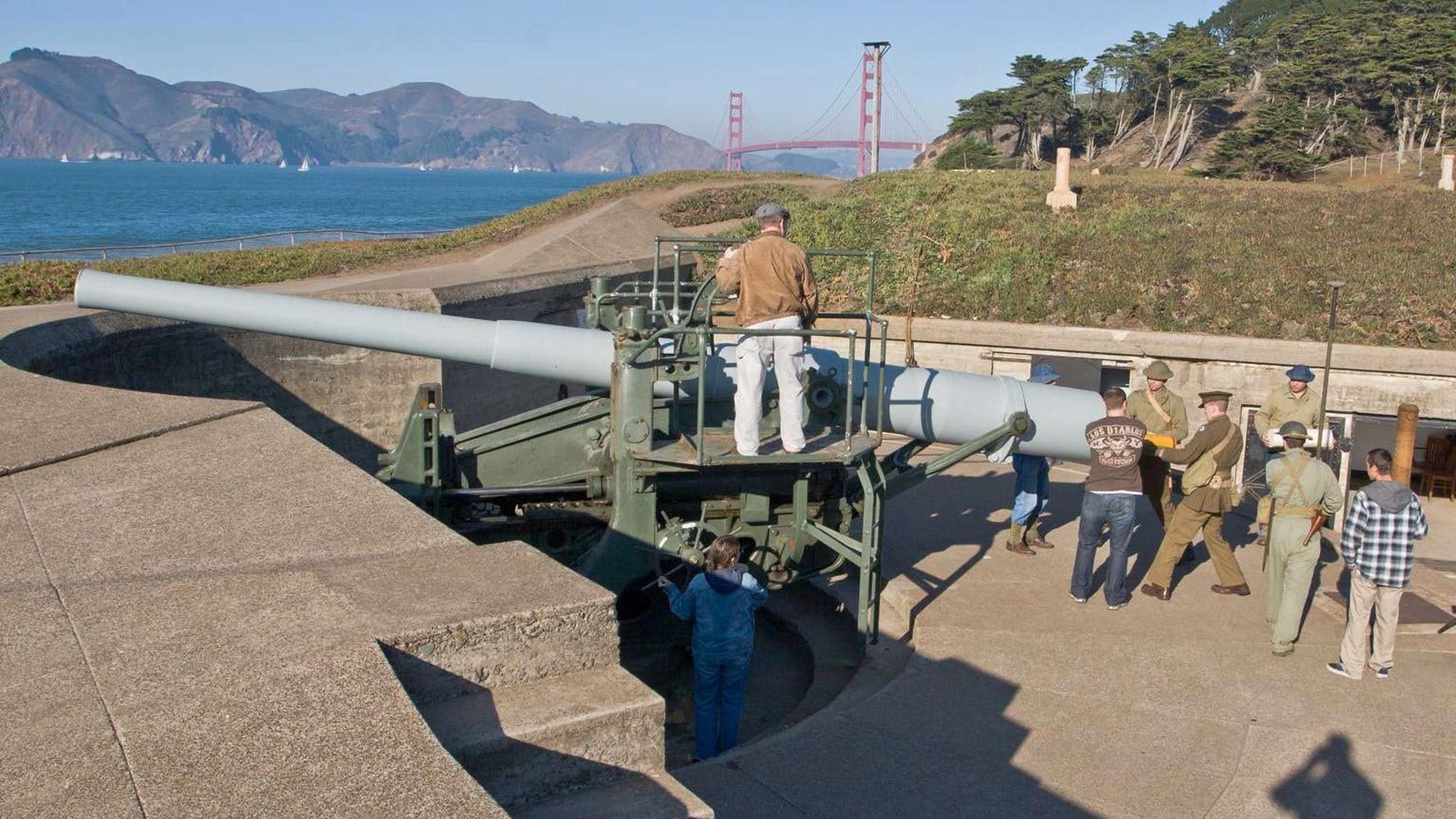
In past wars, these were called coastal batteries – reinforced concrete bunkers where coastal artillery pieces were installed to shoot at the ships of invaders. We had coastal batteries along the Eastern seaboard, the Gulf of Mexico, and the West Coast. You can still see some of the old coastal batteries at the Presidio in San Francisco, and across the Golden Gate bridge in the coastal highlands of Marin County. Out in Montauk on Long Island, you can visit old World War I and II coastal defense batteries. You can visit others along the Gulf Coast at Battery Pensacola and Battery Worth at Fort Pickens. In the northwest, there are old coastal battery fortifications at Fort Flagler and Fort Worden guarding the entrance to Puget Sound. Even West Point was the site of batteries that defended the Hudson River from naval invasion by the British during the Revolutionary War.
In Europe, entrenched concrete Nazi coastal defense batteries can still be visited at Normandy and elsewhere along the continent’s coast in Denmark, the Netherlands, and Norway.
So, not much has changed, has it? The Iranians have their missiles dug in along their coast, defending their country, missiles being the modern equivalent of the artillery used in World War II and earlier wars. Our naval vessels no longer have the big 16-inch guns that fired 2,000-pound warheads from battleships. Modern destroyers have offensive weapons such as Tomahawk cruise missiles, and aircraft carriers launch combat jets carrying guided missiles and highly-accurate guided bombs such as the JADAM and Paveway series of bombs that use GPS and laser systems to guide the bombs to their targets.
All these modern weapons cost millions and millions of dollars and are called “standoff” munitions, meaning they can be fired at targets a great distance away, either from the ground or from jet aircraft or from ships. That’s what the war is in Iran right now – a standoff war. We fire at Iran’s tankers from the relative safety of our ships in the Gulf of Oman or the Indian Ocean, and Iran fires at our ships or ground installations in Jordan from the relative safety of heavily reinforced coastal missile batteries along their coast on the Persian Gulf, or to the south, Iran’s coast on the Gulf of Oman.
The U.S. is said to still have as many as 50,000 ground troops in the region. Many of them used to be stationed in Kuwait and Bahrain and Oman and other Gulf states friendly to the U.S., but Iran has driven our ground forces out of the Gulf to a few installations that we maintain further away in Jordan. The extra distance doesn’t matter to Iran, however. Iran has developed new ballistic missiles with “electro-optical seekers,” according to the Wall Street Journal. The new missiles are better able to hit moving targets such as U.S. warships, because the missiles can maneuver from the normal parabolic path of ballistic missiles. Iran also has missiles and drones that can maneuver at the last minute as they near their targets, making them more difficult to shoot down with Patriot anti-missile missiles, or anti-drone weapons that are radar guided.
So, the U.S. is back on its heels, having to resupply ships in the area of the Persian Gulf from a borrowed British base on Diego Garcia, an island in the Indian Ocean more than 2,000 miles away from our forces near the Strait of Hormuz. And who knows where are the 50,000 ground troops we are supposed to have “in the region,” as reports have it. Some are no doubt in Jordan. Some may be on Diego Garcia. Some Marines are aboard Navy vessels afloat near the Strait of Hormuz.
The question is, what are the 50,000 U.S. troops even doing there? They are not going to be used in ground combat. All they’re doing is costing even more hundreds of millions of dollars to keep them there for no apparent reason. We’re fighting Trump’s kind of war – an incredibly stupid tit-for-tat show-war that he thinks makes us look tough, while all we’re doing is shooting at Iranian tankers so Iran can shoot back at our navy ships and at whatever military targets are still located in the Arab states across the Persian Gulf and in Jordan. What sense does that make? Precisely none militarily, and none economically, as high gas prices and prices for everything proves beyond a shadow of a doubt. Meanwhile, Trump has started yet another trade war that is also costing consumers and taxpayers more money.
Trump’s war with Iran will go nowhere that is advantageous to the United States. We haven’t got enough missiles to take out all the Iranian missile batteries along the Strait of Hormuz, of which there are likely hundreds. Iran knows this. If Trump thinks he’s fighting a war of attrition, and will wear Iran down, he is grossly mistaken. The attrition is on the other foot. Iran is reducing our weapons stockpiles, both offensive and defensive, day by day, one attack at a time.
Trump and the idiots he put in place to run his war, mainly the idiot who is obsessed with our soldiers’ testosterone levels, Pete “I’ve got a big one too” Hegseth, have no clue about how to fight an enemy such as Iran, which has been defending itself against invaders for several thousand years. Trump keeps saying, “We hit them very hard.” What the hell does that mean? He doesn’t know. He wouldn’t know a hard hit from a peck on the cheek, he is so ignorant about the military and how to fight a war.
It is embarrassing when a country with an economy that is a small fraction of that of the United States is holding its own against “the most powerful military in the world” as Trump and his minions put it. The way to end this war is to start the engines and go home. Donald Trump can’t give that order, because it will make him look like a “loser.” For Hegseth, he’ll look like he’s got “low-T.” How horrible for him.
All the hired Pentagon influencers and right-wing pundits in the world aren’t going to dig these two stooges out of the mess they’ve got themselves into.