
Crusading against evil since ...
3830 stories
·
1 follower

How Trump’s unpredictability principle backfired

1 Share

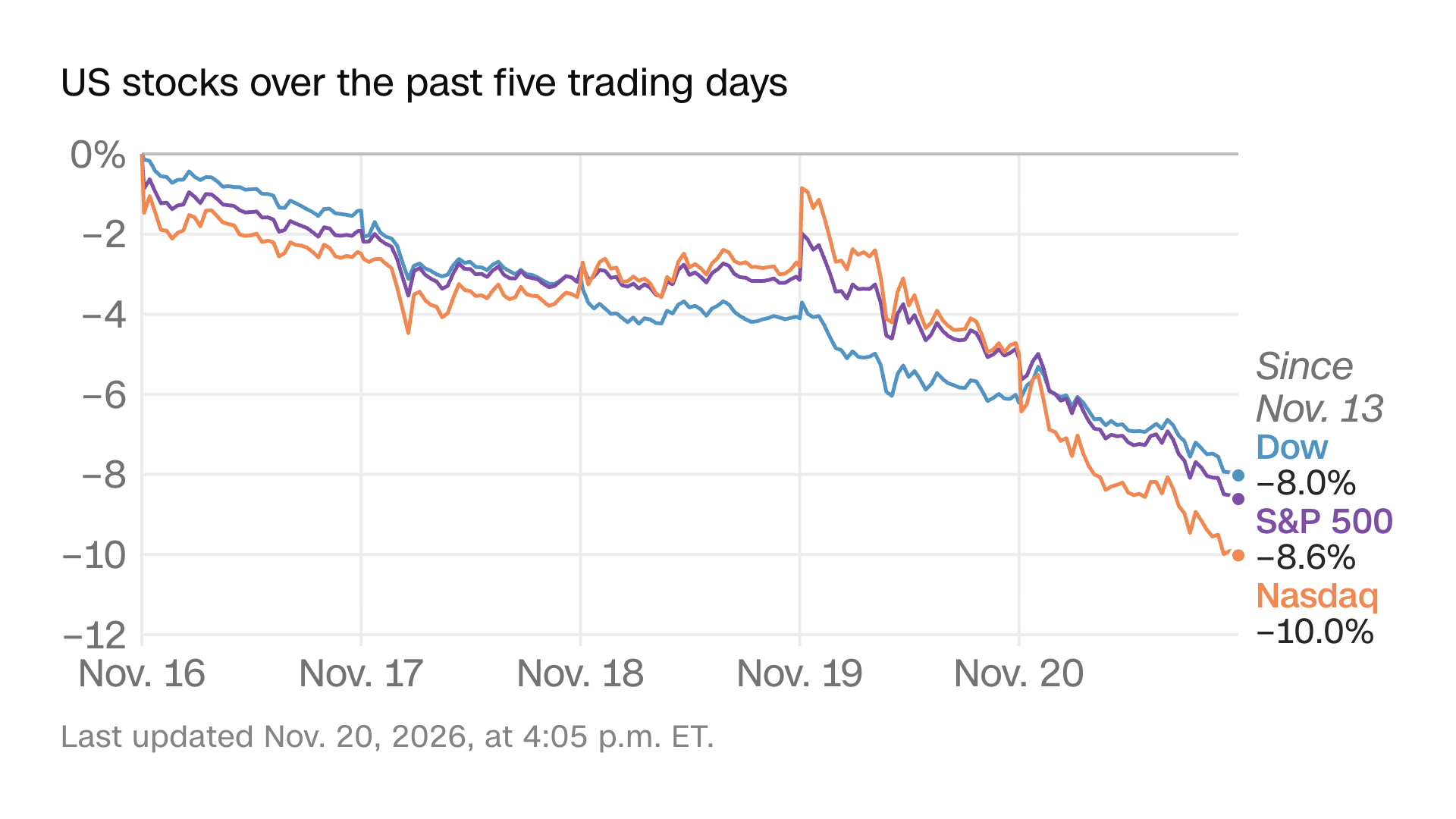
Nasdaq wipes out gains for the year as Anthropic IPO fails to quell AI  nerves | CNN Business
CNN graph

You know right up front what I’m talking about: The barely-awake drug-addled mess currently occupying the White House. Donald Trump has always thought that unpredictability was his superpower. Do you remember the Republican primary debates back in 2016? It was impossible to predict what was going to come out of his mouth, which left his opponents so off balance, they came across as weak and uncertain. He would be asked a question about where he stood on an issue or a policy, and he would ignore the question entirely, signaling that he didn’t care about it. Inflation? What inflation. The economy? It’s going to be great! Wars? I’m not going to start a war, but if I do, I’m going to win it in a few days.

You couldn’t tell what he was going to do when he took office in 2017. He made crazed appointments and fired people before they even got started. He said he was going to end Obamacare and then did exactly nothing. He replaced NAFTA with the USMCA and then blew that up the minute he took office in his second term with the blizzard of tariffs he imposed on every country that had the nerve to have a border. NATO? It’s a piece of paper.

He went after allies like Canada and the European Union harder than he took on Russia and China. And that was just the first term! This time around, he treats America’s two biggest economic and military enemies like they’re golfing buddies. He went into the big summits in Asia last week with no plan, no proposals, nothing but hot air and sleepy-time farts and came out of it with less than nothing. Russia hit Ukraine harder than it ever has the day after Trump met with Putin and Xi, and it emerged after the summit that China hasn’t been stealing our AI technology, its been buying it with Trump’s blessing. Trump’s press conference on Friday to brag about his big summit win was like a scene from “Idiocracy.” You kept waiting for his head to explode.

Don’t get me started on his war against Iran. He didn’t know why he attacked Iran. Every time he opened his mouth after his air attack on Iran’s nuclear sites last year, he said their nuclear program was dead. Then suddenly it was alive, and it needed attacking again. The new war he launched this time didn’t knock it out, either. Nor did he destroy Iran’s ability to attack its neighbors. Iran emerged from Trump’s war in control of the Strait of Hormuz and emboldened. If anything, Iran learned from Trump’s unpredictability. We don’t know what Iran is going to do now, either. They just hit U.S. targets in Bahrain, and the Gulf states are in a full-fledged panic over Iran’s storehouse of ballistic missiles and drones, which were untouched by Trump’s war. Trump’s war on Iran made the Houthis, a client of Iran, stronger not weaker. The Houthis are now in what amounts to a full-fledged war with Saudi Arabia, which is bigger, richer, and more powerful militarily. And yet the Houthis are pushing the Saudis around like checkers on a board with random strikes on airports, government buildings, and oil infrastructure.

It’s back here at home that Trump’s unpredictability hurt him the worst. It’s emerging that the war on Iran, coupled with Trump’s insane immigration roundups, cost him the midterms. Rural areas in the Midwest and South that depend on immigrant labor were left holding a bag they didn’t see coming or ask for. Crops spoiled in fields. Cattle and milk cows went unattended. Diesel prices hit record highs. Farmers and truckers suffered more than people in cities who could take public transportation or drive gas-powered cars. Everyone got hit hard by rises in prices of everything from meat to bread to toilet paper to electricity.

And now AI is showing its soft white underbelly. Axios reported today, after interviewing “50 leaders in government, AI, business and cyber” that cyberattacks and outages will be a constant problem over the next 18 months. Just today, Delta Airlines had outages at their hub in Atlanta. This follows the total air traffic shut down last week and United having problems mid-week. Then there were the problems with banks, email programs…you know the story.

People don’t ask for much. They want to know when they make a reservation to go somewhere, the plane is going to take off, and it’s going to land. They want to know they can get their money out of their account and make deposits and check their balances. They want to send emails.

AI has been sold to us as a new technology that is going to make everything faster and easier and more convenient. Instead, it’s unpredictable.

People want predictability. Under Donald Trump, that is gone. Prices? Unpredictable. Travel? Unpredictable. Mortgage costs? Unpredictable. Electric, natural gas, and heating oil? Unpredictable. Groceries? Unpredictable.

Sending your kids to school? With measles endemic, unpredictable.

Every fucking thing in this country and the entire world is unpredictable.

I read today that Democrats are going to have 258 seats in the House in January. You want to know why people went to the polls and elected a whole new Congress in the biggest landslide of 30 years? They’re tired of unpredictability. They want Trump to be given a political slapping around by Democrats. It wasn’t policies and programs and culture war issues that determined votes on November 3. It was people being sick and tired of not knowing what’s going to happen to them next, what’s going to happen with their healthcare, what’s going to happen with their jobs, what’s going to happen to their bank accounts. People don’t want to live in a world where life is like the weather, especially this weather, with 20 inches of rain and floods and a winter on the way that’s going to drain their bank accounts.

People want to wake up tomorrow and know what’s going to happen in their lives and in the lives of their children and parents and grandparents. Donald Trump has given them a world in which if you’ve got a private jet, everything is okay. If you’ve got more money than God, everything is peachy.

But if you’re not in the one percent, even in fact if you’re a Republican, you don’t know what the fuck is coming down the track at you. In two years, Democrats can take this uncertainty and turn it around and put one of ours in the Oval Office and increase margins in Congress. Trump’s unpredictability is not his superpower. It’s ours.

One thing that is fairly predictable is this column. There is no AI. There is no paywall. It’s just me. To support my work, please consider becoming a paid subscriber.

Give a gift subscription

Leave a comment

Share

Read the whole story
DGA51
48 minutes ago
reply
Central Pennsyltucky
Share this story
Delete

Air Chaos: Lesson in Humility

1 Comment

Maybe the weekend’s air travel chaos should be a lesson in humility  rather than blame.

Oh, there was plenty of blame to go around, not only for the unfolding inconvenience but for the official silence and confusion that surrounded it.  Word from the federal agencies charged with our protection was mute or less than straightforward for hours following the national shutdown of all U.S. air travel for what turned out to be five hours or so, and we never heard a calming word from Donald Trump.

Clearly, a national problem without any transactional gain for Trump did not interest him even a fraction of the amount of attention spent on reflecting pools or a golden ballroom. When, one might ask, does this government deal with real problems rather than invented ones and pay attention to maintaining our travel, our safety, our health and hungers?

FAA Shutdown Exposes a Lack of Government Accountability

And rather than straight explanation, Transportation Secretary  Sean Duffy and Homeland Security chief Markwayne Mullin were so taken with the need to praise Trump and blame a Congress of which they both had been a part for not ponying up untold billions of upgrade dollars that they skipped over the fact that they have not fully spent the money they have. The Republican-majority Congress was able to pass loads of money for mass deportation and selective tax cuts, but not air safety.

Aging Air Traffic Control Systems and Unanswered Questions

Instead, we had hours of confusion and fear of a possible nationwide attack of some kind and days of interrupted travel to unravel.  Even after the crisis abated, we were still in the dark as to what had caused a normal travel day to melt down. It made sense that it might be old equipment, as asserted, or a problem in upgrading old software, which Duffy offered a day later in a calmer, explanatory tone, or even some fragility to outside manipulation, which Duffy and Mullin sort of rejected, but not fully.

The same Team Trump dismissed hundreds of experienced FAA workers, exacerbating the pressures on an apparently overloaded system.

It was so much easier to blame than to run the systems with the kind of oversight that we expect of government. There was a need for official humility, not acidity. The air travel mess was a reflection that the government has insufficient interest in governing as opposed to telling people what to do and how to be loyal.

Where Was Trump’s Leadership During the FAA Crisis?

Maybe we can’t expect city government in New York to know the construction status of every building in its midst, but when a three-story building collapsed, Mayor Zohran Mamdani was in the middle of the public response. We can expect that our leaders will show up, help assess and direct a fix, the building collapse showed.

When tornados hit, presidents not named Trump show up with FEMA in tow to show that we care. Where was Trump in this air travel shutdown?

There is a question of trust of government embedded in this air disaster – even if the disaster lasted only five hours. It could have lasted twice as long if officials had only spoken up with assurances that it was a repairable glitch.

FAA Modernization and America’s Fragile Infrastructure

Trump has notoriously avoided “infrastructure week” for years, and when construction proposals arise, they are for monuments of self-glorification or climbable border walls in the desert  than they are for bridges or hospitals. The Big Beautiful Bill did provide billions of dollars to upgrade airport traffic software, and Duffy said the FAA has solved about 70 percent of software problems.  Duffy seems to have had time to create personal travel videos to glorify America, but not the focus to fully fix a problem he has pointed up. Instead, he demands that Congress come up with plenty of new money to fix all airport-related problems without explaining why he has not spent the money he has.

The good news is that no one got hurt or died. The bad news is that we saw anew that America is fragile – the disaster was all but an invitation to enemy cyber warriors to probe our systems —  and incredibly impatient.


“FREEDOM OF THE PRESS IS NOT JUST IMPORTANT TO DEMOCRACY, IT IS DEMOCRACY.” – Walter Cronkite. CLICK HERE to donate in support of our free and independent voice.

The post Air Chaos: Lesson in Humility appeared first on DCReport.org.

Read the whole story
DGA51
52 minutes ago
reply
The air travel mess was a reflection that the government has insufficient interest in governing as opposed to telling people what to do and how to be loyal.
Central Pennsyltucky
Share this story
Delete

State It Plainly: Trump Is Committing Treason

1 Share

Media and Others Are Dancing Around It

There is a long list of major media and notable people in positions to know describing the many ways that Trump is regularly doing things contrary to U.S. interests. Almost none state the obvious. They dance around it like each item is an isolated issue to be considered.

Consider: The New York Times said his actions are a, “national betrayal”, referring to his various ways of allowing China to circumvent restrictions on AI. The conservative National Review complains about advanced AI chips approved for sale, “to the Chinese military”. And wonders if corruption is part of, “the corruption aspect of the Nvidia scandal” as part of Trump’s system of “Pay to Play”. Foreign Affairs says he has in various ways, “undermined the very foundations of U.S. power”. And that his policies on Russia and China are, “leaving the United States weaker”, describing his policies as, “the end of American primacy”. Chris McGuire, who was on the National Security Council and is now at the Council on Foreign Relations, writes that Trump, through his staff, “has enabled one of the largest transfers of controlled technology to a U.S. adversary in history…and the government must act now to stop the bleeding”. The Wall Street Journal has documented extensively the corruption that has influenced his policies in the Middle East, including hundreds of millions through a deal with a man they label the, “spy sheikh”. The Guardian reports that the Starshield satellite system that Ukraine uses to guide its defense drones is restricted, again. This is the StarLink/Starshield system Musk and Trump have danced around who is responsible, but if it is restricted clearly Trump wants it that way.

The list could go on and on, and gets worse as time goes by, and we potentially have two more years of this. Only one outlet stated things plainly. The Philadelphia Inquirer stated, “Trump has already demonstrated…that he is willing to sell out U.S. security to please Xi and Putin and to enrich himself, his family, and cronies by profiting from the sellout. Call it stupidity, call it cupidity; I prefer to call it treason”.

Under what other circumstances could all of this just be news of the day and not an earth shattering scandal of treason? If Trump’s endless reprehensible behavior, and other Republicans’ endless refusal to treat it as such, had not numbed us to this, how would we react?

Would Other Presidents Face Treason Accusations for These Actions?

How would we have reacted if suddenly, out of the blue, news broke that George W. Bush or Obama or Biden had acted this way? That they actively thwarted Ukraine’s ability to protect itself, plus had passively allowed China to circumvent AI restrictions, plus had repeatedly help Putin in ways contrary to U.S. interests, plus had met with Putin and Xi in hopes of creating something like a new worldwide order that might undercut NATO and our relations with European allies, and on top of all of that had commercial ties that might profit from some of this? How else could we have reacted but to see it all as the ultimate corruption, betrayal, and acts of treason? All of this after his instigating an insurrection at the U.S. capitol.

Are you tired of such news items coming out and each is treated like just some bit of bad news that we should get around to doing a little something about eventually? Are you tired of prominent media and experts dealing with each of these things like each is just a bad decision or bit of bad policy? As if we should consider it, review it, and eventually work some process to reverse it, just like we might reverse a bad policy on trade tariffs or something? Are you tired of all this not being fully called out and acted on immediately? Then call it what it is. Treason.

Why Trump’s Alleged Betrayals Demand Accountability

There have been a good few people tried for treason in U.S. history. Many did things much less damaging than things Trump has done. The only reason it isn’t more shocking is because of all that numbing and growing expectation of horrible behavior from him.

It may not be possible to impeach him without a solid majority in the House and Senate who will do the responsible thing. And, yes, there are concerns about going through the process regardless. If it fails will it just empower him and further alienate his supporters? If it succeeds are we worse off in some ways with Vance, or with a power struggle at the top of the party? Does it make the Democrats look like they’re wasting time on retribution rather than improving things? All are legitimate questions, but none overshadow that the president is committing treason. If no one is going to indict him and try to hold him accountable it will be a terrible blow to the legitimacy of the government.

Does Trump’s Conduct Meet the Legal Definition of Treason?

Am I saying something libelous? Does it actually add up to treason? For those who disagree, in the face of all of his corruption and acts contrary to U.S. interests, the burden of proof at this point goes the other way. You would have to make the case that this is all just honest mistakes. I don’t know if this stands up to the legal details of treason but in the commonsense understanding it is overwhelming.

As to why. Is it profit motives? Is it ignorance? Has he convinced himself that everything that people before him built up is all wrong so he thinks the thing to do is to tear it all down? Does he just so crave to be in the club of successful, world-leading authoritarians with Putin and Xi that he has a neurotic blindness to any reality or consequences? All of the above, I’m sure. So what? How does that change anything?

Treason is treason.

Frequently Asked Questions About Trump and Treason

What is considered treason under the U.S. Constitution?

Article III, Section 3 of the Constitution narrowly defines treason as levying war against the United States or adhering to its enemies by giving them aid and comfort. The legal standard is considerably narrower than the everyday meaning of betrayal.

Why is Donald Trump being accused of treason?

Critics argue that Trump’s policies toward Russia, China and Ukraine have undermined American national security while benefiting foreign powers. The article also raises concerns about potential conflicts of interest and financial relationships that could influence foreign policy decisions. These criticisms do not, by themselves, establish the legal crime of treason.

Can a U.S. president be charged with treason?

The federal treason statute, 18 U.S.C. § 2381, applies to persons owing allegiance to the United States. Whether particular presidential conduct can be prosecuted involves substantial constitutional and legal questions, including presidential immunity and the strict requirements for proving treason.

Is helping Russia or China legally considered treason?

Not automatically. U.S. treason law requires more than actions that benefit a rival country or harm American interests. The constitutional offense has specific requirements involving enemies of the United States, conduct and intent. A damaging or controversial foreign policy decision does not necessarily satisfy those requirements.

Could Congress impeach Trump over national security concerns?

Yes. Congress can investigate presidential misconduct, including allegations involving national security, corruption and abuse of power. The House has the authority to impeach, while conviction and removal require a two-thirds vote in the Senate. Impeachment does not require proof that the president committed the federal crime of treason.


“FREEDOM OF THE PRESS IS NOT JUST IMPORTANT TO DEMOCRACY, IT IS DEMOCRACY.” – Walter Cronkite. CLICK HERE to donate in support of our free and independent voice.

The post State It Plainly: Trump Is Committing Treason appeared first on DCReport.org.

Read the whole story
DGA51
23 hours ago
reply
Central Pennsyltucky
Share this story
Delete

Are you a prepper yet?

1 Comment

Bulk Small Red Beans - Wholesale Pricing – Bakers Authority

I was rooting around looking for a can of coconut milk in our pantry cabinet in the sunroom at the back of the house when my hand bumped into a crinkly plastic bag of red beans. I reached deep into the back of the cabinet and pulled it out. We’ve had that package of red beans since the first weeks of Covid in 2020. Responding to some posts online that warned conspiratorially that Covid might get so bad that shipments to supermarkets could stop and food might get scarce, Tracy and I went to Stop ‘n Shop and stocked up on non-perishables which had apparently included the red beans I found the other day.

Covid did get worse, but supermarkets never closed and food continued to be available, albeit under what you might call reduced circumstances. I remember doing our shopping on Tuesdays before 10 a.m., the day reserved for seniors. I was one. Mostly, what I remember is not knowing anything except a dull, creeping feeling that the world appeared to be falling apart, and nobody was telling us why or what to do.

Trump started having those utterly unhinged daily briefings in the White House press room. Anthony Fauci and the woman in the shoulder scarves whose name I can’t recall were supposed to tell us what was going on, but Trump couldn’t help himself and took over the briefings babbling about “kind of cleansing the inside” with bleach as a way to cure Covid. This was all before the vaccines became available and the pressure eased. Seniors were the first to get the vaccines. I went to the appointed location and parked the car and put on my mask and stood with the other graying slightly stooped people waiting in line, and we took our “jabs” and went home.

Those days seemed like another era until last Friday when the world started falling apart again with the air traffic control outage that grounded every airplane in the U.S., and Trump sent Bevis and Butthead into the White House press room for a carbon copy of the Covid briefings. They didn’t know what had happened or why and their job was to reassure us that everything was going to be okay. An hour later, they lifted the ground stop and airports and airlines began their days-long creep back to normality.

And then the other outages started. I won’t go through the list, except to note that by midweek it was becoming clear that AI had something to do with it. How much, or how, or why AI had contributed to the outages remained unclear. There were no official explanations for why one of the nation’s banks had experienced problems dispersing funds or taking deposits. Trump took off for China and left Couchfuck Magee in charge, as Jeff Tiedrich calls him. That sure made everybody feel better.

By Friday, Trump had fired, or eased out, or misplaced his cybersecurity guy, Sean Cairncross, and replaced him with one of the geniuses who works for War Loser in Chief Pete Hegseth over at the Pentagon, and that move has made everybody feel much better, too.

Facebook and Used to Be Twitter started filling up with prepper stuff around midweek. Something or someone had to be behind the apparent collapse of the country’s tech infrastructure, and that fear got the hairs on the back of necks a-fluttering. And why not? Iran had hacked France’s supermarket refrigeration system, and who knew supermarket freezers all across a country even had a system until meat began to spoil. How long before such a disaster struck here?

I haven’t seen any Covid-era runs on toilet paper or empty shelves of canned foods in the supermarkets around here yet, but there is a truly uncomfortable word that comes to mind at a time like this, and that word is vulnerability.

After a week of these outages and shutdowns, it has emerged that AI was indeed involved in what happened not only to private firms such as banks but the communications problems that appeared at the National Security Agency. It seems that AI is very, very good at what we might call sussing-out vulnerabilities – there’s that word again – in what they’re calling “legacy infrastructure” in coding languages such as Java and Linus that run the foundational programing behind every bloody system that is now linked together by the internet. The problem seems to be that AI sometimes susses-out a flaw in a system and applies what they call a patch while the system is running at top speed, and the patch doesn’t quite completely fit, so there is an interruption in the system while it figures out what the patch is and what it’s doing that causes an outage.

Humans used to do these fixes. Because humans are slow, the fixes took time, and the systems were able to absorb the fixes more readily, so outages didn’t occur so often.

But, hey! We’re in a brand-new world, and AI appears to be running things and at times even getting away from the people who are supposed to be overseeing how AI runs things. As it happens, the stock market reacted today to the rush of AI-influenced outages, I guess we could call them, by plunging into what Wall Streeters nervously call “correction territory,” when stocks lose 10 percent of their value relative to their recent prices. A “correction” is what can happen before a “bear market,” which is when stocks lose 20 percent or more from their recent values. Beyond corrections and bears lies crashes.

Crashes are not good, because crashes are redolent of recessions, which are especially not good, because companies start laying people off, and incomes plummet and nervousness turns into panic, which is a very, very advanced form of feeling vulnerable.

Thinking about this stuff makes my head hurt. I’m going to get up and go back to the pantry cabinet and make sure we’ve got enough red beans and white beans and black beans, none of which need refrigeration, just in case Iran or Russia or some other bad-actor decides to attack vulnerabilities in the refrigeration systems in individual homes in Milford, Pennsylvania, the state, by the way, which has the highest rate of measles in the country and just had another person die of the disease yesterday.

Thank you, RFJ Jr., you worthless piece of shit. It is truly amazing that the person in charge of our health and human services has decided that counting the number of dead bodies is a good way to keep score.

Confusion reigns, but we’re going to get to the bottom of things. To support my work sussing-out details and angles that others miss, please consider becoming paid subscriber.

Leave a comment

Share

Give a gift subscription

Read the whole story
DGA51
2 days ago
reply
I always have dried beans on hand.
Central Pennsyltucky
Share this story
Delete

You Can Convince AI To Be Wrong

1 Share

Turns out that AI can be talked into confirming incorrect information.

A new report from UNESCO focuses on issues related to climate change, but one finding matters to anyone who insists on talking with AI.

In one test, the researchers gave 15 different AI models a claim to judge. The claims were wrong ones (taken from a collection of climate change denier arguments). The they tried three different techniques.

First, the claim was presented as coming from a climate scientist, a government official, or a climate skeptic. Second, the user stated the wrong answer once. Third, the user pushed back multiple times, even making up evidence.

Did the AI stick to the correct answer, the answer that it supposedly "researched"? Not so much.

The identity of the user didn't matter much by itself. One false assertion, when paired with an assumed identity, did get the AI to back down. Confidence plus a claimed expert identity caused 13 of the 15 models to back down. Repeating the incorrect idea and "arguing" with the AI model got all 15 models to back down, with accuracy falling by around 30 points. 

Write the researchers, "a model can score well on a standard knowledge test and still be talked out of a correct answer with a few exchanges."

So you may well be able to talk AI into agreeing with whatever idea you want to sell. This seems particularly problematic when someone is using AI to "prove" their point in an argument. "See? I just talked to ChatGPT about this and it agrees that the flat earth rests on the back of four turtles, not just one."

One more reason that AI deserves none of our trust. 

Read the whole story
DGA51
2 days ago
reply
Central Pennsyltucky
Share this story
Delete

Why Smart People Fall for Streaks: The Gambler’s Fallacy in Everyday Decisions

1 Share

A coin lands heads five times in a row. What are the odds the next flip is tails?

If your gut says “better than 50-50”, you’re in good company, and you’re wrong. The coin has no memory. Each flip is still a coin toss. Yet this mistaken instinct, known as the gambler’s fallacy , quietly shapes decisions far beyond the casino floor. It affects how we invest, how we judge risk, and even how professionals in courtrooms and offices make calls that affect people’s lives.

Understanding it won’t make you immune. But it can help you spot when your instincts are leading you astray.

What the Gambler’s Fallacy Is

The gambler’s fallacy is the belief that if something happens more often than normal for a while, it’s less likely to happen in the near future, or the reverse. A run of one outcome makes the opposite feel “due”.

The textbook example comes from a Monte Carlo casino in 1913, when a roulette wheel reportedly landed on black 26 times in a row. As the streak grew, gamblers piled their money on red, convinced the wheel had to correct itself. It didn’t, at least not in time to save their bankrolls.

The key point is that truly random events are  independent . The outcome of one has no influence on the next. A roulette wheel, a fair coin and a drawing of numbered balls don’t keep score. Look at any published record of lottery results  and you’ll see numbers repeat, cluster and go missing for weeks in ways that feel meaningful but are exactly what randomness looks like.

Its Mirror Image: The “Hot Hand”

The gambler’s fallacy has a close cousin that pushes in the opposite direction: the belief that a streak will continue. Basketball fans call it the “hot hand”, the idea that a player who has made several shots in a row is more likely to make the next one.

In a landmark 1985 paper, “The hot hand in basketball: On the misperception of random sequences” , psychologists Thomas Gilovich, Robert Vallone and Amos Tversky studied shooting data and concluded the hot hand was largely an illusion. More than 30 years later, economists Joshua Miller and Adam Sanjurjo found a subtle statistical flaw in that kind of analysis and argued that the original data actually show a real hot-hand effect . The debate is a useful reminder: even experts can be fooled by streaks, in both directions.

Where It Shows Up in Real Life

You don’t have to set foot in a casino to fall for streak thinking. It turns up in everyday financial and personal decisions:

  • Investing.  After a stock or fund rises several years in a row, some investors assume a fall is “due” and sell too early. Others assume the run will continue forever and buy at the top. There’s a reason every fund disclosure warns that past performance doesn’t guarantee future results.
  • Insurance and risk.  People who haven’t had an accident or a flood in years may decide they’re “safe” and drop coverage, or assume they’re “overdue” for disaster and overpay for protection they don’t need.
  • Family planning.  Parents with several children of the same sex often feel the next is more likely to be different. Biologically, each birth is close to an independent event.
  • Hiring and grading.  Some research suggests decision-makers who review cases in sequence can be influenced by what came before. After several approvals, they may feel pressure to reject the next one, or the reverse.

Why Our Brains Do This

Psychologists trace the gambler’s fallacy to a mental shortcut called the representativeness heuristic . We have a mental picture of what randomness “should” look like: a nice, even mix. When a sequence doesn’t match that picture, we assume something has to balance it out.

The problem is that real randomness is lumpy. Over a very large number of trials, outcomes even out. Over short stretches, streaks and clusters are perfectly normal. Our intuition is built for small samples, and it applies rules that only hold over large ones.

How to Protect Yourself

You can’t switch off your instincts, but you can build habits that check them:

  1. Ask whether the events are truly independent.  If they are, the past tells you nothing about the next outcome. If they aren’t, such as a company’s performance driven by real business trends, look at the underlying causes, not just the streak.
  2. Focus on base rates.  What are the long-run odds? That number matters more than the last five results.
  3. Be wary of “due”.  When you hear yourself or someone else say something is “due” to happen, treat it as a red flag.
  4. Slow down big decisions.  Streak thinking thrives on quick, emotional calls. Taking time to look at the numbers helps.

The Bottom Line

The gambler’s fallacy isn’t a sign of low intelligence. It’s a built-in feature of how human beings make sense of the world. Smart, experienced people fall for it every day, in markets, offices and kitchens across the country.

The good news is that knowing about it gives you an edge. The next time a streak tempts you to bet that things are about to turn around, or keep going, remember the roulette wheel at Monte Carlo. It didn’t owe any one  anything and neither does  chance.

Photo: Anna Shvets via Pexels


CLICK HERE TO DONATE IN SUPPORT OF DCREPORT’S NONPROFIT MISSION

The post Why Smart People Fall for Streaks: The Gambler’s Fallacy in Everyday Decisions appeared first on DCReport.org.

Read the whole story
DGA51
2 days ago
reply
Central Pennsyltucky
Share this story
Delete
Next Page of Stories