Crusading against evil since ...
3585 stories
·
1 follower

AK: Can The State Force District To OK Charter?

1 Comment

The Fairbanks North Star Borough School Board has made some charter fans big mad, and now the courts will be involved.

FNSBSD last fall dealt with a request to open a charter school in the district, to be the Pearl Creek Steam Charter School. The board voted unanimously to deny the request. They had plenty of reasons-- 52 pages worth, in fact. Those reason included a lack of a facility plan, lack of a clear enrollment projection, a mess of a contract, no transportation plan, an inadequate instructional plan that doesn't fully address state standards, no student lunch plan, no professional development plan, an admission plan that is probably illegal, an error-filled and incomplete budget, and the fact that this would have a big financial impact on the district. FNSBSD has already been closing schools to deal with dropping enrollment and funding. "Hey, the district is financially strapped, so let's open a new building," said no responsible school board ever. The Pearl Creek proposal is to reopen one of the closed schools as a charter school.

Also, said the FNSBSD board, this school is probably going to fail. "The plans in the application do not demonstrate likelihood of success," is how the board put it. Again, 52 pages of details covering the above.

The charter crew offers an estimate of $830,000 cost to the district. The district COO says it's more like $2.8 million. Coverage of the "controversy" has been extensive, especially from reporters Patrick Gilchrist and Shyler Umphenour at KUAC and Corinne Smith at the Alaska Beacon.

But Governor Mike Dunleavy would really like to see more charters, and so would Education Commissioner Deena Bishop, and so would the Dunleavy-appointed members of the Alaska State Board of Education, which has the power to overrule local school boards.

So in April, the state board went ahead and approved the charter over the objections and explanations of the duly-elected local school board. The state board declared that, essentially, the charter board had filled out all the paperwork, and that was good enough. Took them a whole fifteen pages to say it.

Bobby Burgess, the president of the FNSBSD Board of Education, had a comment for KUAC.
“Basically, my read of the state’s decision is that, if the application is filled out in full, the contents don’t really matter, even if the plan described is impossible to execute,” Burgess said. “It kind of seems like a lower standard than we hold students to on homework assignments.”
Cue the lawyers. The district appealed the state board decision. The charter board filed a civil lawsuit with request for a preliminary injunction in state Superior Court to force the district to sign the charter and get the building re-opened and ready. Last week Superior Court Judge Kirk Schwalm in Fairbanks denied the charter's request for preliminary injunction.

Now, in the newest twist, Acting Attorney General Cori Mills has filed an emergency petition to force the district to get that school opened. Because nothing says "We do too have an adequate plan for this charter school" than insisting you can get it up and running in two months. (Mills is Acting AG because the legislature rejected Dunleavy's first choice.)

Meanwhile, Pearl Creek STEAM Charter is still announcing that it will be open in the fall on both its website and Facebook page.

There are other issues at play here. Veteran reporter and columnist Dermot Cole points out that Pearl Creek will widen the gap between the haves and the have-nots, part of a larger charter trend in Fairbanks:
I believe that nearly all of the charter schools in the Fairbanks area have tended to attract enrollment from families with higher incomes or families where the parents have the time, energy and ability to be directly involved in their children’s education...

There are far fewer economically disadvantaged students in Alaska charter schools than neighborhood schools. There are also fewer students for whom English is a second language. Most charter schools do not have bus transportation for students, school lunch programs or other features that would make them more accessible to poor families.

I’m guessing, based on what I know about Fairbanks, that most charter school families have more flexibility built into their lives, whether it’s because of economic status, help from extended family members or the sense of mission that the best parents share.

Beyond all that, Fairbanks now has the bizarre situation of a district that has tried to cut costs by closing a school now being told by the state that they must reopen the building and pay for someone else to run a school there, reversing the decision of the elected local school board. 

It's not the most extreme version of state governments usurping the power of local school boards (take Ohio, where school districts can get in legal trouble for failing to hand buildings over to charters). But it is one more literal example of how running multiple parallel school districts costs the taxpayers extra. If only choice fans were honest enough to say, "We want choice, so we are going to levy a new School Choice Tax to pay for it." Good luck, Fairbanks.

Read the whole story
DGA51
2 hours ago
reply
Even if the charter's plan is inadequate.
Central Pennsyltucky
Share this story
Delete

LOSER

1 Share
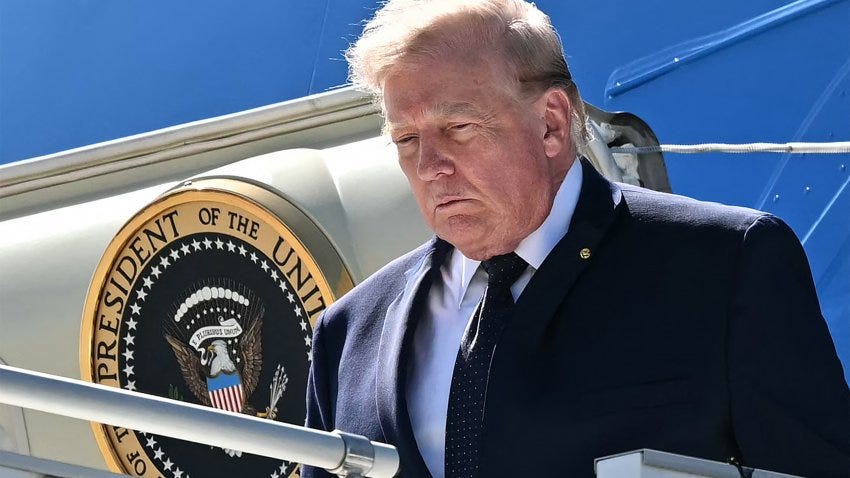
Trump heads to G7 summit in France – NBC 6 South Florida
NBC

There was news this morning that President Vladimir Putin of Russia called Trump yesterday to wish him happy birthday. That must have been a cheery little confab, two of the world’s biggest losers trying hard to reassure each other of their greatness as one throws his hands up in abject surrender to Iran and the other loses 30,000 soldiers on the battlefield every month fighting a war against a country that is dwarfed by the size of Russia and a GDP that is one twelfth its size.

I won’t even get into how much larger in every way the United States is in comparison to Iran.

Today at the G-7 in France, Trump looks like somebody took a 2-by-4 to him. His voice is listless. The back of one of his hands is completely covered in pancake makeup. When he walked out to greet French President Emanuel Macron and his wife Brigitte, Trump’s gait was halting and his wife Melania was not at his side.

He is on the world stage at the G-7, and he looks exhausted and weak and he is utterly alone.

Donald Trump launched a war against the Islamic Republic, and Iran took everything the U.S. and Israel could dish out. Donald Trump announced 28 times that a “deal” to end the war was imminent. Iran did not make such an announcement even once.

All Iran had to do was point missiles and drones at the Strait of Hormuz and stop the shipment of oil and wait for Trump to cave. Yesterday, he caved.

At this writing, the Strait of Hormuz is still closed, under the firm control of Iran, which can sink any vessel attempting to make transit. Iran’s stockpile of enriched uranium is secure. Its oil and gas industries were not seriously damaged. Kharg Island is not in rubble and surrounded by an oil slick. Iran’s ability to use missiles and drones in long-distance strikes against its neighbors and its declared enemy, Israel, is as secure as it was on February 27, the day before Trump launched his war.

When Trump appeared before the press with Macron, the French president called the agreement “very important for peace.” Trump’s face was impassive, a mask of failure and doom. Not one country at the G-7 responded to Trump’s entreaties to help with his war on Iran. He is not meeting with allies. They are unwilling pallbearers at his funeral.

Trump’s big-bully-on-the-block act is finished. Any threats he makes between now and January of 2029 are hollow, and everyone knows it. Pete Hegseth spent a good portion of his interview on Sunday with Margaret Brennan on “Face the Nation” denying reports that the U.S. has severely diminished its stockpile of high-tech weapons such as the anti-missile Patriots and long-range precision Tomahawk cruise missiles. Brennan challenged Hegseth about how many high-tech weapons the U.S. expended against Iran: “There is a crisis with those stockpiles right now,” she said. Hegseth practically shouted, “That is a manufactured story that the media wants to peddle.” When Brennan reminded him that he had testified before Congress “that it will take years to rebuild those stockpiles,” Hegseth paused and took an audible breath, gathering himself before responding, “You don’t have to read back to me what I testified.”

Trump’s war on Iran turned out to be just another of his many, many lies. As the war wore on, he even stopped using the word, “war,” calling it an “excursion.” Amazingly, his choice of words turned out to be accurate. It wasn’t a real war, even though 3,000 Iranians lost their lives and parts of Iran’s infrastructure and military were damaged but not destroyed. Trump and Hegseth went on an excursion to the Persian Gulf and all they got was an international energy crisis caused by Iran’s closure of the Strait of Hormuz and an embarrassing “deal” that returns everything to where it was on February 27.

Hegseth is just another Crusader who went to Persia and got his shit handed to him. Trump is a bully, but no one fears him anymore. Wait until you see his rally on the Mall on July the 4th. Not even Lee Greenwood and Kid Rock will be able to lift his spirits. His polling isn’t going to bounce back when gas prices come down. Iran beat him. He’s a loser.

This is so delicious, I can’t even tell you. It’s going to get worse for Trump, not better, between now and November, and I’m going to be covering every minute. To support my work, please consider buying a subscription. I will put your money to very good use.

Leave a comment

Share

Give a gift subscription

Read the whole story
DGA51
6 days ago
reply
Central Pennsyltucky
Share this story
Delete

One big grift

1 Share

The SpaceX IPO, valuing a motley collection of dubious business at over a trillion dollars, marks the abandonment of the Efficient (financial) Markets Hypothesis, one of the zombie ideas I criticised in the wake of the Global Financial Crisis. Not only do financial markets fail in the task of valuing assets accurately, but the institutional structures that are supposed to make them work have given up trying.

This was prefigured by the rise of Bitcoin and other forms of crypto. Revealingly, no one any longer uses the term “cryptocurrency” – these assets are never used as currency in ordinary transactions, and even their illicit uses seem to have faded. Rather, Bitcoin is valuable solely because it is valued. As I pointed out back in 2018, (free from paywall here) once this logic is accepted, it can be applied to financial assets more generally, and particularly to stock markets.

For quite a while, financial institutions like Goldman Sachs held out against crypto. But the rewards became too great to ignore and the crypto industry too politically powerful. Crypto moved from the netherworld it once inhabited to the respectability of exchange traded funds.

The extension to stock markets has been happening for a while, with meme stocks like GameStop, and then with massive valuations of AI stocks. But meme stocks are a sideshow, and the future of AI is unclear enough that it’s possible to make a case.

It’s only with SpaceX that we can see the complete abandonment of any pretence at rationality. In the case of SpaceX, I was struck by Dave Karpf’s observation that Musk’s wealth in 2020 was “only” $24 billion. Everything of value in his career (Tesla cars, batteries, Starlink) had been achieved by then, and everything he has touched since then has been a disaster (Xitter, Cybertruck, robotaxis, Starship). Yet his wealth has multiplied 50 times over).

In support of the IPO, Goldman Sachs has put its name to the claim that the company will grow 100 times over by 2030. This is patently absurd. Nothing in Musk’s ragbag of assets has this kind of potential.

Starlink, the pre-2020 bit of the business, has been successful enough, but satellite-based Internet is never going to be huge. And there is plenty of downside risk, as Europe and China try to develop alternatives. Given that Starlink’s satellites have a life of only five years, the business could well be in sharp decline by 2030. Starship, by contrast, seems unlikely to succeed in getting humans to the Moon, and won’t make much money even if it does. Talk of Mars, data centres etc is a joke.

The AI part of the business is barely even a joke. Not only is Grok an also-ran in the LLM stakes, but Musks’ promotion of racism, terrorist riots and sex crimes leaves him, and the company open to huge liability, at least in Europe, where Trump can’t protect him.

The comprehensive corruption of the financial system confirms me in the view that the USA is one big grift. Not just the financial system, but politically and militarily as well. But that’s a topic for another day.

Read the whole story
DGA51
7 days ago
reply
Central Pennsyltucky
Share this story
Delete

After Helene: Lost & Found

1 Share

After the floodwaters receded, the debris that remained wasn’t just wreckage — it was the scattered contents of people’s lives. A few have made it their mission to give it all back.


LISTEN TO THIS STORY’S SOUNDSCAPE


It was two months after floodwaters swelled by 27 feet along the Swannanoa River that Jill Holtz, an Army National Guard member, stepped onto a debris-strewn football field 600 feet north of the riverbed and made a decision that would change her life.

And the lives of countless victims of tropical storm Helene.

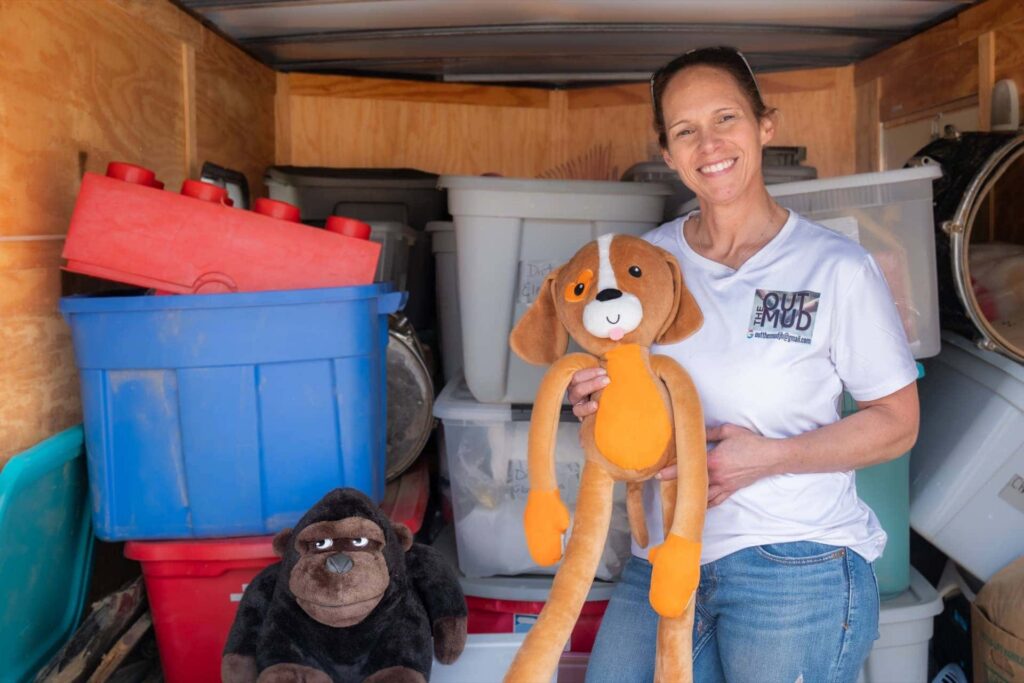
In the middle of the field was a toddler bed displaced by the storm. A Batman comforter was draped across the mattress, trapped in place by the blue metal frame. Two mud-caked stuffed animals, an orange monkey and a gorilla, were tucked into the headboard.

Scattered across the landscape, all around her, were the contents of people’s homes. Whole closets worth of clothes still on their hangers lay atop a puree of grass and mud. Trailer homes sat on their sides in the rubble. Glass dishes and pots, some undamaged by the violence of the rushing river, peeped out from upturned chunks of ground.

Holtz didn’t see piles of unsavageable wreckage. She didn’t consider the task of cleaning and fixing the mountains of momentos to be impossible. Instead, Holtz, 45, knew she had to do everything she could to return the items she found to the people who lost them in the greater Swannanoa area.

“[Imagine], you’ve lost everything, and you’re surrounded by all this stuff that is not yours. You’re surrounded by brand new stuff, sure, you’re surrounded by donations, sure, but you’ve lost a piece of home,” Holtz said. “If I can give that one little thing back to somebody, man, it means the world.”

And so she launched Out the Mud, a volunteer group designed to reunite lost items with their owners. Eighteen months after Helene’s floodwaters rushed through this 5,000-person community about 12 minutes east of Asheville, Holtz is still returning precious items to their owners.

And she is not the only one. Mandy Wallace is the artifact recovery technician for MountainTrue, a non-profit organization that has been working to clean debris from the French Broad and Swannanoa rivers since the storm. Since March 2025, she and her team have returned roughly 120 items through postings on their lost and found Facebook page. “It turns into a Nancy Drew mystery,” Wallace said in early March from her office in Weaverville, North Carolina. “Who’s this belong to? Who’s missing this?…I need to get it back.”

Alice Wright, an associate professor of anthropology at Appalachian State University who studies the relationship between people and material objects, says that returning even a single valued possession can mean everything to someone who has lost everything. “Having that material connection has the potential to provide that tangible, I mean, the literal touchstone to safety, to comfort, to your identity and who you are,” she said. “There’s something so human [about] our connections to these objects that really encourages us to empathize with each other and to extend that neighborliness that the storm brought to the surface.”

Standing at the end of the same field on a sunny March morning more than a year later, Holtz looks over the now-tidy grass and nearby beds of spring daffodils that are just beginning to bloom. There is no trace of the damage the river once wrought. Except only minutes before, Holtz bent down and dug up a pair of earrings and a photograph in the back yard of a nearby abandoned home. She carefully placed them in the back of her trailer, which was filled to the roof with multicolored plastic boxes of found objects, waiting to be returned.

“There is still so much stuff out here,” said Holtz, dressed in a tee shirt and jeans, a silver necklace with “fearless” engraved on it tucked under her collar. She’s not planning to stop looking anytime soon.

As of March, Holtz has returned over 400 possessions to their rightful owners. But roughly 800 items — toy trains, Christmas ornaments, baseball trophies, heaps of photos, a drum set, jewelry, on and on — remain unclaimed in a 6 by 12 foot trailer she transports back and forth from her home in Raleigh, four hours away. What follows is a spotlight on just a few of those worldly possessions — three that have been successfully returned and two that are still lost.


RETURNED & FOUND – STILL LOST

Denise and Greg Carraux — 28-year-old love letters

•RETURNED
In December 2024, while searching for lost objects in the area in and around the football field, Holtz and her volunteers found three postcards, still intact and readable. Based on information visible on the cards, each was sent from Switzerland to Houston, Texas, within the same two weeks during the spring of 1998. Holtz cleaned the cards, took photos of them and posted her find online in the hopes of hearing from the owners.

Nine months later in September 2025, Greg Carraux, 67, received a message on his phone from an unknown number with a photo of the postcards and a note asking if they belonged to him. At the time, one of Holtz’s volunteers, Jill Alexander, was going through any items with names on them and trying to find their information via Google.

He showed the images to his wife, Denise Carraux, 66, who immediately recognized what they were.

“People say ‘it’s only material things,’ but when you look at it, it’s like, you lost the light, you lost everything. So basically, at 67 I’m starting over again,” said Greg Carraux, who explained the couple moved to the area only four months before the storm. The floods washed away many of the valuable items they had brought with them from Houston, Texas, valuables collected over years and generations.

The postcards were keepsakes from the very beginning of their relationship. Right after the two met in early May 1998, Greg went away on vacation for 10 days. Each day he wrote a letter to Denise about his travels. From those letters their romance blossomed. To Denise and Greg, the sentimental value and history of the postcards make them irreplaceable.

“Things are very important because they capture your history,” Denise said. “I’m just so happy to have them.”

Luckily, two more postcards were found and returned to the couple this March.


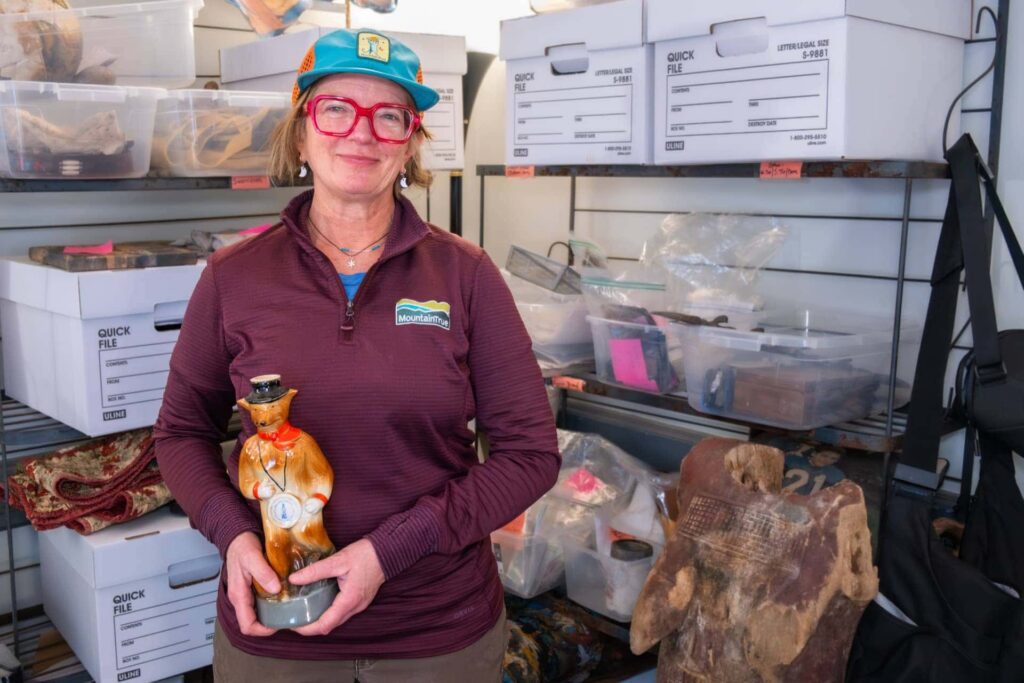
Mandy Wallace — A 1976 Jim Beam decanter
•FOUND – STILL LOST
In March 2025, while cleaning up debris along the French Broad River as a part of her work for MountainTrue, Mandy Wallace, 55, came across a tiny piece of ceramic glass poking out of the mud. She bent over to pull it out, expecting a fragment, and was surprised to see a fully intact ceramic Jim Beam decanter emerge in the shape of a small orange fox.

“It was the very first found item for our organization,” Wallace said. “The beginning of all of this.”

Earlier that month, Wallace along with 10 other full-time workers had been hired by MountainTrue to handle debris cleanup along the rivers after the storm. Including Wallace, all of the new hires had lost their jobs due to damage from the storm. The non-profit had received a small grant from the Land of Sky Regional Council, a multi-county, local government, planning and development organization, to support the cleanup initiative.

Since onboarding what Wallace calls the “OG Debris Team,” 92 workers have been added to the organization’s cleanup crew thanks to another $10 million grant MountainTrue received in July 2025 from North Carolina Department of Environmental Quality.

As their team grew and more items were collected, Wallace was officially given the title of Artifact Recovery Technician in September 2025. She now has her own office in Weaverville, North Carolina, with shelves full of items including quilts, old china, photo albums and a recently found 3-foot-tall handcarved wooden statue of a female form.
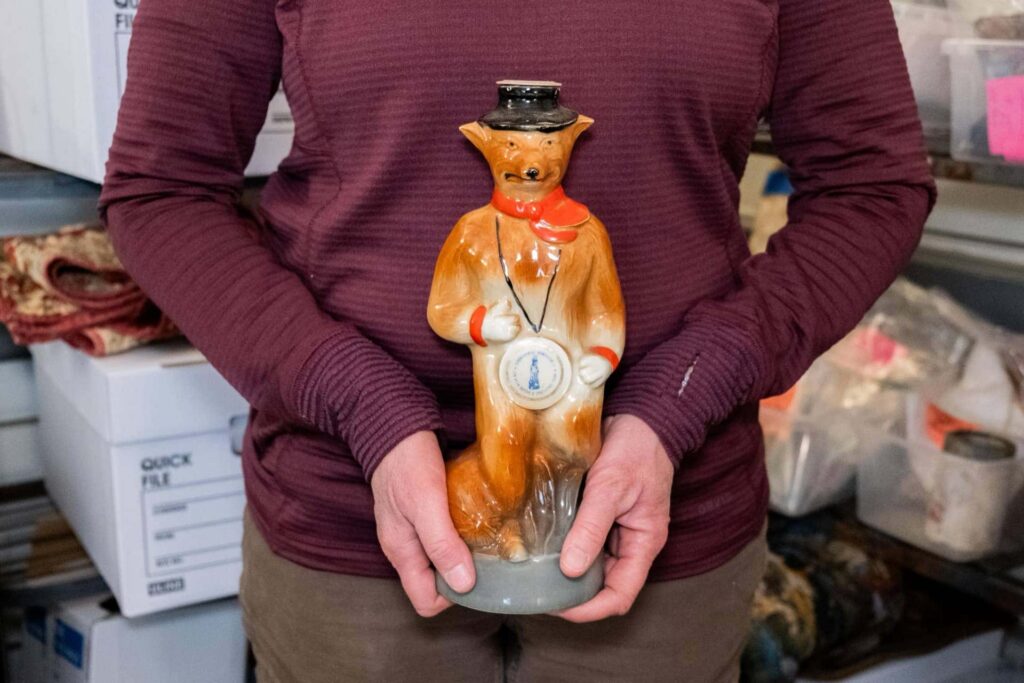
The Jim Beam decanter sits on her office windowsill slightly away from the shelves of other objects across the room. It is joined by various other items she has collected, none of which look like they could have survived tumbling through roiling floodwaters.

“My favorite items are the ones that are just so delicate,” Wallace said.


Jack and Caitlin Wright — Baseball cards

• RETURNED
In April 2025, alongside Wallace, a team of MountainTrue volunteers were working along Sweeten Creek right off the Swannanoa River in Biltmore Village, an historic and flood-prone neighborhood on the southern edge of Asheville. Amid the debris were multiple sleeves of old baseball cards scattered along the riverbank.

In September 2025, Wallace posted the cards along with other found objects — crumpled photographs, military pins, award plaques, vases and CDs — on the group’s Facebook page.

In February 2026, Jack Wright, 43, who is of no relation to Alice Wright, reached out to claim many of the baseball cards. Back in April, his wife, Caitlin Wright, 37, had claimed their daughter’s baby photo album collected from roughly the same location the cards were found.

Even after the album was returned to the couple, however, Jack doubted that any of the other items they lost in the flood would have survived. When the storm hit, Jack’s generational family paint business, which was located roughly a mile away from Sweeten Creek and along the river, had been completely washed away. The cards along with the baby album had been about 30 feet above the ground level in storage when the river water started to rise.

“There were probably 40 to 50 cards, big three-ring binder books up there that had multiple sleeves of cards in them,” Jack said. “They’re just old cardboard from, you know, back in the ’80s and ’90s. I never would have thought they would have survived.”

But when Jack finally decided to look through the Facebook page, he was surprised to see the baseball cards that he grew up with and collected with his father.


Jill Holtz — Children’s stuffed animals
• FOUND – STILL LOST
The stuffed monkeys Holtz found at the center of a football field in Swannanoa two Decembers ago were the first objects she recovered after the storm.

“That’s what started it. I saw these stuffed animals, and was like, ‘I’m gonna find the little kid that this belongs to,'” Holtz said.

Despite posting photos of them on Facebook, Holtz still has not been able to connect with the original owner, but she hasn’t given up hope. She has, however, been able to return numerous other stuffed animals to locals around the area.

While cleaning up the field later that December, Holtz found a giant, roughly 2-foot-tall white teddy bear with a red bowtie caked with dirt. It took over a week of multiple scrubbings before it regained its original coloring.

“I think that I found it and I thought I wasn’t going to hold on to it at first because it was just so, so beyond dirty,” Holtz said. “I remember setting it out, and then I just was like, ‘I can’t leave that. I can’t do it.'”

Her perseverance paid off because shortly after posting the bear to Facebook, a woman came to claim it. The bear had been a Valentine’s gift from her husband years ago. “It was so worth it. It was full circle, complete closure,” Holtz said. “I was so thankful that it belonged to her.”

In June 2025, Holtz found another stuffed animal, a medium-sized reindeer wedged between two logs behind a nearby cornfield, where it had been stuck for nearly eight months. After she retrieved and cleaned it, she posted the image to Facebook. Not long after, a mother messaged Holtz saying it belonged to her young daughter and they set up a time to meet. “She met me with her daughter, and I was able to give it back to her,” Holtz said. “It was very emotional.”


Joel Friedman — A hand-painted tabletop

• RETURNED
Nearly four weeks after the storm, Ciro Pena, a local water guide and owner of Blue Heron Whitewater Rafting, was hiking alongside the river north of Asheville looking through debris for lost items when he stumbled upon something he recognized.

Five miles north of Marshall, North Carolina, a small town of only 800 residents, he pulled a 4-foot-tall hand-painted tabletop from the mud. The tabletop, he knew, belonged in one of only two nearby coffee shops, Zuma Coffee, owned by Joel Friedman, 65. The business, which has been open for 25 years, was known to have had four tabletops painted and gifted to the establishment by local artist Lois Simbach. When the storm hit, the river filled the shop with more than 9 feet of water, washing away three of the four tables.

Months later, in late April 2025, Friedman had a grand re-opening of Zuma Coffee and Pena showed up with the painted tabletop. Both Friedman and the community were overjoyed.

“At that point, we needed anything to lift us up. Any little victories were big victories,” Friedman said.

Only a few months before, another one of the tabletops had been found by a different local who was hiking in Del Rio, Tennessee, 30 miles downriver from Marshall. “It felt like an old friend had come back to visit. It felt like anything’s possible,” Friedman said.

Today, both of the two lost tabletops remain in the shop. One is used regularly for its original purpose while the other Friedman has slightly different plans for. “We’re gonna hang it on the wall, sort of a symbol of resiliency,” Friedman said. “Things, even if they’re in your memory, are never really lost.”

This article is part of Caught in the Current: Helene Recovery in Asheville and Beyond  a project that we have partnered on with the School of Journalism at Northeastern University.  Their enterprising students took on the story of Asheville, North Carolina, a community still dealing with the devastation of Hurricane Helene, 18 months later. As part of our mentoring program, we’re amplifying their efforts by sharing the amazing work produced by their students. Visit the official interactive magazine for the project HERE.


“FREEDOM OF THE PRESS IS NOT JUST IMPORTANT TO DEMOCRACY, IT IS DEMOCRACY.” – Walter Cronkite. CLICK HERE to donate in support of our free and independent voice.

The post After Helene: Lost & Found appeared first on DCReport.org.

Read the whole story
DGA51
9 days ago
reply
Central Pennsyltucky
Share this story
Delete

Not “If You Can Keep It”, but “If You Want It”

1 Share

Ben Franklin Was a Little off Target

Here’s a refresher on the story: People outside the constitutional convention in 1787 waited to hear what kind of government the members came up with. This was shortly after the revolution. What constitution we would have was being debated and it was not at all clear which kind would be chosen. Some wanted a very democratic system. Some wanted, not quite a king but a lifelong president who had very broad power. Some wanted essentially an aristocracy, allowing only the rich and powerful and well connected to be in positions of making decisions with very little influence from the people.

The story, probably made up later, was that when they were done and leaving the convention hall a woman asked Ben Franklin what kind of government the nation would have. His answer was, “A republic, if you can keep it”.

A “republic” meant a representative democracy. Representatives would make decisions but they would be selected by voters. Some current conservatives try to twist “republic” into meaning we should not be a democracy at all, but that’s not true and not what the members of the convention meant, by their own words.

But perhaps a better quote would have been, “A republic, if you want it”. After all, there had just been a strong disagreement within the convention because of those who wanted the public input as removed as possible from influence on the decision makers, being sure more democracy wouldn’t work. They thought either the public doesn’t know enough (always debatable) or it would be chaotic, or the majority would rule like a tyranny over minorities. That is minorities such as minority religions or any other groups not in the main. That’s why our constitution acknowledges rights, so even a minority religion or other group has freedom too.

But our nation’s history has always had a tension from those who don’t quite buy the idea of democracy. In any given time there are those who feel a strong leader or group would get things done better. That might mean allowing the top to indulge in some corruption, and might mean some rights are lost, but the idea is, that’s the only way to get things done. Actually trying to have democracy and all our rights fully enforced is too unwieldy and just doesn’t get things done. With our long Congressional stagnation you could see where people might feel that way.

There are also always those who are just greedy. On the large scale it’s those among the leaders of industry and finance who warp the system to their benefit without regard for how that conflicts with what voters want or with the peoples’ rights. On the small scale, consider white people during the Jim Crow era who supported it, because making black people work almost like slaves made whites richer and they liked that.

On a still smaller and more subtle scale there’s a form that has always been around and continues today. The idea, most promoted by Republicans, to minimize regulation so industry and finance can run unhindered. If that results in some people getting hurt by unsafe work conditions or unsafe products, well, that’s just the price that prosperity requires. Likewise the top-down, supply-side economics that focus on letting the rich maximize the gap between the wealthy and everyone else under the same rationale.

And how have Republicans, especially, but also too many Democrats, and others pushing the same ideas, how have those policies and leaders and office holders managed to keep those ideas going? Keep the votes often almost 50-50 on related issues? Because so many of us kind of agree. Yeah, that candidate might be more favorable to business owners than to unions, but if I vote for the other one who is pushing democracy and rights, we might keep those rights but be poorer, or so we’re told. But if I vote for the one favoring the rich, we might lose some protection of rights, we might end up with a bigger divide between the top and the rest, but maybe I can end up on the winning side of that divide.

It’s the same old trade off in different forms. The idea that it’s just not practical to have all that democracy and all those rights. It’s too unworkable. We should just accept that a certain amount of damage and corruption and unaccountable centralized power is the way things need to work. And too often too many of us tend to lean that way. That’s obvious in our most recent presidential election where a little over half the voters chose a corrupt, narcissistic, power hungry, abusive candidate who had tried to lead an insurrection to overthrow our democracy and rights once already.

So the question that should have been posed is not, “if you can keep it”. The question is, do enough of us lean that direction, favoring democracy and rights over partial authoritarian rule? The question to the woman and to the nation as a whole is not about keeping it. What it’s about is, “if you want it”. So, do enough of us even want it?

Make your voice heard!


“FREEDOM OF THE PRESS IS NOT JUST IMPORTANT TO DEMOCRACY, IT IS DEMOCRACY.” – Walter Cronkite. CLICK HERE to donate in support of our free and independent voice.

The post Not “If You Can Keep It”, but “If You Want It” appeared first on DCReport.org.

Read the whole story
DGA51
11 days ago
reply
Central Pennsyltucky
Share this story
Delete

Allies and enemies: With Trump, which is which?

1 Comment

It used to be one of the easiest jobs for a president of the United States after going through Inauguration Day and all the ceremonies and balls and parades. The next day – not later in the week, but the very next morning, for most presidents, before 9 a.m. -- one of those curved doors to the Oval Office opens and your chief of staff enters accompanied by two men. One of the men is in uniform, the other in a neatly pressed suit. The younger of the two men is carrying a briefcase. They’re here to give you the first intelligence briefing of your term.

In the old days, if there was a lot going on in the world, the briefing might even take place in the Situation Room, the secure bunker-like space an elevator ride away in the White House basement, so the briefers could refer to maps they already put up on the wall. These days, the maps would be on large flatscreen TV’s. The briefers would begin by telling the president about any places where U.S. troops or even embassies might be under threat or in active danger. During the long wars in Iraq and Afghanistan, the briefers might have recent casualty figures and reports of “kinetic” action – bombings carried out by Navy or Air Force jets, maybe a terrorist attack in Baghdad or Kandahar, firefights if they are likely to lead to action taken by more U.S. forces.

After the active military actions involving U.S. forces around the world have been reported, the briefers might run down recent actions or statements by U.S. allies and enemies. What has happened over the last few days in Ukraine, for example, or reports of Chinese naval activity near the Philippines in the South China Sea, or perhaps the results of an election in South America or an attempted coup in Africa. Maybe the president of the European Union said something newsworthy about the new U.S. president, or the Chinese announced a new trade deal in a part of the world in which the U.S. has national security interests, or Russia has shot down a commercial airliner near the border with Ukraine, or a new Russian submarine has been reported to have departed the port of Severomorsk in the Murmansk region of northern Russia. The president will be told when reports have been relayed to the Pentagon by the intelligence services of allies and what importance U.S. intelligence places on the reports.

What the president of the United States has not needed to be told, at least until now, is which countries are allies and which are enemies. Certain assumptions have been stable throughout the years since the end of World War II. European nations are our friends and allies. Nations such as Russia and China are our rivals and even economic enemies in the struggle for resources and dominance in certain regions of the world. Other nations, such as unstable autocracies in South America and Africa, or even on-the-fence countries such as Armenia and Azerbaijan or Moldova or Serbia, might enter the conversation if there are recent developments that impact U.S. interests or ongoing conflicts that might end up drawing more intense attention of U.S. intelligence or the Pentagon.

Being one of the people who delivers the president’s “daily brief” used to be a plum assignment. To get the job, you would need to pass the background check for the very highest security clearance. People who were briefers of the president have gone on to bigger things. Bob Woodward, yes that Bob Woodward, carried the briefcase when he was a young ensign in the Navy accompanying senior briefers to the White House every morning. That’s where some of his sources came from when he was a reporter for the Washington Post in later years.

Think of what it’s like today. Donald Trump doesn’t get up in the morning and go downstairs to the Oval Office to get his morning briefing. It is said when he receives a briefing at all, he likes to be shown videos and photographs and given a single page to read, if that.

This is because Donald Trump does not believe in United States interests. He believes in Donald Trump’s interests. To the extent that his interests are affected by national security information, he will listen to briefings. Trump might want to know what the chances are for new developments in parts of the world that are not on the front pages of newspapers, such as Albania or Azerbaijan.

He has remade what used to be the lists of U.S. allies and enemies. NATO nations, which were at the forefront of American national security for decades as they stood fast against Russia and the countries behind the Iron Curtain, are not necessarily considered allies under the Trump regime. He has threatened Denmark, a NATO nation, with taking over their territory of Greenland. He has threatened to turn Canada into the 51st state. He regularly belittles national leaders of NATO countries, calling them names and posting silly memes on his social media account. Countries which have been our enemies, such as Russia, he considers friendly to his interests because he wants to develop hotels or golf courses or condos there.

It emerged last year that the way to become an ally of Donald Trump during his second term in office is to flatter him and give him things of value. Qatar, a Gulf nation, gave him what was described as a $400 million gold plated 747. Other countries have delivered gimcrackery made from gold into his hands in the Oval Office, the acceptance of which violates about 20 ethics rules. We don’t know what goes on behind the scenes in U.S. foreign relations of the Trump administration, but it is a sure thing that Trump himself and his company are being offered business opportunities all over the place. Jared Kushner, married to Trump’s daughter Ivanka, has been on the receiving end of billions of so-called “investments” from Gulf nations. Trump’s real estate buddy, Steve Witkoff, is said to have been nakedly upfront about potential business deals as he has served as Trump’s special envoy here and there…mostly there.

Countries that have been long-time U.S. allies such as those in NATO and even Korea and Japan have learned that when Trump yells at you, it’s best not to yell back, but rather refer to him in grandiose terms and arrange to give him gifts that, while not as grandiose as a 747, are almost certainly worth millions of dollars. Trump, who once called the whole idea of crypto a “scam,” has changed his mind and conveniently established a way to slip him money through Liberty Financial, his crypto investment firm. We have no way of knowing what crypto “wallets” are held by the Trump sons and daughters that could be filled with crypto coins or cash or whatever dodgy form such payoffs take these days. Because the world of crypto is secret. Why do you think it’s secret? So, it can be used to shift money around without anyone seeing a thing on the table, that’s why.

You would think the United States would be standing foursquare behind Ukraine as an ally. Not only are they under attack by one of our enemies, Ukraine is the last bulwark between Russia and Europe and the countries that used to be our allies there. But nooooo. Trump doesn’t want to build hotels in Kyiv. He wants to build them in Moscow, because Russia is bigger and it has oil and it is a country that is at least potentially richer.

The question almost asks itself. What does Donald Trump believe in when it comes to the international interests of the United States? The answer is beyond imagining. There was once a notion that “what’s good for Standard Oil is good for America.” Boy, do those cutthroat times seem innocent looking back from 2026. Just look at the trash heap Trump has turned the White House into. He’s holding a mixed martial arts fight in the White House backyard put on by a company he owns stock in. Look at his recent assertion that his presidential papers belong to him, not to the United States, which paid for them, as the federal law states. Trump has had the Department of Justice prepare a challenge to that law as unconstitutional. Why? So, he and his family can profit from the record of his presidency, including from top secret materials that he will assert belong to him and that he will take with him, so he can use those secrets to his advantage in business deals after he leaves office.

It doesn’t matter if what’s good for Donald Trump is also good for America. What’s good for Donald Trump is good for Donald Trump, and to hell with the rest of it. That is now the foreign policy of the United States in a single sentence.

News from the home front: My wife, Tracy Harris, has begun her own Substack, writing about our life together in Milford and reporting on the dreams and aspirations of our many cats and dog and other goings on. Here is a link to her latest column, where you can sign up for a subscription:

Tracy’s Substack
Wildlife in Milford, Part One
On our first day in Milford, a huge Bald Eagle landed in a tree across the street from our house and watched us all day as we moved in. Occasionally it would fly away and circle high above our heads for a few minutes, then return to sit and stare as the movers carried boxes from the truck into the house…
Read more

Subscribe now

Share

Leave a comment

Read the whole story
DGA51
12 days ago
reply
This is because Donald Trump does not believe in United States interests. He believes in Donald Trump’s interests. 
Central Pennsyltucky
Share this story
Delete
Next Page of Stories