Log in


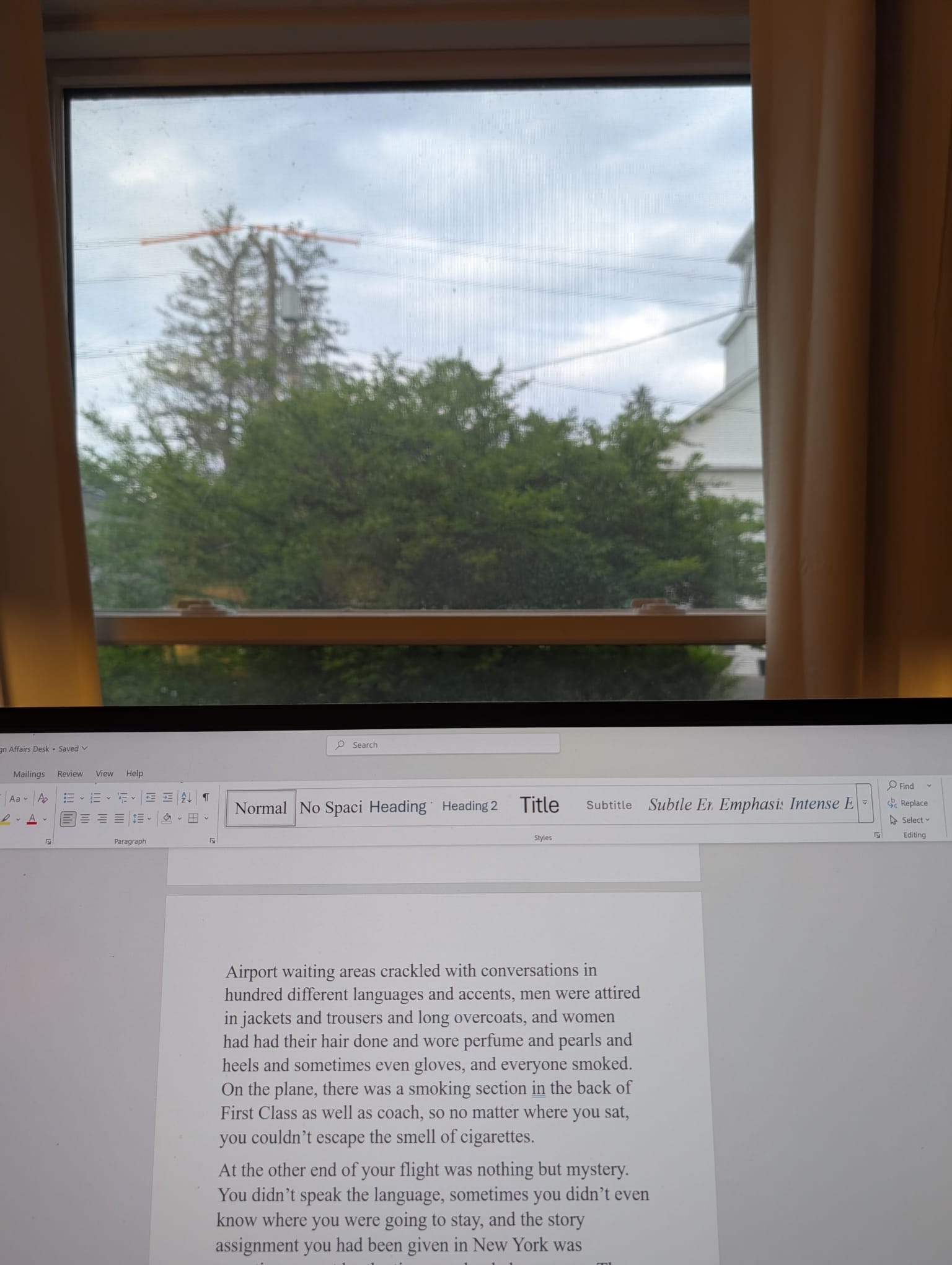
Over the years, I have sat down at a good number of Foreign Affairs Desks to write reports. My favorite was the one I had in Mosul, Iraq, in 2003. I was with an infantry company in a small basecamp they had established on the edge of the Old City in a former social security office. To fit canvas cots into the place, they had removed all the desks in the building and piled them in an alley in back, so lacking a real desk, I made one with two stacks of boxes of MRE’s and a piece of lumber I found leaning against the wall outside the building.
I had an actual wooden writing desk in a common area on my floor in the pension where I stayed in Beirut. I set up my Olivetti Lettre 22 and pounded away on Christmas night in 1974 as artillery thundered outside the window from the hillsides just south of the city. My desk in Haarlem in the Netherlands overlooked the train station, and the one I had in Paris looked out through French doors on a walled garden in what they would now call a “boutique” hotel just off the Champs Elysees. I filed my story about the war of terror then raging in the Middle East at a telex machine in a basement room in the hotel – click thunk ckick thunk click thunk – the keyboard worked to create its long ribbon of punctured paper tape that I would feed into the maw of the machine to transmit the story over phone lines under the Atlantic when I was finished writing.
There was something magical about working overseas back then. My backpack was stuffed with paper maps of where I had been and where I was going, and no one back in New York knew where I was from day to day, even week to week, because making international phone calls was so expensive, and letters took days to arrive even when sent via airmail, which was also expensive and only marginally faster than regular mail that went from overseas to the United States on cargo ships.
This afternoon, my friend Clyde Haberman sent out an email with a great line from the Hitchcock movie, “Foreign Correspondent.” Haberman wrote, “The publisher asks a reporter played by Joel McCrea, ‘How would you like to cover the biggest story in the world today?’ The reporter replies, ‘Give me an expense account and I’ll cover anything.’’’ That was the way it was when newspapers and magazines were flush with advertising money and a seat in coach on an international flight didn’t feel like you were being strapped into the electric chair. Airport waiting areas crackled with conversations in a hundred different languages and accents, men were attired in jackets and trousers and long overcoats, and women had had their hair done and wore perfume and pearls and heels and sometimes even gloves, and everyone smoked. On the plane, there was a smoking section in the back of First Class as well as coach, so no matter where you sat, you couldn’t escape the smell of cigarettes.
At the other end of your flight was a foreign land and its mystery. You didn’t speak the language, sometimes you didn’t even know where you were going to stay, and the story assignment you had been given in New York could have been rendered moot by the time you landed. The war that was supposed to break out, didn’t. The minister you were supposed to interview had been deposed by a coup. The politics of a country or even a region had been frozen solid by fear of a terrorist attack that happened on the ground or at sea or in the air while you were on your flight. The cab driver wouldn’t take you where you wanted to go because a new militia had taken over the area and set up roadblocks you couldn’t get through.
Spring is upon us in Northeast Pennsylvania, although across the country in the Rockies they’re digging out from a late snowfall that is said to be as wet as it is deep. There is a war going on in the Middle East, because there is always a war in the Middle East. When governments aren’t at war with each other, they are at war with their own people, and the climate is at war with all of them, all the time.
It used to be that you had to travel overseas to witness wars by governments against their own citizens, but that is not necessary anymore. You can take a domestic flight to a city anywhere in this country and see men wearing masks and helmets and combat vests carrying rifles lining up civilians and handcuffing them and driving them away to be imprisoned behind the kind of barbed wire enclosures you used to have to travel to distant lands to encounter. The word “concentration camp” that you once saw in history books or reports from dictatorships across oceans now appears in our own press about our own country almost daily.
Deciphering reality from propaganda used to be something that you had to do in foreign capitals that were unfriendly to this country such as Moscow and Budapest and Beijing. Now propaganda appears on a screen you can hold in your hand and read as you sit in a café in your own hometown, and deciphering it is just as hard as it was when it was generated in a foreign language.
To learn what is really happening in the war that our own tax dollars are paying for is impossible. You can’t travel where the war is because flights have been cancelled to most of the region, and even if you drove across borders and arrived near where the missiles are flying or have flown, you can’t learn anything because every place anywhere near the war is off limits. You can’t learn anything from looking at satellite photos, because our government has shut down distribution of commercial satellite images of the entire area around the Persian Gulf. The country that our president has ordered to be bombed and “obliterated” by missiles has distributed satellite images of damage they have done to U.S. bases. It feels odd to depend on the “enemy” to provide information, but then, Iran is not technically our enemy because we have not declared war on that country, and our president tells us that it is not a war that is being fought, but an excursion our military has made into lands where we are not wanted, or the war is over.
But I don’t know, because nobody knows anything. Today, Rachel Scott, an excellent reporter for ABC News, talked to our president, because apparently if you call him on his cell phone, he will talk to you. She asked him about the apparent breakdown of the ceasefire in the Strait of Hormuz, where U.S. naval vessels have been fired upon by Iranian drones and so-called “fast boats,” and U.S. forces have hit what they call “targets” on Iranian soil along the Strait. “It’s just a love tap,” our president told the reporter from ABC News.
I don’t know about you, but I have never seen a love tap that leaves a crater in the ground 30 feet deep and 50 feet across where a building used to stand.
I guess we don’t have real foreign affairs anymore. What we have is a Secretary of State who travels all the way to Rome to meet with the Pope of the Catholic Church to try to convince him to stop being critical of the U.S. war on Iran by giving him a gift of a little piece of engraved crystal in the shape of a football.
Upon seeing the crystal football, Pope Leo, who is from Chicago and is known to be a fan of the baseball team, the White Sox, looked blankly at our Secretary of State and said, “Wow. Okay.”
Here is what I can tell you this evening about the war on Iran that is not a war; about the White House ballroom that was going to be paid for by private donations that they now want to charge taxpayers one billion dollars for; about the federal Department of Health that has decided it’s a good idea to recommend vitamin D to treat a deadly disease that was once eradicated before vaccinations became a conspiracy against your health rather than a lifesaver; about a drunken FBI director who thinks it’s a good idea to travel around on government aircraft carrying a case of expensive bourbon with his name engraved on the bottles to give away to favored friends at the same time he is helping to prosecute one of his predecessors for a fake crime; about one of our political parties that has decided the best way to win elections is to make it impossible for the other political party’s supporters to vote…
Wow. Okay.