Log in


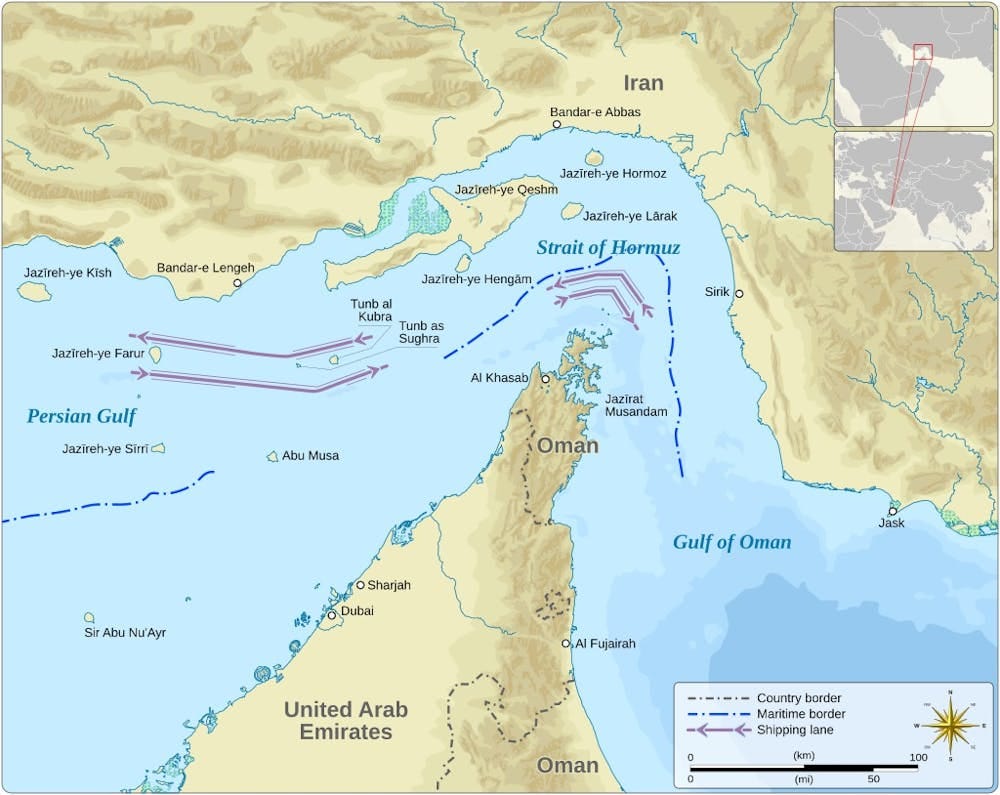
You knew it was coming. Yesterday, the U.S. shot missiles at two rocket launchers located on Larak Island, a small island sitting just off the coast of the much larger Qeshm Island just off the coast of Iran at the north end of the Strait of Hormuz.
Got that? They shot at two missile launchers that U.S. Central Command says were observed preparing to launch mines into the Strait of Hormuz. The U.S. has claimed that mines have been cleared from a route through the south end of the Strait. Larak, along with sections of Qeshm Island, are the closest pieces of land controlled by Iran to the route the U.S. has been using to escort civilian ships through the south side of the Strait.
It is unknown if the U.S. missiles hit their targets, but it is likely that they did. The U.S. would have probably used Tomahawk cruise missiles to hit the Iranian targets, as they are very accurate and very hard for anti-missile defenses to shoot down. If the U.S. Navy did shoot Tomahawks at the Iranian launchers, that’s at least two more of our severely depleted stock of cruise missiles that are gone.
Iran responded to the missile attack by firing several missiles at U.S. forces in Jordan. Central Command reported late today that the Iranian missiles were intercepted before they reached U.S. targets. Patriot missile interceptors are usually deployed to defend against Iranian ballistic missiles, so there went several more Patriots, the other kind of munition that we have severely depleted during Trump’s tit-for-tat war with Iran.
Iran has multiple underground factories which manufacture several models of medium-range ballistic missiles capable of hitting targets in Jordan: The Shahab 3, range 2,000 km; the Ghadr, range 2,000 km; the Sejjil-2, range 2,500 km; and the Khorramshahr, a powerful liquid-fueled rocket capable of carrying heavy warheads, range 3,000 km.
It is not known what sort of ballistic missiles Iran fired at U.S. targets in Jordan, but it is known that Iran’s stocks of offensive missiles were not seriously depleted during the initial phase of Trump’s war.
Iran, of course, knows everything about our depleted stocks of Tomahawk and Patriot missiles, because the actual numbers of both sorts of missiles remaining in U.S. stockpiles have been in the news over the past few weeks. It goes without saying that Iran knows exactly how many ballistic missiles are in their own stockpiles. Iran has full knowledge of our satellite intelligence capability. They know that every move made by their military is being watched 24-7. It would cost Iran almost nothing to put a couple of missile launchers on Karak Island and make a show of preparations, moving a bunch of soldiers around and then stashing them safely away and wait to be attacked. Knowing that their ballistic missiles would be intercepted, Iran could launch a few of its cheapest missiles at U.S. forces in Jordan in retaliation.
Then Iran could sit back and add up who wasted the most money on the most expensive-to-replace missiles.
Iran knows the arithmetic being done in Hegseth’s Pentagon: how many thousands of testosterone shots will be needed to put in the rear ends of how many over-30 soldiers, sailors, airmen and Marines whose tests come back wanting.
It is simply astounding to think that our country’s military leadership is falling for the simple tactics being used against them after six months of on-again off-again war. Iran knows who controls the Strait of Hormuz. They do. Today, fewer than 20 ships are transiting the Strait daily. Before the war, as many as 100 to 150 ships passed through the Strait each day carrying oil, fertilizer, liquid petroleum and other precious cargo.
Compared to what it is costing this country to maintain 50,000 ground troops in the Middle East and the naval blockade of Iran’s ports, it is costing Iran almost nothing to limit trade through the Strait of Hormuz to an expensive trickle. Donald Trump wanted a war against Iran. He got one. Iran’s larger strategy against Trump is to keep him guessing and the Strait of Hormuz largely shut down until the November elections.
Iran won the shooting war. Now they’re winning the political war on Donald Trump and the Republican Party whose loyalty to him is so unblinking, it will likely cost them the midterm elections.
Watch this space for news about more of our extraordinarily expensive missiles wasted on a war that Trump cannot bring to a satisfactory end.