Crusading against evil since ...
3598 stories
·
1 follower

What Does the Declaration Mean by Pursuit of Happiness?

1 Share

I wrote this short essay about the “pursuit of happiness” for the editorial page of the StarTribune newspaper, where it was published on July 3.

_____

Opinion | What did the founders mean by the pursuit of happiness?

The authors of our founding document were deadly serious about a goal we might see as whimsical.

By Timothy Taylor

When the five-person committee that drafted the U.S. Declaration of Independence declared it to be “self-evident” that there was a right to “the pursuit of Happiness,” what manner of happiness did they have in mind?

In a declaration explaining why the signers felt compelled to commit treason against their existing government and to prevent “the establishment of an absolute Tyranny,” it seems unlikely that they were foreshadowing the whistling cheeriness of the 1988 Bobby McFerrin hit, “Don’t Worry, Be Happy.”

When you are announcing that you “mutually pledge to each other our Lives, our Fortunes and our sacred Honor” for the purpose of fighting a Revolutionary War, it seems unlikely that they were thinking of the giddy, throbbing happiness of the 1986 Beastie Boys hit: “You gotta fight for your right to party.”

The authors of the declaration — Thomas Jefferson, John Adams, Benjamin Franklin, Roger Sherman, and Robert R. Livingston — were not being playful, whimsical or ironic. They were deadly serious about “the pursuit of happiness.”

Drawing on a long philosophical tradition going back to ancient Greece, they believed that happiness was the result of living a virtuous life. Franklin wrote that “virtue and happiness are mother and daughter.” Jefferson later wrote: “Happiness is the aim of life. Virtue is the foundation of happiness.”

Naturally, any self-respecting modern American will quickly stand up and declare: “No virtue-monger gets to tell me what cookie-cutter set of rules I am obligated to follow.”

For 21st century Americans, this notion of happiness as virtue may seem self-contradictory. After all, isn’t virtue almost by definition dry and boring: that is, about discipline and abstemiousness, not the freedoms of fun and pleasure?

But as understood by the authors of the declaration, happiness isn’t about the feels. Instead, in a tradition going back to Aristotle, virtue was understood to be developed through a lifetime of practice. The goal is a deeper and richer satisfaction gained as a person grows into a full and flourishing existence. It’s about taking seriously the idea that you can pursue a version of your best self.

Of course, the pursuit of happiness may not succeed. Real life is messy. Personal goals can change. Families can quarrel. Marriages and friendships can crumble. Health and finances can go sour. Happiness, virtue and flourishing are never guaranteed.

The Nobel-prize winning novelist V.S. Naipaul, who was born in Trinidad in 1932 and lived there for 18 years before receiving a scholarship to Oxford and moving to the United Kingdom, offered a paean to “the beauty of the idea of the pursuit of happiness” in a 1991 essay, in which he wrote:

“Familiar words, easy to take for granted; easy to misconstrue. This idea of the pursuit of happiness is at the heart of the attractiveness of the civilization to so many outside it or on its periphery. I find it marvelous to contemplate to what an extent, after two centuries, and after the terrible history of the earlier part of this century, the idea has come to a kind of fruition.

“It is an elastic idea; it fits all men. It implies a certain kind of society, a certain kind of awakened spirit. I don’t imagine my father’s parents would have been able to understand the idea. So much is contained in it: the idea of the individual, responsibility, choice, the life of the intellect, the idea of vocation and perfectibility and achievement.

“It is an immense human idea. It cannot be reduced to a fixed system. It cannot generate fanaticism. But it is known to exist; and because of that, other more rigid systems in the end blow away.”

The Declaration of Independence proclaims the “Right of the People … to institute new Government, laying its foundation on such principles and organizing its powers in such form, as to them shall seem most likely to effect their Safety and Happiness.”

Americans have disagreed for 250 years over how best to enunciate the foundational principles of their government and how to organize its powers, and it seems right and proper to me that such disagreement should continue. But the lodestar of such discussions is that people have a “self-evident” and “unalienable” right to pursue their own concept of their own happiness. The concept was radical then, and remains so today.

Timothy Taylor is managing editor of the Journal of Economic Perspectives, based at Macalester College in St. Paul.

The post What Does the Declaration Mean by Pursuit of Happiness? first appeared on Conversable Economist.

Read the whole story
DGA51
1 hour ago
reply
Central Pennsyltucky
Share this story
Delete

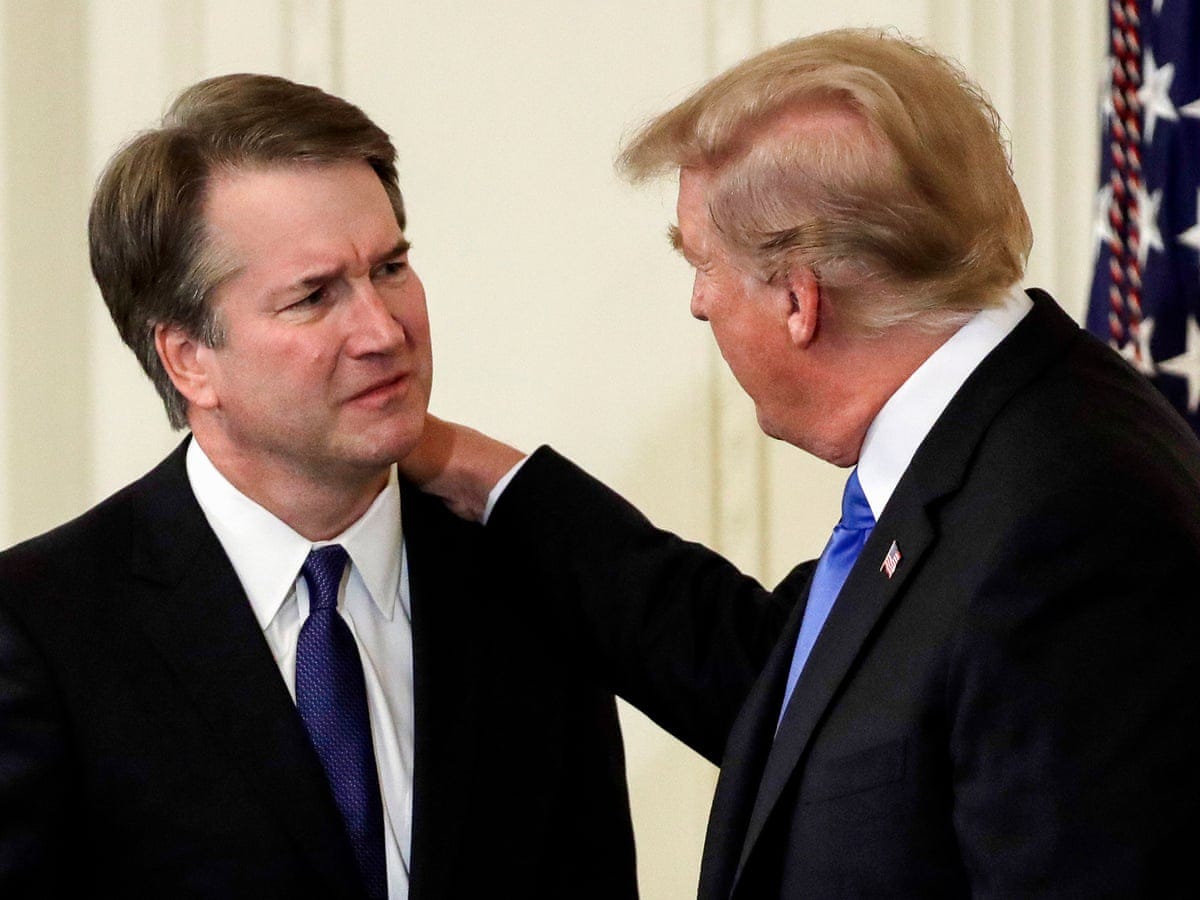
Justice Brett Kavanaugh is a sniveling, lying, double-talking, corrupt, arrogant asswipe who should be impeached

1 Share
Kavanaugh will 'step up' to keep Trump on ballots, ex-president's lawyer  says | Brett Kavanaugh | The Guardian
The Guardian

We have a new living constitutionalist gun-slinger in town, and he’s gonna tell us what’s in the Constitution and how it should be applied in this modern day and age when we’ve got problems the framers could not have foreseen. So, bye-bye textualism and bye-bye originalism, c’mon over here and meet ol’ Six-Pack himself, Brett Kavanaugh.

I read this idiot’s birthright citizenship concurrence and dissent. It reads like it was written by someone so arrogant, he doesn’t expect anyone to look up his recitation of bullshit and see if any of it comports with reality or history or anything else, for that matter.

Kavanaugh has succeeded in making himself famous for voting with the majority to overturn Trump’s executive order on birthright citizenship, but not because it violates the 14th Amendment. No, our Brett-boy has found himself a couple of obscure federal laws from the 1940’s and 1950’s that he says are violated by Trump’s order, and because Trump broke the law but did not violate the Constitution, his executive order should be made null and void.

Kavanaugh wants us to believe that the 14th Amendment doesn’t mean what it clearly states: All persons born or naturalized in the United States, and subject to the jurisdiction thereof, are citizens of the United States and of the State wherein they reside. There is a lot of stuff in the Constitution that isn’t very clearly stated. Even the First Amendment’s guarantee of freedom of religion is quibbled over between the “free exercise” clause and the “establishment clause” and what they mean. But to say straight up that if you’re born in this country or have been naturalized, you are a citizen…what’s the problem with that, Brett?

Lots of problems, says the man who has shed his previous belief in textualism, the theory holding that the words in the Constitution as written are what matter, and his belief in originalism, that the meaning of the Constitution should reflect the beliefs and circumstances of the Constitution when it was written. Hell, Kavanaugh eagerly signed onto his pal Clarence Thomas’ decision in the big Second Amendment case, New York State Rifle & Pistol Association, Inc. v. Bruen, that we shouldn’t have any laws that don’t follow the so-called “history and tradition” of the laws at the time that the Second Amendment was written.

Got that? These fuckers are saying they’re so in love with the original meaning of the Constitution that they’re not going to put up with any laws that aren’t exactly like the laws were in 1791, when the Bill of Rights was added to the Constitution.

But then along comes Donald Trump and his obsession with what he and his brown-people-remover Stephen Miller call “illegal immigration,” and so Trump just up and says the 14th Amendment doesn’t apply to kids whose parents are not either citizens themselves or in this country with some sort of “legal status.”

Kavanaugh says, yep, that’s right: the 14th Amendment doesn’t apply because “significant illegal immigration into the United States is a new circumstance that was largely unknown as of 1868.” Of course it was, you drooling doofus. There weren’t any laws making immigration “illegal” in 1868 because we had open borders and we were taking anyone who wanted to come to these shores and work hard and pitch in and help us expand the country. No less than 12 of the states that currently have stars on the flag didn’t even exist in 1868. We needed people to populate the virgin territories and start businesses and plow fields and harvest crops…if only because after 1865, we didn’t have slaves to do that hard work anymore.

Kavanaugh dives into a couple of cases to show how the Supreme Court has read the Constitution to go along with the changes of the modern world. Why, goodness, Supreme Court justices had to find a way to interpret how the Fourth Amendment applied to searches of cars, because there weren’t any cars in 1791 or 1868! I’m not kidding. You have to read this shit to believe it. Listen to this quote from Kavanaugh: “In First Amendment cases, courts apply free speech protections to the Internet notwithstanding that the Internet did not exist in 1791 or 1868.”

Really, Brett? There was no internet when the First Amendment was written, so the Supreme Court had to read the Constitution in such a way as to take into account all this modern shit that’s come along? He even quotes a case from 2024 cautioning that we can’t allow our Constitution to be “trapped in amber.”

What happened to Thomas’ amber guns of 1791, Brett? Or Alito’s “amber” that the word “abortion” isn’t found in the Constitution, and there were anti-abortion laws on the books back in the day when the 14th Amendment’s “equal protection of the laws” was written?

All that’s out the door for our Brett-boy, so he can come down on the side of the man who appointed ol’ Six-Pack to the court on the birthright citizenship issue. Kavanaugh tells us that birthright citizenship doesn’t apply to children born to illegal immigrants because “Framers of the Fourteenth Amendment could not have fully anticipated” all these brown people coming across the border. He even tells us that the framers would have seen it as an “odd result” for citizenship to be granted to “foreigners” who have children in the United States.

No, you blathering, dissembling liar. Everyone was a “foreigner” in 1868, unless you were a native American. The framers of the 14th Amendment were themselves the descendants of “foreigners” who came to these shores from other lands. That’s why they wrote the opening words of the 14th Amendment. They wrote “all persons,” on purpose. They didn’t write “the following persons,” or “the persons of whom we approve,” or “the persons with this skin color but not that one.” Kavanaugh even says that “changes in travel” couldn’t have been foreseen by the framers, so that makes everything different today. They can fly on jets across oceans! They can drive cars across borders! The framers couldn’t have seen that coming!

Kavanaugh, and the rest of the right wingers who have had their undies in a wad over the court’s interpretation of the 14th Amendment to mean exactly what it says, want it both ways. They want no abortion now, because it was illegal then. They want no gun control laws now, because there weren’t any gun control laws then. But when it comes to babies born in this country to people who are here on temporary visas or no visas at all, they don’t want ‘em. That the babies themselves didn’t have any say in the matter about where they were born doesn’t concern these so-called “conservatives.” To them, fetuses have a “right to life,” but babies born to immigrants or even to temporary visa holders don’t have the rights granted to them in our own Constitution.

This is pure fascism. It is exactly what Hitler did in Germany in the 1930’s. He was the one who said who could be citizens of Germany and who couldn’t, who had rights and who didn’t. It’s exactly what Stephen Miller and Trump want. They want to be the ones who get to say “we will allow the following people into our country.” Look who they define as refugees they will admit to this country. White South Africans and nobody else. Not Black South Africans. Not real refugees from places like Haiti and Somalia. But white people who come from a country that oppressed an entire people for centuries? Hey, come on in! You’re our kind of folks!

Some of the experts in the legal community are calling Kavanaugh’s “concurrence with exceptions” an invitation to revisit the birthright citizenship issue in the future. His refusal to read the 14th Amendment to say what it so clearly says created a decision with a 6-3 majority to overturn Trump’s executive order, but only a 5-4 majority to do so on Constitutional terms according to the way the document was written. This is going to turn into another campaign like the one they launched against abortion. It took them 50 years to get a Supreme Court that would give them the Dobbs decision saying there is no constitutional right for women to control their own bodies. It may take them another 50 years to get a court that will effectively amend the Constitution so the 14th Amendment isn’t a part of it anymore. They would like nothing better than to go after the 14th Amendment’s guarantee of due process and equal protection of the laws. That would be the way they could overturn Brown v. Board of Education, which they’ve wanted to do since the day the decision came down in 1954.

This country will not survive the Supreme Court as it is presently constituted. The 6-3 majority will go after every law passed by a Congress and a President from the Democratic Party when they are in power. If Democrats want their party, and our democracy for that matter, to survive into the next century, they’re going to have to expand the court to 15 justices, and they’re going to have to write laws that constrain the court using other powers granted to the Congress under Article III. That won’t guarantee that the Republicans won’t get elected and tilt-a-whirl the Supreme Court back the other way, but it would be a start.

Writing this column every day of the week is a fulltime job, and it is the way Tracy and I pay the bills. Because I want my columns to be read widely, I don’t put up paywalls. So, I want to make a direct plea to those of who who have been reading my column for free to become paid subscribers. Thank you.

Give a gift subscription

Leave a comment

Share

Read the whole story
DGA51
1 day ago
reply
Central Pennsyltucky
Share this story
Delete

Ten Federal Voucher Myths

1 Comment

Jorge Elozar, head of Democrats for Education Reform (a group started by hedge fund managers to convince Democrats to support education privatization), has been lobbying hard for the federal voucher program, with most of their talking points gathered into a single post here offering ten reasons that the Dems should not repeal the federal vouchers; the list corresponds to the reasons DFER thinks Democratic governors should sign on.

Let's look at the list.

1. It helps public school students.

Note that this is different from the claim that it helps public schools, which is slightly more honest than Elorza's suggestion elsewhere that public schools might benefit from this. 

But as usual, the list of expenditures includes things that public school students should and do provide, like transportation, special education services, and career training. This only makes sense if the public schools somehow manage to off-load some services to federal funding, which would be bad news for local control and for students who need those services. But it would be good news for those policy leaders looking for ways to dismantle public education and sell off the parts.

2. It Can Bring Significant New Resources Into Public Education

Again, the hint public school systems will benefit from these programs. But come on- if the feds really wanted to inject funding into public schools, it would be far easier to just offer tax credits for supporting a public school. A complicated set up with "scholarship granting organizations" is only useful if you are trying to launder public money so that you can legally give it to a religious organization.

"Scholarship organizations can support services that school districts often struggle to provide at scale, creating new educational opportunities without requiring states to raise taxes or cut other programs." Again, if this were an actual goal, the feds could devise much better ways to do it. Instead they are busy closing down the Department of Education and promising to send education back to the states, by which they mean sending back responsibility for funding any programs the feds don't like.

3. It Helps Close the Out-of-School Enrichment Gap

So federal vouchers will get poor kids SAT coaches and violin lessons? Maybe. But I'm waiting to see regulations that actually limit voucher use to non-wealthy students. Otherwise, I expect that these vouchers will follow the common pattern of mostly supporting families that are not wealth-impaired.

4. It Advances Democratic Priorities Like High-Impact Tutoring

Maybe that is a Democratic priority? It shouldn't be. Two-sigma tutoring is a fabrication, a snare and a delusion that has been thoroughly debunked

But even if it weren't an exercise in unicorn farming, please note the usual privatizer shift here, turning beneficial tutoring from something the system provides for everyone into a commodity that you are free to shop for on your own. This is right in line with the choice movement-- "Your child's education should be your responsibility, not society's. But here's a little voucher check to take some of the sting off when we wash our hands of you."

5. It Expands Opportunity for Students With Disabilities

Again, why are we touting a system based on the idea that families of these students should have to go find necessary services on their own. If only there were a program, like a federal program-- a sort of  Individuals with Disabilities Education Act, and if only that program were fully funded. I bet that would be a far better solution than handing parents a check and saying, "Good luck! Buh-bye!"

6. The Fiscal Impact Is Small Relative to the Federal Budget

Compared to the massive trillion dollar holes blown in the budget by this administration, the amount that this will add to the deficit isn't so bad. So...yay?

DFER skips the other financial impact, like the estimate from American Federation for Children, a severely pro-privatization group, estimates that $300 per child will have to be spent marketing the tax shelter part of this program to convince people to contribute. 

7. It Represents an Investment in America’s Future

Does it? DFER argues that we should welcome throwing more money at education. "The ROI from helping a child learn to read, master algebra, recover from pandemic learning loss, or access specialized support far exceeds the program’s cost," Elorza writes, without asking why the importance of these programs might call for an actual federal investment instead of a tax shelter that is designed to help public tax dollars flow to private schools. Did you forget that was the purpose of the federal voucher program? Elorza is glad you did.

8. It Is Popular With Voters

You know a good way to find out what voters want? Let them vote on it. Except they're not going to do that because school vouchers have never once been voted into place by voters. Voters, given the choice, have rejected vouchers every time. Which is why they are rarely given the choice. Every voucher program in this country was birthed by legislative shenanigans.

You want to show me how popular your program is? Don't show me the results of carefully crafted polling questions. Let people vote.

9. Democrats Need a New Direction on K-12 Education

This one is just whacky. "Ten years ago," says Elorza, " Democrats were the undisputed party of education." I will not dispute for a second that the Democrats lost their claim to be an education party, though I would say that it happened a lot sooner than ten years ago. Ten years ago would be when the GOP started pushing the exact same policy that DFER is arguing for today. 

How did they lose their education mojo? By listening to people like DFER and pushing policies like test and punish, privatization, and generally offering right wing policies with a blue towel draped over their shoulder. But DFER was founded explicitly to perform the "inside job" of getting Dems to fall in line with the privatization movement, and they have been consistent ever since, repeatedly trying out versions of "If you were a true and smart Democrat you would totally want to back school choice." And also "Public schools suck because of the evil teachers union." 

Do the Democrats need a new direction in education? They surely do, but following the privatization policies of Betsy DeVos is neither new nor win Dems education plaudits.

10. Democrats Should Be the Party of Opportunity

To be clear, Elorza is arguing that the federal vouchers expand educational opportunity. The questions he skips are: what kind of opportunity, for whom, and at what cost? Watch this bit of misdirection:
Families are asking for more options, more support, more tutoring, more enrichment, and more help for their children. The FSTC provides all of those things.

This skips over the most important question, which is what would be the best way for the feds to provide those things? Because this isn't it, and to pretend that this program, carefully designed as a tax shelter than funds private schools, is somehow a big boon for public schools and public school families is baloney. 

The DFER argument is like saying, "Yes, an AK-47 assault rifle will let you mow down a bunch of fleshy, vulnerable human beings, but let's not be hasty. You could do useful things with it, too, like cut down shrubbery or open a door you accidentally locked. Really, I don't understand why you don't fully embrace the AK-47 bush trimmer."

Elorza also throws in a bonus myth-- governors should opt in "to keep resources in the state." In that construction, "keep" is doing some heavy lifting, since we are talking about redirecting funds that were already bound for the bottomless money pit that is DC. 

DFER is presenting a backwards-engineered argument. They start with the policy they want to pursue; now they've searched for an argument, landing on "This will solve Problem X" rather than start with Problem X and asking what a good solution for that would be. DFER wants to dismantle and privatize education, and federal vouchers are set up to further that cause of converting a shared societal responsibility into an individual shopping problem.

None of this, unfortunately, means that more states won't sign up for some free federal money. The bare minimum we can hope for is some actual guardrails and restrictions on how the money would be used. Maybe even an actual out loud conversation about the steady erosion of the country's promise of public education. But I don't expect any of that from DFER.  

Read the whole story
DGA51
1 day ago
reply
Yes, an AK-47 assault rifle will let you mow down a bunch of fleshy, vulnerable human beings, but let's not be hasty. You could do useful things with it, too, like cut down shrubbery or open a door you accidentally locked.
Central Pennsyltucky
Share this story
Delete

Fighting Federal Climate Denial: Rebecca Lindsey and Climate.us

1 Share
From: NatCen4ScienceEd
Duration: 41:31
Views: 29

NCSE members had the opportunity to hear from Rebecca Lindsey, managing director of Climate.us — a private, nonprofit successor to the shuttered Climate.gov. Lindsey discussed the importance of preserving public access to trusted climate science data and shared insights into the development of Climate.us. She was interviewed by NCSE Executive Director Amanda L. Townley, who applauded the efforts of Lindsey and her colleagues to keep this resource so vital to the public understanding of climate change operating.

Interested in becoming a member? Join our fight by signing up! A membership supports NCSE's work to safeguard sound science and ensure students get the accurate science education they deserve. https://ncse.ngo/member-social

Read the whole story
DGA51
1 day ago
reply
Central Pennsyltucky
Share this story
Delete

The "Pro-Life" Movement Wants to Execute Women Who Have Abortions

1 Comment

a shadow of a person behind bars of a jail cell
Photo by Akira on Unsplash

It really was only a matter of time before the anti-abortion movement pulled down its “we care about women” facade and began demanding that women be prosecuted for ending their pregnancies. Caroline Kitchener, the best abortion rights reporter around, has a piece in the Times about the rise of the carceral pro-lifer — that is, the willingness of more and more abortion opponents to come out and say they want to jail or even execute women for abortions.

Subscribe now

Some of these people are fringe figures. But many are in the mainstream. And, perhaps most troublingly, some heads of the nation’s largest and most effective anti-abortion groups are shifting from “we would never put women in jail for abortion” to something squishier — we don’t want to put women in jail for abortion right now, but we might consider it should it become more politically palatable. And they are working hard to make it politically palatable.

I say it was only a matter of time before abortion opponents began pushing to jail women for abortion because it’s baked into their claims that life begins at conception and that a fertilized egg is the moral equivalent of a born child. Many people, myself included, believe that human life begins at conception. And many people, myself included, do not believe that this makes a fertilized egg the moral equivalent of an infant — or a 38-week-old fetus.

If this is the claim — that a fertilized egg is a person and should be imbued with the same rights as any other person — there is still a case for abortion (in no other circumstance are you required to donate your organs, blood, and so on so that someone else might live; we don’t even mandate organ donation from dead bodies). But that is not the path the anti-abortion movement is following. They claim that women have a unique obligation to any egg fertilized in their body. And that to remove an embryo or a fetus is akin to killing a child — and should be treated legally as such.

They call this “equal protection,” a perverse use of a phrase originally meant to make African-Americans full citizens under the law. The anti-abortion movement enjoys doing this, stealing from equality movements of the past in order to force profound inequality on women. They accuse Black women of being genocidaires of their own children. They minimize horrific Nazi crimes by calling abortion a “Holocaust.” They call the movement to jail or execute women who have had abortions “abolition.”

Subscribe now

The anti-abortion “equal protection” scheme is not worried about protecting women equally, or at all. Instead, the entity being “equally” protected is a fertilized egg, embryo, or fetus. And indeed, “equal protection” is a breathtakingly inaccurate term here — if my kidneys are failing, I do not have a right to affix myself to you and borrow yours for the better part of a year. But they are giving fertilized eggs the same “rights” as born people, insofar as they are insisting that anyone who causes the death of a fertilized egg, embryo, or fetus is a murderer and can be tried as such. In one group’s info page, they claim that they are not calling for the death penalty for women who have abortions. “Equal rights protection answers who the law protects, it does not prescribe any particular penalty,” they say. “It seeks to bring the same legal protections to preborn children that currently apply to born children.” Except, of course, there are more than 2,000 people currently on Death Row in the US, largely for murder. If women who have abortions face the same legal penalties as murderers, well — some women will be sentenced to death for abortion.

Some of the most influential abortion opponents, Kitchener writes, are starting to push the envelope on punishment and accountability for women:

“In the last four years, our attitude has lightened a little bit because we are looking at the scope of the problem,” John Seago, the president of Texas Right to Life and a major force behind Texas’s abortion bans, told her. “I want for it not to be taboo to ask, ‘What is the accountability for these women?’”

Seago was talking about one novel idea: Stripping the medical licenses from any woman who practices medicine and has an abortion. But on the question of whether he would support prosecuting women for abortion, well, he was unwilling to answer.

“We want to have a conversation to talk about what is the proper approach,” he told Kitchener. “By answering yes or no, it shortcuts a discussion.”

This is a change. In 2021, he was telling the Atlantic, “There’s a question of morality: Is it ethical to penalize women seeking abortions in Texas? We have categorically argued that women need to be treated differently than abortionists. Even with civil liability, we say that women cannot be the defendants. That’s not the goal.” Apparently Seago’s morality has shifted.

This kind of chipping away is how the anti-abortion movement has long worked. There were the extremists — the clinic bombers and those who overtly supported them — and then there were the savvier lawyers and activists who penned legislation, clogged up the courts, and slowly acclimated the American public to the idea that abortion was “controversial” (despite significant majorities of Americans supporting abortion rights), that a moderate position was for abortion to be tightly regulated, and that Roe was wrongly decided. This chipping-away strategy made abortions harder and harder to get, and cemented into the American mind that the issue was morally complex and horribly divisive, and might be solved if we just sent it back to the states to decide. Now that that’s happened — that abortion rights are in the hands of state legislatures — it’s not enough for the anti-abortion movement, which wants to ban abortion for every person in America (and outside of it). But they are on the back foot in terms of public opinion. Their abortion bans are unpopular. Jailing or executing women for abortion will be less popular still. So they are doing the slow and steady work of turning the dial of public opinion — getting us used to the idea that women might go to jail for abortion.

You can see this evolution among some of the movement’s most prominent leaders. Kristan Hawkins of Students For Life, one of the leading anti-abortion organizations in the country, wrote along with anti-abortion leader Marjorie Dannenfelser that “we state again emphatically that we oppose prosecuting women for abortion.” But here’s what she said to Kitchener just a few weeks ago:

“My message is, ‘not now,’ but I’m not saying ‘not ever,’” said Ms. Hawkins, who emphasized that culture would have to undergo a major shift before she would seriously entertain a law that puts abortion patients in jail. “You have to make abortion unthinkable before you get to that point when you ask, how are you going to prosecute?”

If abortion is unthinkable, though, then there would be no one to prosecute because no one would have thought about it. Hawkins, obviously, is thinking about it — and knows that there is no universe in which no woman ever will choose to terminate.

This is what’s coming. And the US would not be the first or only country to throw women who have abortions in jail. Right now, there are several women across Central America sitting in prison, many of them because, they say, they had miscarriages. It’s nearly impossible to tell the difference between a spontaneous abortion (a miscarriage) and an abortion caused by abortion pills, which is now the vast majority of women now have abortions in states where the procedure is banned. Criminalizing abortion, and certainly criminalizing women who have abortions, turns every woman’s body into a potential crime scene: Is a miscarriage really just a miscarriage? It means any woman seeking medical help for a miscarriage would be treated as a murder suspect.

Laws jailing women for abortion will not pass tomorrow (although some legislators are indeed trying). But understand that this is where the anti-abortion movement is headed — and unless abortion rights proponents and normal people who don’t hate women can get it together (or at least pay attention), it’s where we may all end up.

xx Jill

Subscribe now

Share

Leave a comment

Read the whole story
DGA51
1 day ago
reply
Some of these people are fringe figures. But many are in the mainstream.
Central Pennsyltucky
Share this story
Delete

Uber-Rich Repeat Ayn Rand’s Deadly Mistake

1 Comment

“I’m So Smart, Listen to Me” Has Led To Historic Catastrophes

In a New York Times piece, “All Men Are Created Equal, Not Everyone Agrees“, Kim Phillips-Fein correctly critiques the current trend of rich men who disparage equality and want us to give way to whomever they take to be the exceptional few. She quotes billionaire Peter Theil and others that there are such special people, themselves included of course, whom we should defer to. She defends equality but points out that unfortunately notable people throughout U.S. history have disputed the idea that all are equal. It’s the same ridiculous and horrendous mistake that Ayn Rand made, which will be describe.

First, “All men” should obviously be shortened to “All”. All genders, all colors, all sexuality, simply “All”. The Times piece implies that but let’s state it explicitly.

Second, as the piece points out in quotes from various men, they confuse the meanings of equality. They claim that because not all have the same intelligence or productivity, that equality is therefore a myth. Well of course not all have the same capabilities or temperaments. The equality staked out in the Declaration of Independence is equality of value. Bright or not, greatly productive or not, each is a human deserving, no, requiring the full respect, and treatment-with-value as every other. That these men of claimed brilliance stumble over this simple distinction highlights their shortcomings. History shows that those same blind spots have created catastrophes.

To explain, let’s look at how this is all a repeat of the mistake Ayn Rand made. A mistake so absurd and deplorable as to, again, highlight its own shortcomings.

Well over a decade ago I read Ayn Rand’s “Atlas Shrugged”. Long before reading it I had known her philosophy, Objectivism, and felt it had some truth but was incomplete. Knowing that, I never felt the need to read her novel. When I did read it I was surprised at it’s core theme. The core thing that she expresses relentlessly, almost without pause, throughout her long novel, is her complete contempt for almost all people.

It’s supposed to celebrate the individual, but just like in real life, actions speak louder than words. In her story there are maybe 25 people in the whole U.S. who are virtuous, productive and capable. All of the other 99.9999 percent are idiots who couldn’t even feed themselves if not for the work of this handful of worthies.

This is not some exaggeration. This literally is the story. The brightest man goes about finding all the other men who can think and are productive (they are almost without exception men), and convinces them to leave society and live in their own compound. Their expressed purpose is they think society is so messed up it deserves to collapse, and that if this small group withdraws it will collapse. Indeed the end scene is several of them flying over New York City watching as transportation and power and lights fail. Society disintegrates into chaos with, we’re given to understand, starvation and all the worst results you can imagine. All because this handful of people withdrew and the rest of us idiots are incapable of keeping the lights on without them.

A philosophy of productiveness, of initiative, of responsibility for oneself is exactly correct as far as it goes, like one side of a coin. The side of the coin she missed has most of the value of everything from the teachings of Jesus, to the philosophy of the Western World in the constitution. Her extreme elitism stands in contrast to the open compassion of Jesus, and to our constitution. To our central idea that we hold all people in such high esteem that the sanctity of every individual is our core. That the sanctity of the wisdom of the people, through democratic elections, is the foundation of our government. She claims to believe that, but her book tells a different story.

It is the bulk of the people, workaday people, whose industriousness, ingenuity, and character creates pretty much everything worthwhile. Their relentless building, generation upon generation, of cultures, economies, societies, cities, philosophies. Far from being unable to feed ourselves or keep the lights on, we are the ones who grow the food and literally do keep the lights on. Who did she think she was and how did she come to be so bizarrely arrogant and blindly ignorant? How does one come to think that the very people who grow all the food and do all the work couldn’t keep things going if not for the “blessed” presence of her and a few who think too much of themselves? If Musk and Theil and some of their fellows wanted to leave now, leave their companies to the direction of others, and go live in a compound away from the rest of us, they are welcome to it.

Adding a note here about the current crop of uber-rich, it is also the work of the many that created the wealth owned by the few rich men now claiming superiority. As directors they may have ambitious ideas and state the goals but then every step of carrying that out is done by competent, workaday people. The many built the wealth that those rich few now stand on to claim their superiority.

Unfortunately, it is often those few that are exceptionally effective who are too good at amassing power. They leave the workaday people with less than what their work should gain them, get them frustrated, play on their fears, play groups off each other, and end up undermining the good world that the work of the bulk of the people creates.

Rand’s one-sided coin, her philosophy of logic without heart, is dangerous. In her story not only do her elites withdraw, some actively sabotage the work of the many, under the idea that their collapse is needed in order to have a clean start toward a better future. Better in the eyes of one person, Ayn Rand. That’s the exact same mistake Mao Zedong made in China, starving millions, certain it was necessary in order to lead them to a better future. There is nothing more dangerous than moral certainty without heart.

We humans, we many, contain both, logic and heart. Our ideas are great because they have both, from New Testament compassion to the democracy and rights in our constitution. Rand missed that. Missed it in a most extreme way. Missed the best 99.9999 percent of it.

Now this current crop of uber rich want to repeat all of that mistake.

They are amazingly good at some things, at amassing money, and spearheading organizations of engineers to build spaceships and satellite networks and the like. At the same time they readily demonstrate that they are very bad at some essential human skills and understanding.

Take Elon Musk’s DOGE project to radically cut government spending. Wantonly hacking away at parts of an organization in the “move fast and break things” mode and then building new things as you go is a great way to advance a technology company. But it’s a terrible way to approach governing when the “break things” part is real peoples’ lives who may be ruined in the mean time.

Musk either didn’t know that, which would emphasize that his skills do not extend to human leadership, or he didn’t care, which would be worse. It verifies that even though these men are uber-accomplished they have flaws which disqualify them from leadership regarding the lives of the many.

Mao Zedong, as noted, was also amazingly capable and accomplished. He rose from being a peasant to leading the people of the most populous country to completely transform it. But, oops, the holes in his understanding of humanity led him to impose policies that created a famine that killed 40 million people. In a current parallel, there is a very credible estimate that when the DOGE project mostly eliminated U.S.A.I.D., the foreign aid agency, it resulted in 600,000 additional deaths worldwide, in the first year.

Being good at some things does not qualify one to mess with peoples’ lives. The fact that these current uber few don’t even seem to have a sense of what their limitations are, that they are too un-self-aware to know that they don’t know, is such a fundamental disqualification they would be terrible choices for most high positions. Yes, let them lead companies. But don’t let them anywhere near the governing of the people.


“FREEDOM OF THE PRESS IS NOT JUST IMPORTANT TO DEMOCRACY, IT IS DEMOCRACY.” – Walter Cronkite. CLICK HERE to donate in support of our free and independent voice

The post Uber-Rich Repeat Ayn Rand’s Deadly Mistake appeared first on DCReport.org.

Read the whole story
DGA51
4 days ago
reply
Being good at some things does not qualify one to mess with peoples’ lives.
Central Pennsyltucky
Share this story
Delete
Next Page of Stories