Log in


Yesterday, Donald Trump announced what he bragged would be “the most crushing economic operation ever taken against any country.” You will be astonished to learn that Trump’s threat to economically strangle Iran has a name: “Operation Economic Fury.” If that sounds familiar, maybe it’s because his shooting war was called “Operation Epic Fury” before it became Operation Abject Failure and began receding into the mists of time.
Trump has an idea about countries he considers lesser entities than the one he’s in charge of. They’re weak, and he can push them around. If he gets mad enough, he can drop some bombs on them and send some of our missiles their way and blow them up. That’ll show ‘em.
How’s that working out for you, you flabby toothless menace?
In fact, what has the record been for the good ole’ USA when we decided to bomb countries we didn’t like and bury them with our gigantic and all-powerful economy?
Let’s ask North Vietnam, now referred to as plain old Vietnam, after the U.S. spent ten years bombing the shit out of them and killing more than a million of its citizens. Are they behaving the way we wanted them to, back when they were a communist domino that if it fell over would cause the entirety of Asia to go commie – or whatever the hell the theory was? Depends on how you look at it, I guess. These days, they’re making t-shirts and socks and plastic toys for Walmart and Target, so there’s that.
Or how about Afghanistan? We spent 20 years trying to kill enough of them that they would do what we told them. Who’s in charge over there these days? Same guys who were running things when we first attacked them in 2001: the Taliban. Have they changed their ways? Not according to the number of women who aren’t allowed to work and must appear in public with their bodies and heads and faces covered.
The problem with countries like Vietnam and Afghanistan and Iran is, they have a thing that has confounded incipient conquerors for centuries: borders.
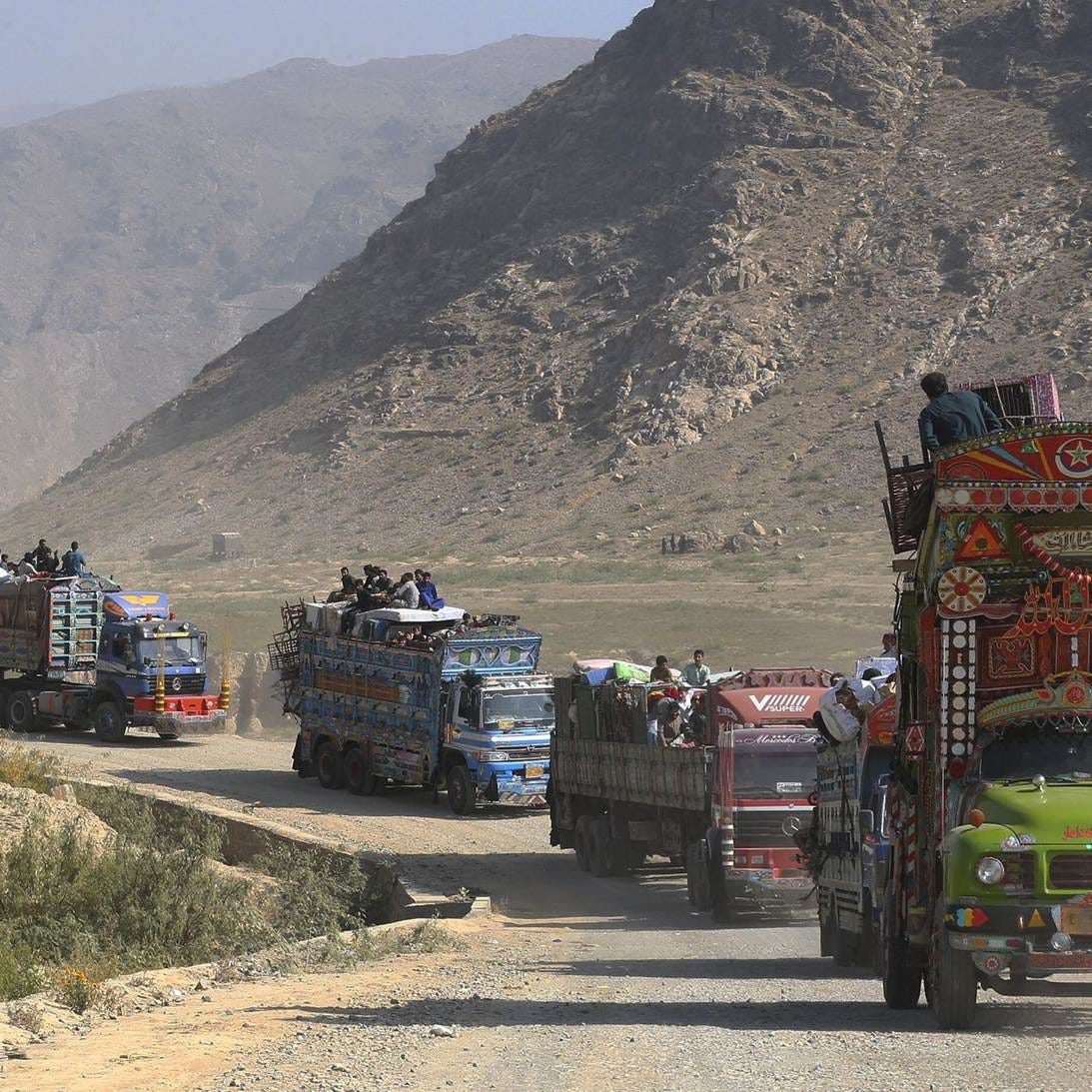
Afghanistan has borders with Pakistan, Turkmenistan, Uzbekistan, Tajikistan, China and Iran – which we’ll return to in a moment. If anyone tries to impose sanctions on Afghanistan, like try to keep them from importing goods and essential material they don’t produce like gasoline and steel and aluminum and even lumber, they just start smuggling. Afghanistan has borders that are mountainous, that are flat deserts, that are snowbound in winter and hot as hell in summer. Do you think that stops them? Ha! They’ve been moving goods across those borders since they did it on the backs of donkeys. These days, they’ve got trucks, many of them made by Mercedes Benz, huge diesel-powered six and ten-wheeled monsters with flat-faced cabs that are capable of splashing through rushing rivers, crossing 10,000 and 15,000 foot high passes, and plowing their way through roadless tracks of mud and sand to get where they’re going. Where they’re going, most of the trucks don’t have to pass through tunnels or under overpasses, so they can be piled impossibly high with cargo. The photo at the top shows some of these trucks after having crossed over a pass in Afghanistan.
See the people riding on top? Many of them could be smuggled, too. What are the trucks carrying? Who knows? They follow smuggling routes that are largely unpoliced, that cross borders where there are no border cross-points. Immigration? Customs? They’ve been moving people, livestock, precious materials, essentials such as fabric and rugs and wheat and coal for decades on trucks, and before that, for centuries using primitive carts, and on the backs of men and donkeys.
When I was in Afghanistan, I drove a road between Jalalabad and Asadabad near the border with Pakistan. It was so pot-holed and bombed out by war, it was a 10 mile per hour dirt road that took more than three hours to travel just 30 miles. We passed dozens of trucks like the ones in the photo headed south. In a village where we stopped for water, my translator questioned the driver of one of the trucks. He had begun his trip in China, crossing into a narrow finger of Afghanistan, then into Pakistan and through a mountainous region, crossing back into Afghanistan near Asadabad, never going through a single formal border crossing or being assessed a penny of duty or travel fees, on dirt roads the whole way.
When they stop for the night, drivers and passengers, if there are any, get out and build cooking fires and make dinner. Then they unroll blankets and sleeping bags and sleep under the trucks until dawn, and they get going again.
Hey, Donny! Do you think you’re going to stop smugglers like those guys with a declaration of economic war?
This story is about Trump’s threat to beat Iran economically, just like he says he beat them with bombs and missiles, so let’s have a look at a map of Iran, shall we?
Iran has 3,600 miles of border with seven countries: Afghanistan, Iraq, Turkey, Pakistan, Turkmenistan, Azerbaijan, and a very short 22-mile border with Armenia. If you’re following closely, and I know you are, you’re probably noticing the names of some of the same countries that have borders with Afghanistan. This is where the culture of smuggling comes from. The people who live in these countries have been there for centuries. They’ve been trading across these borders since before there were borders. The Afghan-Pakistan border has been there only since 1893, when it was established between the ruler of Afghanistan and the foreign secretary of British India, back when Great Britain still had colonies all over the globe. It’s one of what they call “natural borders,” running largely along a ridge of mountains that begins in the foothills of the Himalayas and runs all the way down to the thinly populated desert of southern Afghanistan.
The border between Iran and Afghanistan didn’t exist until it was established over 60 years of negotiations and treaties and surveys between 1872 and 1935 held by Turkey and the British – there they are again, the Brits with their fingers in everything they can reach by sea or conquest by army.
Then there are Iran’s other borders, and of course its very long and strategic coastline on the Persian Gulf and Gulf of Oman in the south, and let’s not forget its coast on the Caspian Sea, which it shares with a few other countries…let’s see who they are…oh! That’s right! Russia and Azerbaijan, and Kazakhstan, and what do you know, there’s Turkmenistan again.
More smuggling by boats large and small, modern and ancient, such as the wooden sailing vessels called dhows. And wouldn’t you know, dhows still sail the waters of the Middle East in the Persian Gulf, Red Sea, the Indian Ocean, and the coast of Africa as they have for centuries.
Are you picking up a trend here, the one involving the word “centuries?”
And along comes Donald Trump, and he figures that because he’s a big, important guy who’s got a huge ballroom under construction at the White House, along with a new helipad that will allow him to walk a few feet to his helicopter instead of several hundred feet, and he’s got golf courses, and hotels and gold-plated country clubs and even a gold plated 747 that was gifted to him by an Emir from the Persian Gulf, and of course, he’s got his own political party that will do his bidding…well, Donald Trump is so big and so important that if he says jump, all those countries that have been smuggling stuff for centuries and centuries will answer, how high, just like his lackeys in the Republican Party do!
Trump’s threat to damage Iran’s economy includes sanctions, of course, which has been tried before, going all the way back to 1979 when the hostage crisis turned Iran into a pariah state and the U.S. decided they shouldn’t be allowed to play with the big boys economically and froze tens of billions of their assets in foreign banks.
But Iran smuggles money, too. You’ve had a look at the big trucks going through the Afghan pass. Now imagine trucks just like those are traveling across Iran’s border with Afghanistan or Russia or any of the other countries Iran has a border with, and under those sacks of concrete or wheat or fabric or whatever are big piles of cash money in U.S. dollars or Chinese renminbi or Japanese yen or another currency of any other country that buys Iran’s oil.
Iran can move money anywhere it wants, and not just by truck. Iran can use the informal Hawala system, a global network that moves money through a kind of Arabic and Asian honor system that is as ancient as smuggling by land. The system doesn’t use electronic transfers between banks. It doesn’t even move cash across borders. It works like this: a customer in one country, say Iran, contacts a Hawala broker. He wants to move money from Iran to another country. He gives the money to the Hawala broker in Iran, who contacts a broker in another country. That broker gives money in cash to the recipient in the other country, with the brokers in each country taking a transfer fee. It can also work the other way: the person in Iran wants money, so he goes to a Hawala broker and promises that a friend in the foreign country will cover the transaction. The Hawala broker gives him cash in Iranian currency. In the second country, the friend passes cash in the local currency to the Hawala broker in that country. Each broker takes their cut. No cash moved, except within the country where the debt was incurred.
When I was in Afghanistan in 2004, I ran out of cash. Afghanistan didn’t have cash machines, and I couldn’t go to a machine and use my debit card and get Afghan currency. I was introduced to a Hawala broker who owned a grocery store. I gave him a check for $1000 on my bank in Los Angeles. He gave me $800 in Afghan money and recorded $100 for himself. The Afghan broker sent the check by mail to a broker in L.A. He cashed it for $1000 and noted the $100 fee for himself. The transaction was recorded between the two brokers. The next time it happened in the other direction, the U.S. broker took the $1000 from the person transferring the money and took $100 for himself. On the other end, the Afghan broker gave $1000 to the recipient and kept $100 for himself.
No money exchanged hands except within each country.
The same sort of transaction can happen with tens, hundreds of thousands, even millions. It’s all done by fees and by honor between the brokers. Nothing is recorded in banks or wire transfers. It just happens.
How does Donald Trump plan on beating smugglers of goods and money with centuries of experience? He doesn’t have a clue. Iran beat him by standing up to his bombs and missiles. They’ll beat him by standing up to his sanctions. If there are borders, there are holes in them. If there are coastlines, there are pipelines and unregistered tankers and dhows.
If Trump decides none of his plans and schemes are producing the results he wants, he’ll start shooting missiles at Iran again. Iran will shoot missiles back at U.S. allies and U.S. bases. Trump will declare Iran beaten for the 13th time. Iran will laugh and keep smuggling.
This could go on for a while. Watch this space.