The recent panic about a breach of Medicare computer security by an “AI agent” contrasts sharply with other recent cases such as the Telstra and Optus outages that left many Australians unable to reach Triple Zero. In those cases, no one blamed the computers involved. The mistakes were clearly sheeted home to the corporations that operated them.
This wasn’t always the case. When the term “artificial intelligence” was coined some 70 years ago, the first mainframe computers (absurdly primitive by modern standards) were viewed with the same awe and concern as the AI agents of the present day. There were even “algorithms” (though the term wasn’t used in that way at the time) that were supposed to pick ideal dating matches.
Failures were inevitable, and blame-shifting became routine. “The computer made a mistake” was the 1960s equivalent of “your email must have gone to junk”. Gradually, however, we realised that the problem was not with the computer but with incorrect information fed into it or badly written programs invoked as a result.
We need to make a similar adjustment when we discuss AI “agents”. If someone enters a prompt like “find Australian medicine statistics” into a program like ChatGPT or Claude, and the result is a breach of Medicare’s site, the responsibility does not lie with a piece of code. Either the human who entered the prompt or the corporation producing the code made a mistake, and they should be held liable for the resulting damages. If it’s impossible to work out who is at fault, liability should be joint and several – that is, both are liable for the full amount of the same loss, and the cost can be allocated between them.
Fixing the problems of agentic software won’t be easy. The frequency with which early computer programs malfunctioned made “debugging” (a term predating its use in computing) an essential part of information technology. Bugs might be found in the operating system, the program itself or the information fed into it. In one case, the problem was a literal bug: a moth that got caught in the relays. But with enough determination the source of the problem could usually be found and fixed.
Traditional debugging is much more difficult with agentic programs. It may be possible, after the fact, to work out what the program has done. But it’s impossible to inspect the hundreds of billions of parameters in a large agentic model and work out why the agent did it.
In this context, the idea of constraining the program with “guardrails” or “harnesses” is naive in the extreme. The whole point of telling a computer program to perform a task is to get around obstacles to that task. And with no understanding of the internal workings, external constraints will be treated as obstacles.
In most cases, the only solution will be to abandon many of the capacities that are supposed to make agents useful, such as the ability to log in to sites using passwords or to make payments on the user’s behalf.
This will be a huge wrench for corporations that have grown up with the Silicon Valley ethics of “move fast and break things” and “ask for forgiveness, not permission”. They are far more comfortable talking about “hallucinations” and “rogue agents” than about their own responsibility for programs that produce massive errors and real-world damage.
But once AI corporations are made to bear the financial consequences of their reckless negligence, a different kind of calculus will come into play. Instead of thinking, “what cool thing can we make this program do”, the first question will be, “what could go wrong if we let it run”.
Forcing corporations to bear liability for damage caused by their actions will, in all probability, drastically slow the “hyperscaling” rush to produce more and increasingly powerful agentic software. That’s a good thing for the environment as well as the economy.
And none of this will preclude the many benign uses of “AI” software, including massively improved internet search, document summarisation and translation, and software coding. These uses come with the adjustment problems that always arise with new technology, eliminating some jobs while creating others, and so on. But there is no reason to fear that they will accidentally cause a nuclear holocaust or even drain our bank accounts.
Public safety agencies collect large volumes of digital information from cameras, access systems, vehicle sensors and public reports. Data forensics turns those records into evidence that investigators can search, verify and present with a clear account of where it came from. The NIST guidance on digital evidence gives agencies a technical reference for handling this material. A practical program also needs written procedures, trained staff and technology that preserves records without creating unnecessary privacy risks.
The Value of Digital Evidence
Digital evidence can establish a reliable timeline when witness accounts are incomplete or conflicting. A camera timestamp may show when someone entered a facility, while an access record confirms which credential was used. Location data, dispatch logs and sensor alerts can add context if investigators verify that the clocks across those systems were synchronized.
Start by identifying which data sources your organization controls and how long each one retains records. Assign an owner to every source, document its format and set clear access permissions. Agencies should also define when collection is justified. Keeping every available record indefinitely raises storage costs and can weaken public confidence.
Streamlining Incident Investigations
Create a repeatable workflow for collecting, reviewing and exporting relevant records. Investigators should be able to enter a time range, location or incident number without switching among several disconnected systems. For large organizations, enterprise video management software can support centralized monitoring, forensic review and evidence management across authorized locations.
Standardized case folders also reduce delays. Each folder should contain original files, working copies, notes and an access log. The value of synchronized records is especially clear in traffic investigations, where dashcam and telematics data can affect a car accident case. A shared process helps reviewers find the same source material and reconstruct the incident consistently.
Intelligent Search for Critical Insights
Search tools can cut hours of footage review down to a focused set of results. Investigators might filter recordings by time, movement in a defined area or the appearance of a specific vehicle type. Analytics can flag potential matches, but a trained person should confirm each result before it affects a case or public safety decision.
Document the search terms, filters and time zones used during every review. That record allows another analyst to repeat the search and helps explain why certain footage was included. Agencies should test search accuracy with known examples, track false matches and retrain staff when software updates change how filters behave. Human review remains necessary when images are unclear or context is missing.
Ensuring Data Integrity and Access
Protect the original record from the moment it is collected. Generate file hashes where appropriate, preserve metadata and restrict editing rights. A documented chain of custody should identify who accessed a file, what action they took and when the activity occurred.
Role-based permissions help limit exposure. An investigator may need viewing and export rights, while a system administrator may manage retention settings without reviewing case content. Test backups on a schedule instead of assuming they work. Agencies should also set retention periods that reflect legal duties, operational needs and privacy commitments. When records reach the end of that period, approved deletion methods should remove all authorized copies.
Impact on Community Trust
Public trust depends on clear rules for how agencies collect, search and share data . Publish plain-language policies that explain retention periods, approval requirements and complaint procedures. When legally possible, disclose how often systems are used and how many requests for records are approved or denied.
Audits should examine access logs, policy exceptions and overdue deletions. If a review finds improper access, the organization needs a documented response that includes containment, investigation and corrective action. Staff training should cover privacy and evidence handling before employees receive system access.
A credible data forensics program leaves an understandable trail from collection to final disposition. That trail gives investigators useful evidence while giving the public a specific basis for evaluating oversight.
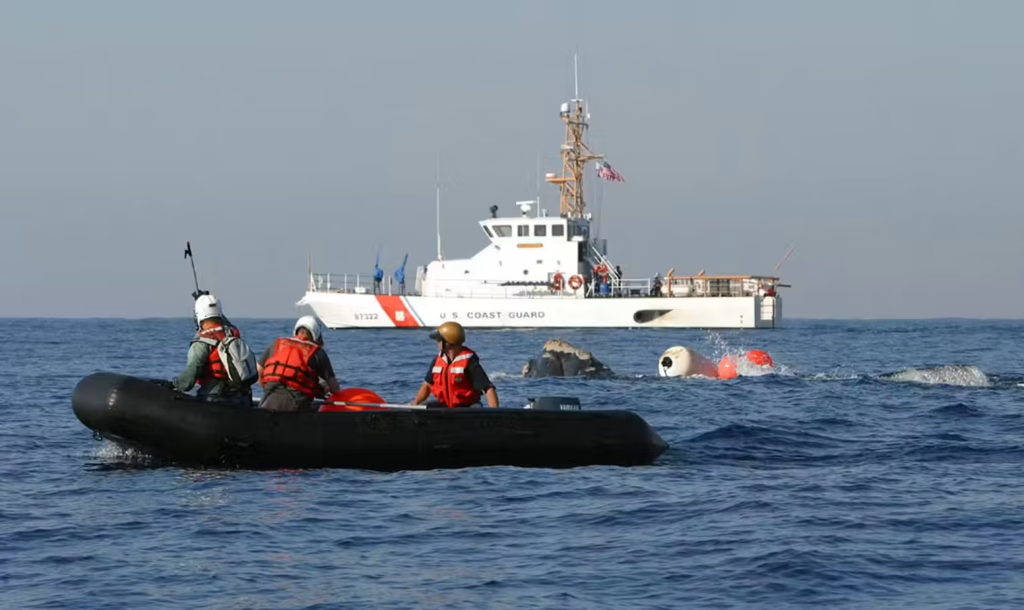
A Coast Guard cutter assists NOAA Fisheries and Florida Fish and Wildlife Conservation Commission members in an attempt to free a North Atlantic right whale that became entangled in fishing gear. Fishing gear entanglements and vessel strikes are two of the biggest threats to these endangered whales. Photo: Alicia Windham-Reid
As an environmental conservation scientist, I have been following these and other changes affecting endangered species. To understand what they mean, let’s take a look at the potential impact on three very different species that are at risk: the Florida panther, the North Atlantic right whale and the monarch butterfly.
What’s Changing in How the Law Is Carried Out
First, here’s what’s changing.
On Sept. 14, 2026, a Trump administration rule change went into effect that redefines harm under the Endangered Species Act to mean only directly injuring or killing a member of an endangered species. The new definition removes an interpretation that had been used for half a century, and upheld by the Supreme Court, that harming an endangered species includes eliminating that species’ habitat.
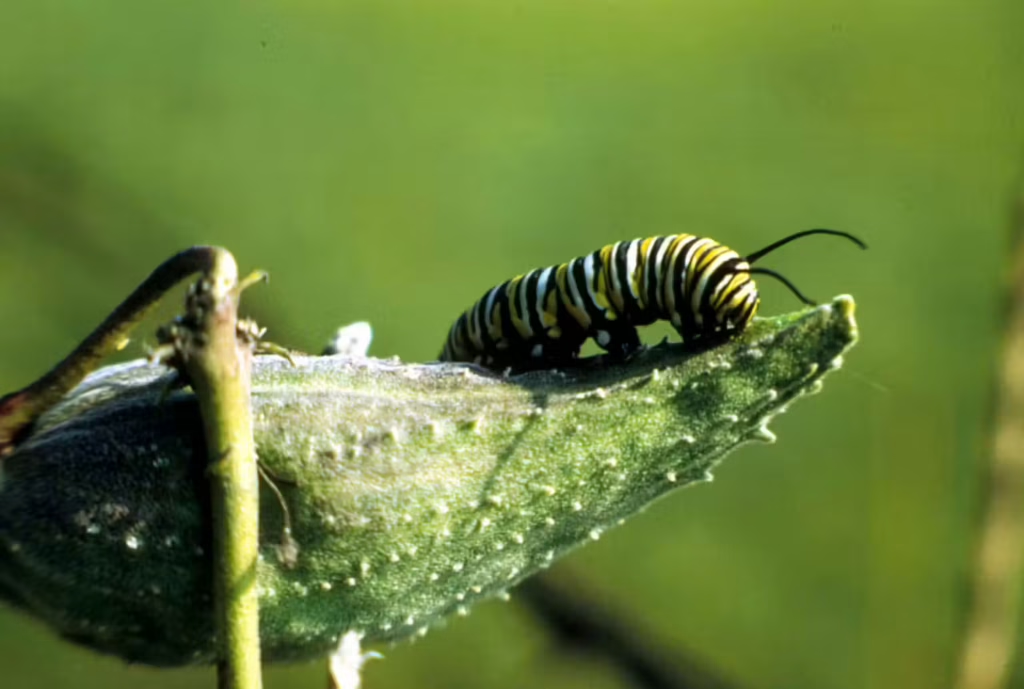
A monarch butterfly caterpillar crawls on a milkweed pod. Monarchs rely on milkweed for food and lay their eggs on the plants, but milkweed is also an aggressive weed in the Midwest. Photo: Ron Singer/U.S. Fish and Wildlife Service
That move alone could gut the law’s ability to protect many species that face their biggest threat from losing habitat they rely on.
But that isn’t all. The director of the U.S. Fish and Wildlife Service wrote a memo to the services’ leadership team dated Sept. 14, 2026, further reinterpreting the law by arguing that it applies only to intentionally injuring or killing an endangered species. So, if you didn’t target that animal, that would be OK. If your ship strikes a whale, or you kill endangered animals while building a new data center, that would no longer be a problem under this interpretation of the law unless you meant to kill the animal.
The administration also recently finalized its removal of what’s known as the Blanket 4(d) Rule. That rule provided automatic protections for species listed as “threatened,” one step before they become “endangered,” and for their critical habitat.
As a result of these changes, species are still listed on paper as endangered but are largely unprotected.
Florida panthers are losing territory to development and face risks from road traffic. Only 120 to 230 of them remain. Photo: Connie Bransilver/U.S. Fish and Wildlife Service Southeast Region, CC BY
These top predators require large home ranges to live and hunt in, about 200 square miles (518 square kilometers) for males and 75 square miles (194 square kilometers) for females, so space is a scarce resource. And that’s where the challenge lies.
The public conservation areas are not capable of fully supporting the panther population. Roughly one-third of the panther’s main habitat is on private ranches and timberlands that are frequently targeted for suburban development in southwestern Florida.
Under the new Endangered Species Act interpretations, it would not be considered a federal offense to clear private palmetto flatwoods or cypress domes. Yet ecology research indicates that fragmenting habitat by breaking it up with roads and development results in panther deaths. The majority of panther deaths that aren’t natural are due to collisions with vehicles as they attempt to cross busy roads.
The revised rule also allows landowners to clear areas that had been preserved as wildlife corridors on their land without being liable for harming the panthers. That could accelerate habitat loss in southwest Florida’s Caloosahatchee River basin and undermine many years of effort put into the Florida Wildlife Corridor, a connected network of public and private lands that allow the Florida panther and other species to roam.
North Atlantic Right Whale: Noisy, Dangerous Seas
In the ocean, habitat is influenced not only by the water but also by sounds that travel through it. That’s particularly true for whale habitat.
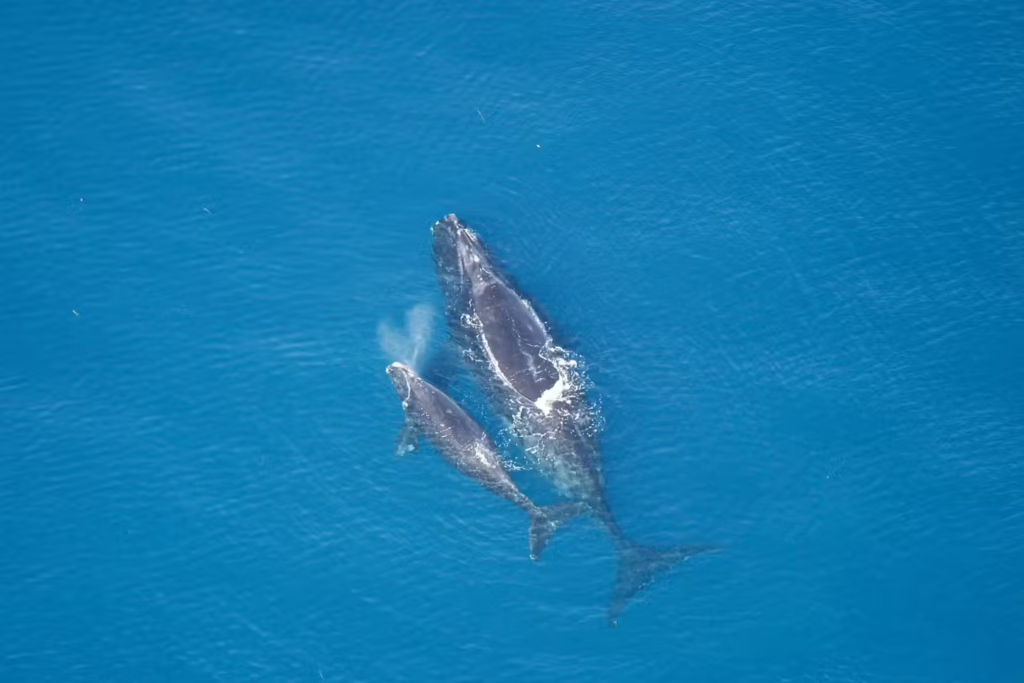
North Atlantic right whales rely on sound traveling long distances through water to communicate. That communication gets harder as the ocean becomes noisier. Photo: NOAA
Right whales communicate with low-frequency sounds that help them navigate, locate food and connect with their calves.
The noise caused by ships, seismic surveys used in oil exploration, and pile-driving associated with offshore energy projects results in background noise that can disrupt these signals.
In addition to sound interference, whales face physical risks from being struck by boats and becoming entangled in fishing gear. The new interpretations of the Endangered Species Act remove some of the legal basis for enforcing rules for noisy seismic surveys, speed limits on vessels and restrictions on shipping routes designed to help protect the whales from harm.
Monarch Butterfly: Living in a Regulatory Limbo
The eastern migratory monarch butterfly (Danaus Plexippus), a delicate orange-and-black butterfly that was once plentiful across North America’s prairies in summer, is an example of a species that would benefit from the Blanket 4(d) Rule.
A monarch butterfly on a milkweed flower. Monarchs are considered threatened, and changes to rules around the Endangered Species Act mean they may wait much longer for protective actions. Photo: Jim Hudgins/USFWS
Without that rule, threatened species no longer get automatic protections and instead rely on agencies drawing up species-specific rules for each one, a process that can take years.
Losing Proactive Protection
The reinterpretations of the Endangered Species Act change the law from one that is proactive to one that takes action only after there has been immediate and intentional physical harm.
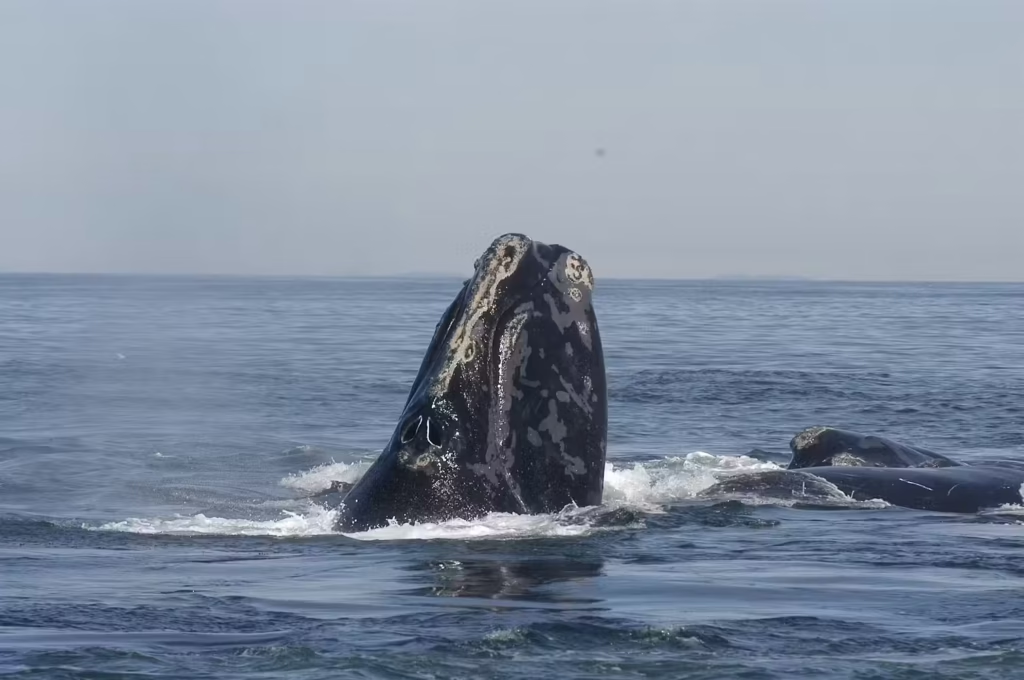
A North American right whale sticks its rostrum – its jaw and snout – above the water. Photo: Moira Brown/New England Aquarium
Hunting is not the primary threat today to the Florida panther, the North Atlantic right whale or the monarch butterfly. Their survival instead relies on the pine flatwoods being in good health, the ocean remaining quiet, and milkweed corridors existing across the continent.
Since nature does not abide by the legal boundaries between species and their habitats, damaging the habitat can result in the loss of the species.
“FREEDOM OF THE PRESS IS NOT JUST IMPORTANT TO DEMOCRACY, IT IS DEMOCRACY.” – Walter Cronkite. CLICK HERE to donate in support of our free and independent voice.
Frequently Asked Questions About the Endangered Species Act
What is the Endangered Species Act?
The Endangered Species Act (ESA) is a U.S. law designed to protect endangered and threatened plants and animals and the habitats they rely on for survival and recovery.
What changed in the Endangered Species Act in 2026?
New federal interpretations narrow the definition of “harm” to focus primarily on directly injuring or killing endangered animals, reducing protections related to habitat destruction.
Why is habitat protection important for endangered species?
Many species depend on specific habitats for food, shelter, breeding, and migration. When those habitats are damaged or destroyed, species can decline even if individual animals are not directly harmed.
How could the changes affect Florida panthers?
Florida panthers depend on large, connected habitats. Reduced habitat protections could increase development, fragment wildlife corridors, and lead to more vehicle collisions and population declines.
Why are North Atlantic right whales endangered?
North Atlantic right whales face threats from vessel strikes, fishing gear entanglements, and increasing ocean noise that interferes with their ability to communicate, navigate, and find food.
How do the rule changes impact monarch butterflies?
Monarch butterflies may face fewer automatic protections because threatened species no longer receive safeguards under the former Blanket 4(d) Rule, potentially delaying conservation actions.
Could these changes increase extinction risks?
Conservation scientists warn that weaker habitat protections could make it more difficult for vulnerable species to recover and may increase extinction risks for some endangered and threatened wildlife.
It’s October, Halloween is coming, and it’s time to look at the graveyard of Trump’s administration.
Stephen Miller. Dead. I mean, you’ve looked at his face in photographs and interviews and even walking across the tarmac to get on whichever Air Force One Trump is using at the moment. There is no there there, as Gertrude Stein said not long after Miller’s great-great grandparents arrived from Belarus at Ellis Island.
Stephen Miller is dead inside. His dead eyes look out at the world from a hole of his own creation, with nothing in his immigrant background reflecting what we would think of as a combustible source of ill will. There is something missing inside Miller. If you are religious, you could call it a soul; romantics would refer to it as heart; others might consider that he lacks a center of being, an origin point for feeling.
Whatever is missing in Miller has caused him to turn to cruelty as gas for the engine that runs him. Feed the machine cruelty and more cruelty comes out. There is something inhuman about him. The only emotion that shows on his face is anger, and even then it’s just a flicker, as if the generation of displeasure and hostility takes too much effort, or perhaps for Miller, it would reveal too much.
There have been press reports that he is infamous for yelling at subordinates and sending screeching emails and texts when he finds something within his sphere of inhumanity wanting, such as an insufficient number of immigrant persons being caused the pain of dislocation and removal from their homes and businesses and schools. But those texts are out of our view. We are left with a person who was dead to the rest of humanity even before Trump knighted him as his cruelty czar.
Trump’s favorite decorative element, gold, is dead. The way Trump displays gold is repulsive, dead from repetition, dead from the lack of imagination reflected in its familiarity. If gold is the only thing you can think of to display your wealth or your taste, it’s dead already by overuse. Gold is dead by its commonness. It’s a cliché that was already dead before Trump came along and anointed it with his belief that gold says “class.”
Kristi Noem. When you feel the need to costume yourself to state who you are, to deck yourself out in western wear and be photographed on a horse, you’re already so dead that not even filing for divorce from a husband who turned himself into a walking cliché will bring you back to life. Dead inside. Dead outside. Dead.
Pete Hegseth. What the dead look like when they try to regain their youth. The phrase “dead man walking” comes to mind when you look at his skinny, too-short pants and his two-sizes too small jackets. His red, white, and blue pocket handkerchief is like makeup on a corpse. He was deadened by alcohol when he was on Fox. Real men don’t abuse women. Dead men do.
JD Vance. What a dead man looks like when he grows a beard. You can pin ivy league degrees on a corpse, but it’s still a dead body.
Todd Blanche. Dead the day he opened his first textbook on civil procedure in law school.
Speaker of the House Mike Johnson. A mummy who belongs in a crypt under a wood-frame church at the end of a dirt road in the piney woods where he was killed at birth by snake-handling charlatans ranting that God had come to take him to a “better place.”
Trump himself. When not even a breakfast of Adderall and a daily transfusion of the blood of infants through the veins of your hands can keep you awake, you are as dead as you look, coffin-ready makeup and all.
A little Friday fun to start the weekend. We’ve had enough grim news, at least until Monday. To support my attempts to lift your spirits as the ground collapses beneath us, please consider becoming one of my paid subscribers.
Congress is formally out of session for the elections, but their bills remain alive – not their legislative bills for us but the bills we still need to pay for them to live in Washington.
In the very season where incumbents are pleading with voters to look beyond cuts in government health spending, higher prices from seemingly irrational tariff policies and unaddressed costs affected by law, it turns out that the one House bill rising all by itself is the members’ food and lodging costs in Washington.
The Washington Post looked at the program that sets no requirements for lawmakers to file for reimbursement for food and lodging – even receipts for expenses. It turns out that taxpayers spent $6.7 million or 21 percent more last year on helping cover the costs of living over 2024.
The program launched three years ago, allows House members to supplement a $174,000 base salary that Congress has not raised in nearly two decades by expensing food and housing costs while in Washington on official business. Specifics of the spending are not disclosed, and lawmakers need not provide documentation, but simply certify that they have incurred the eligible expenses when seeking reimbursements. A similar Senate program does require receipts.
Party affiliation did not seem the relevant factor in individual claims, though the most of the top spenders were Republicans. In this last year, 360 members of the House filed reimbursement claims, including 26 who reported more than $30,000 in expenses and an additional 140 who reported more than $20,000. Their collective spending was $1.2 million higher than in 2024, when 355 members sought reimbursement – about the same number.
The Top Spenders
Given that fraud is such a big topic in Washington, the existence of a receipt-free reimbursement program seems, well, not well attuned to voters’ ears. That the high cost of living, especially in two places, might be problematic, welcome legislators to voters’ world.
The Post reported chasing after the top filers, most of whom were reluctant to discuss their spending. Rep. Jim Baird, R-Indiana, put in for $39,789; Rep. Abraham Hamadeh, R-Ariz., came in second at 39,131. Rep. Jonathan Jackson, D-Ill. spent $37,078 last year, the third-most, including for the mortgage on a second home in Washington.
Most of the top ten spenders did not respond or declined to provide details. In case you wonder, the others included former Rep. Marjorie Taylor Greene, R-Ga., and Republican Representatives Neal Dunn, Fla., Mike Haridopolos , Fla., Ryan Mackenzie, Pa., and Pete Sessions, Tex.
Kedric Payne, a former deputy chief counsel at the Office of Congressional Ethics, said it’s hard to know what drove the spending increases without more information. Housing costs that are the subject of so much political anger could be hitting the very legislators who are putting in for more reimbursement.
The most frugal spender was Rep. Glenn Ivey, D-Md.), who lives in a suburb of Washington, who was reimbursed $62 for meals, usually chili from the cafeteria in the Longworth House Office Building for lunch.
Frequently Asked Questions About House Member Expenses”:
Do House members have to provide receipts for food and lodging reimbursements?
No. Under the House program, members can seek reimbursement for eligible food and lodging expenses in Washington without submitting receipts, instead certifying that they incurred the expenses.
How much did taxpayers spend on House member reimbursements?
House members claimed $6.7 million in reimbursements in 2025, up 21% from the previous year. A total of 360 members participated in the program.
Who claimed the most in House reimbursements?
Rep. Jim Baird of Indiana reported the highest total at $39,789, followed by Rep. Abraham Hamadeh of Arizona at $39,131 and Rep. Jonathan Jackson of Illinois at $37,078. The Washington Post
How much are members of Congress paid?
The standard salary for rank-and-file members of Congress is $174,000, a level that has remained unchanged since 2009.
“FREEDOM OF THE PRESS IS NOT JUST IMPORTANT TO DEMOCRACY, IT IS DEMOCRACY.” – Walter Cronkite. CLICK HERE to donate in support of our free and independent voice.
AI Funders Back Detectors To Catch Pathogens That AI Might Make
It’s a brilliant business model, isn’t it? Create a problem then make money selling the solution? It’s also a timeless business model. Snake oil salesmen have scared people for ages that their health is in danger without their elixir. Equifax credit rating service, that has data on seemingly everyone, didn’t secure your data well enough and lost even social security numbers to hackers in 2017. Then offered credit monitoring service. For free. But in a way that could automatically subscribe you to their paid service.
Now some of the funders of AI have a similar tack. Since AI might be used by terrorists to create new pathogens, they are investing in a company that sells pathogen detectors to the government. Rather than change AI to not create such problems, they’ll make money feebly trying to deal with the problem after the fact.
The company selling the devices is Pilgrim Labs. It has received funding from Peter Thiel for one. Thiel has long invested heavily in AI. Now two top people in Anthropic, the makers of Claude AI, are part of a big new investment in the company.
The company makes boxes that are mounted on poles and monitor the air to try to detect both known pathogens and possible unknown, new pathogens. The Centers for Disease Control has a contract with the company for these devices.
That’s all good and unfortunately necessary, but it’s also a feeble way to deal with the possibility of newly created pathogens. If one of these boxes detects a possible problem and notifies the CDC, then what? The CDC has to analyze it to see if it really is something new and problematic. Then analyze further to really understand it. Then come up with a plan to try to start isolating affected people. Start working on treatment or inoculation. Long after it has had plenty of time to spread.
I’m sure profits from this company will only be a small part of the income of these AI titans but it will be something. And the first time there is a scare about a possible new pathogen, even if it turns out to be a false alarm or easily thwarted, then every town and neighborhood is going to want one of these boxes for quick detection near to them.
Pilgrim is hardly the only incidence of this. Valthos company wants to “identify biological threats and design medical countermeasures” to AI created bio-problems and is backed by much the same investors. Red Queen Bio wants to, “design antibodies that can be manufactured to protect against…threat of an AI-designed virus”. It’s backed by OpenAI. Then there are other kinds of problems that can be addressed for profit. Adaptive Security, from their press release, “trains employees against emerging threats” from AI. It’s backed by AI investors. And World ID, a company started directly by Sam Altman, head of OpenAI, sells a way to prove your human so as to thwart bots. Overall this “sell the solution to the problem they made” seems to be a growing pattern. There is sure to be more coming.
It’s true that trying to detect new pathogens quickly is necessary in any case because new ones can develop naturally, or be created by terrorists using non-AI methods of hacking existing viruses. Plus it’s hard to imagine how AI could be prevented from ever being used to make new pathogens unless we got rid of AI altogether, which is, of course, impossible at this point. But there’s something ugly about this situation because it is the makers of the problem selling the attempt at a solution. Because it’s not the way we’ve encountered problems, or tried to deal with them, in the past.
We invented the nuclear bomb, but that was a government effort to end a terrible war. There were defense contractors who made money off everything that followed but it was different. The initial reason for doing it was different. The indirectness of the profit was different. With AI, which does have its benefits but could also become the new equivalent of nuclear war, this is entirely a matter of private companies racing for profit. Government is involved as a supporter, and as a client, and as a concerned entity, but private company profit is the direct driver.
There were people in the 1950s who made money setting up bomb shelters for worried families. This time it will be the AI investors themselves making money selling us feeble attempts at assuaging the fears of the fallout of what their products might create.
Welcome to the 1950s of the 2020s.
Frequently Asked Questions About AI and Biodefense
What is AI biodefense?
AI biodefense refers to efforts to detect, prevent and respond to biological threats that could potentially be developed or enhanced with the help of artificial intelligence.
Could AI be used to create dangerous pathogens?
Researchers and AI companies have warned that increasingly capable AI systems could make some biological knowledge and techniques more accessible, potentially lowering barriers for people seeking to develop biological threats.
What does Pilgrim Labs do?
Pilgrim Labs develops biosurveillance technology designed to monitor the air for biological threats, including known pathogens and potentially unfamiliar biological material.
Why are AI investors funding pathogen detection companies?
Growing concern about AI-assisted biological threats has created demand for technologies that can detect pathogens and help governments respond to outbreaks. Some investors and executives connected to the AI industry are also investing in companies developing these defenses.
Can pathogen detectors prevent an AI-created pandemic?
Detection systems may provide earlier warning of a biological threat, but detection alone cannot prevent an outbreak. Public-health agencies would still need to identify the threat, determine its risks and develop an appropriate response.
“FREEDOM OF THE PRESS IS NOT JUST IMPORTANT TO DEMOCRACY, IT IS DEMOCRACY.” – Walter Cronkite. CLICK HERE to donate in support of our free and independent voice.
 Log in